
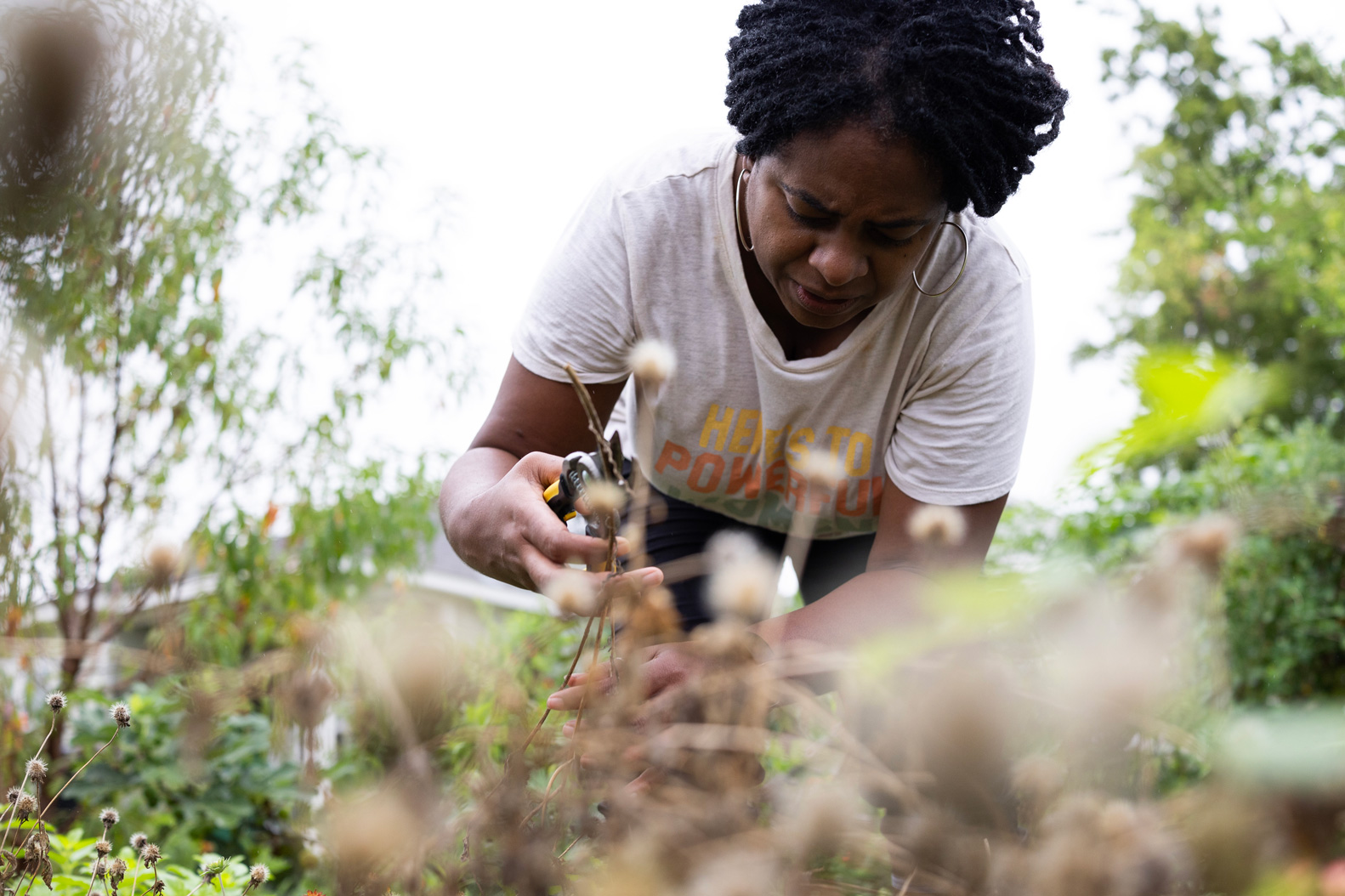

It’s early Saturday morning and Erica Hubbard is wheeling a cart of gardening supplies along Yates Street in Houston’s Greater Fifth Ward. The damp weather, which shifts between a light drizzle and heavy rain, is not holding her back from a day of work at the Hershe Community Garden.
Every fourth Saturday of the month, Hubbard and other volunteers meet to manage a variety of plants, flowers, vegetables and fruits at a grassy lot surrounded by residential homes just off Waco Street. There are twelve raised metal beds for edible plants, rain-capturing tanks, a compost pile, benches for relaxing and flowers and grasses to attract butterflies and bees. You can smell the recently mowed grass and wet soil from the street.
Today, Hubbard is cleaning up some of the older crops to make way for new fall plants. Already some pumpkins have been planted at the front of the property. Around eight volunteers show up to help.
“We’ll all be doing different things here,” Hubbard said. “People can stay as long as they want and come and go. We don’t have a gate for a reason. Anyone can walk through.”
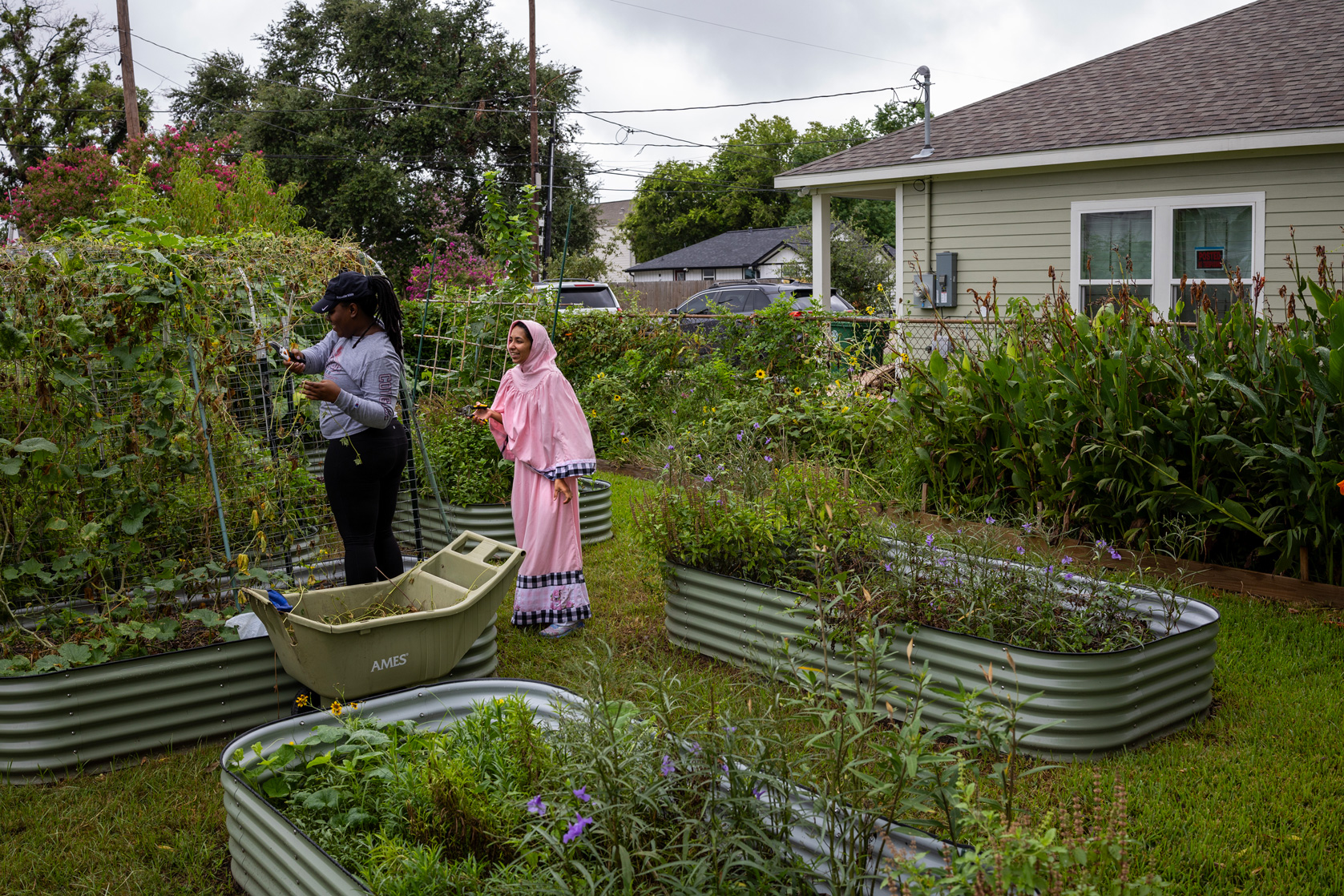
To Hubbard and others, there’s a lot of meaning behind a community garden here.
The city of Houston is split down the middle when it comes to access to healthy food and grocery stores, according to the U.S. Department of Agriculture. Most neighborhoods on the northeast side, including the Fifth Ward area, are one mile or a half-mile from the nearest supermarket. In many cases, residents in these areas have to travel to other neighborhoods to buy groceries.
At the same time, the area’s history of industry has left a contaminated mark on the community. Lead and other heavy metals have leached into the ground and soil over time, including cancer-causing creosote from the Union Pacific Rail Yard. Because of that, gardening edible plants in the soil is not advisable, unless the ground has been remediated and tested.
As a result, many gardeners, including those at Hershe, use raised beds and work to clean the soil through bioremediation, which uses living organisms – in this case certain plants – to break down contamination in the environment.
The garden is a lot of work, but Hubbard said it’s worth it.
“This garden means food freedom,” she said. “It means people have food security, it means access to fresh produce. That means something.”

From dumping ground to garden
Selena Samuel had enough of illegal dumping in her neighborhood. For years, the mother of three watched people drop off piles of trash on street corners, in ditches, on neighbor’s lawns. At a vacant lot across the street from her home, the grass would grow out and trash would build up.
Samuel grew up in the area, left and then moved back in the 1990s. She loved her neighborhood dearly, but couldn’t stand the mess.
In 2017, Samuel and other residents, including Hubbard, formed the Progressive Fifth Ward Community Association for the welfare, improvement and health of the neighborhood.
Eventually, Hubbard reached out to Frank Liu, the prolific Houston residential and commercial developer, who owned the trash-strewn lot across the street from Samuel. They ended up striking a deal that would address both issues at once. He would continue to own the property, but Progressive Fifth Ward would build and own the garden.
“We said, hey this place is empty, it’s collecting trash and we want to put a garden here,” said Samuel, now 78. “He agreed. So, he owns it (the property), but we manage it.”
Funding for the rest of the garden came from Progressive Fifth Ward Community Association and grants, including support from the Port of Houston and District B City Councilmember Tarsha Jackson.
By 2019, Hershe Community Garden was up and running. Five years later, with an ongoing two-year lease with Liu, there is no end in sight: more planting, more volunteers, more outreach.

From left, Erica Hubbard, Jessica White, and Selena Samuel talk about a pumpkin plant that was planted by a fellow neighborhood gardener at Hershe Community Garden, Saturday, Aug. 31, 2024, in Houston. (Antranik Tavitian / Houston Landing) 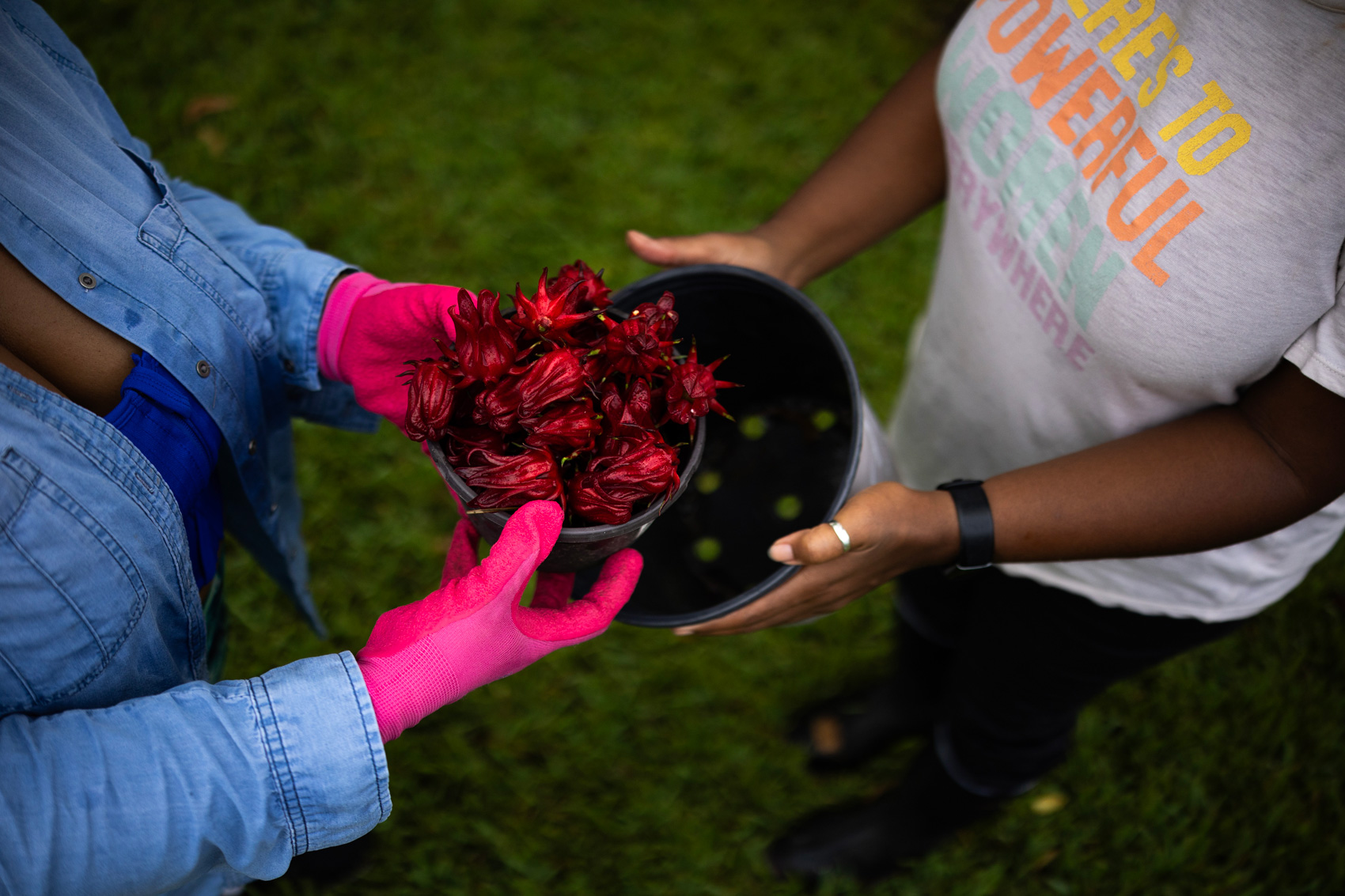
Erica Hubbard, at right, gathers Roselle Hibiscus buds to use for a tea at Hershe Community Garden, Saturday, Aug. 31, 2024, in Houston. (Antranik Tavitian / Houston Landing) 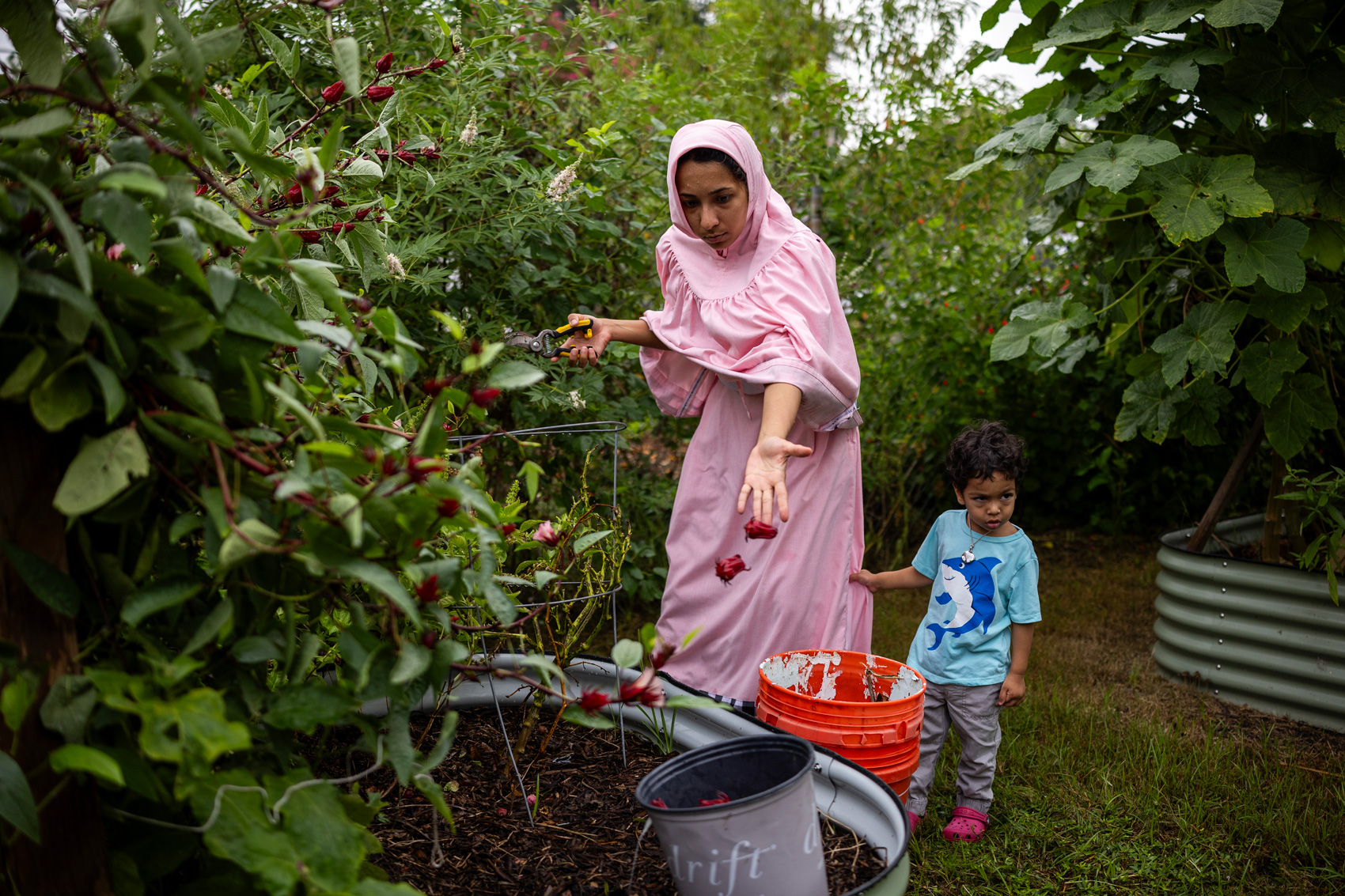
Fatema Mun and her son Hasan Akberali, 2, pick Roselle Hibiscus buds to use to make tea at Hershe Community Garden, Saturday, Aug. 31, 2024, in Houston. Mun and her family drove from Cypress to spend the day learning about the various facets of gardening. (Antranik Tavitian / Houston Landing) 
Erica Hubbard, at left, speaks with Ali Akberali about raised beds at Hershe Community Garden, Saturday, Aug. 31, 2024, in Houston. (Antranik Tavitian / Houston Landing) 
Kitchen scraps and torn pieces of cardboard biodegrade in the compost pile at Hershe Community Garden, Saturday, Aug. 31, 2024, in Houston. (Antranik Tavitian / Houston Landing) 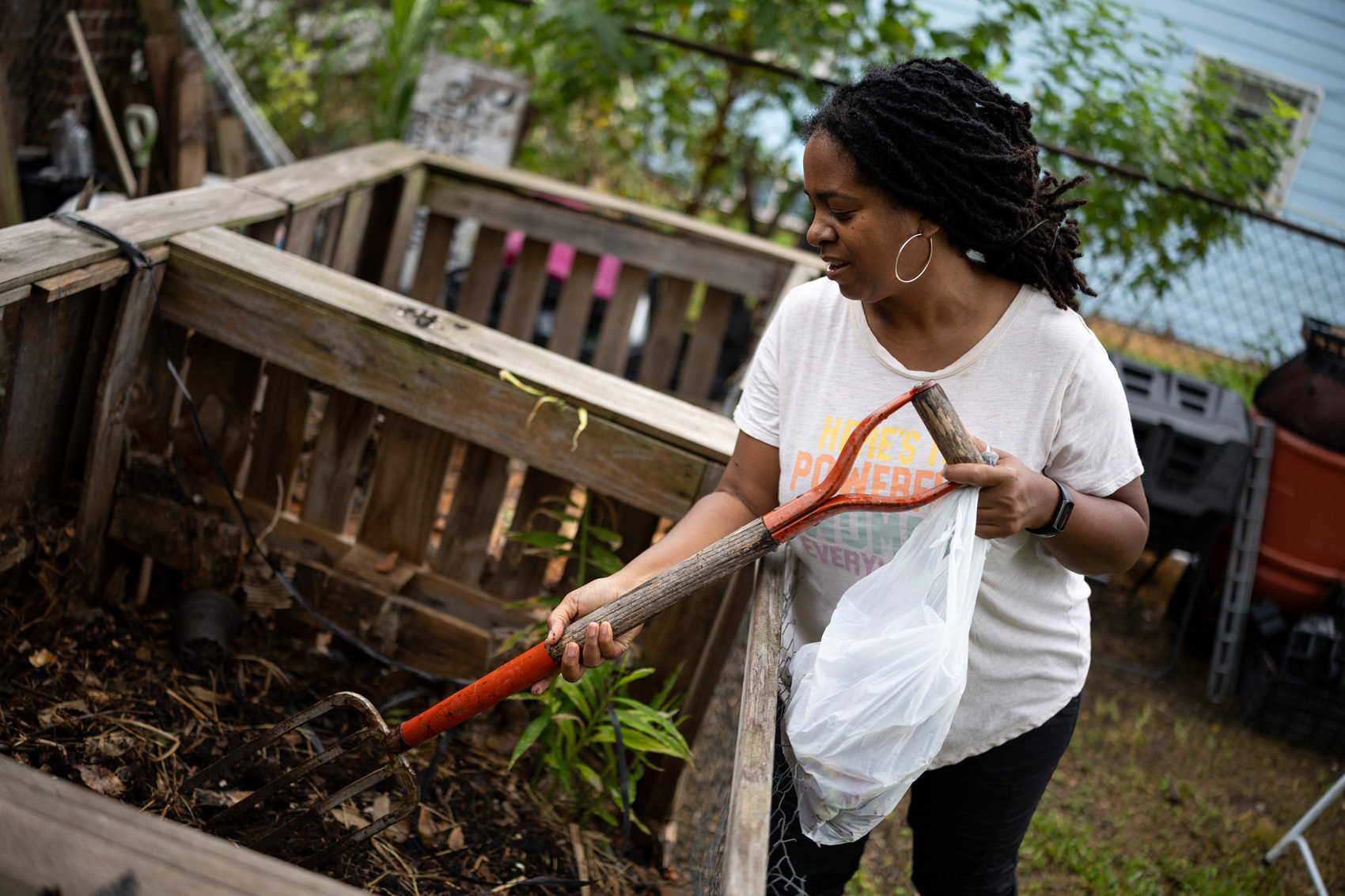
Erica Hubbard turns the compost pile at Hershe Community Garden, Saturday, Aug. 31, 2024, in Houston. (Antranik Tavitian / Houston Landing) 
Erica Hubbard talks with volunteers as they take refuge at Selena Samuel’s patio at Hershe Community Garden, Saturday, Aug. 31, 2024, in Houston. (Antranik Tavitian / Houston Landing)
Samuel is at the garden nearly every day. On this Saturday, she invites the volunteers to her roofed patio after rain begins pouring. The five of them, including Hubbard and three other volunteers, joke and laugh about the work they do. Everyone is passionate about the garden.
David Johnson, 22, is a gardening teacher at Atherton Elementary School just down the street. Another volunteer, Cecile Wright, is hoping to open her own grocery store in the neighborhood called Neal and Nettie’s, in honor of her great-grandparents.
“It’s all about community here,” Samuel said. “We want a place for everyone to meet up, new and old to the neighborhood. It’s not about selfish gains. It’s about bringing the community together.”
Confronting contamination
A few years ago, the Fifth Ward Association discovered the soil along the fence on the left side of the garden had elevated levels of lead. The contamination came from a now-demolished house near the property.
To manage the toxic soil, the gardening team put in a variety of plants, including sunflowers, to draw the lead out of the soil.
“Gardeners can use certain crops that take up various toxic chemicals, like heavy metals, and the chemical will move into the foliage or the above ground portions of the plant,” said Mike Arnold, a professor at Texas A&M Department of Horticultural Sciences and director of The Gardens at Texas A&M. “The gardener will then harvest those and those chemical plants can be taken to a landfill to be disposed of.”
The more concentrated the toxic materials in the soil, the more damaging it is to the local environment. If the chemicals can be dispersed, such as pulling them out of the soil and storing them within the organic matter, the concentration will greatly decrease.

There are only a few plants that can do this work, such as canna lilies, elephant ears and others that are full and take up space. At the garden, the team used sunflowers – which some research shows can be used to remove heavy metals for the soil.
Depending on the contamination, bioremediation can take months to years, according to Arnold, and can be a “long-term solution.” In the meantime Arnold advises gardeners to add thick layers of organic matter to the soil or use raised beds for edible plants on land that used to house industry.
Common sources for contamination include paint, burning waste, coal ash, sewage, petroleum spills and pesticides, among others, according to the Environmental Protection Agency.
“It depends on how degraded the site is and what purposes it was used for beforehand,” Arnold said. “If it’s a spot that you know used to house an industrial complex, I’d strongly urge raised beds or container farming. Remediating those sites would take much longer if you want edible plants.”
Arnold also recommends testing the soil before planting to check on the quality. Texas A&M Extension Service will test soil if a resident sends it in. In some cases, especially in industrial cities like Houston, historical contamination can be hard to monitor. Testing is the safest bet.
After some time, Hubbard said they will test the soil again to see if the sunflowers have made a difference. If it seems promising, it will be something to consider for future endeavors. Already, down the street from the community garden, the association has another lot that is home to a natural prairie.
The team also is in contact with other community gardens around Houston, often shooting messages back and forth about gardening techniques, events and planting.
“My mom and dad were both gardeners, so at a very young age it was my job to water. I’ve always been outdoors, growing things, pruning things, dealing with stuff,” Hubbard said. “It’s something I want everyone to be exposed to.”