

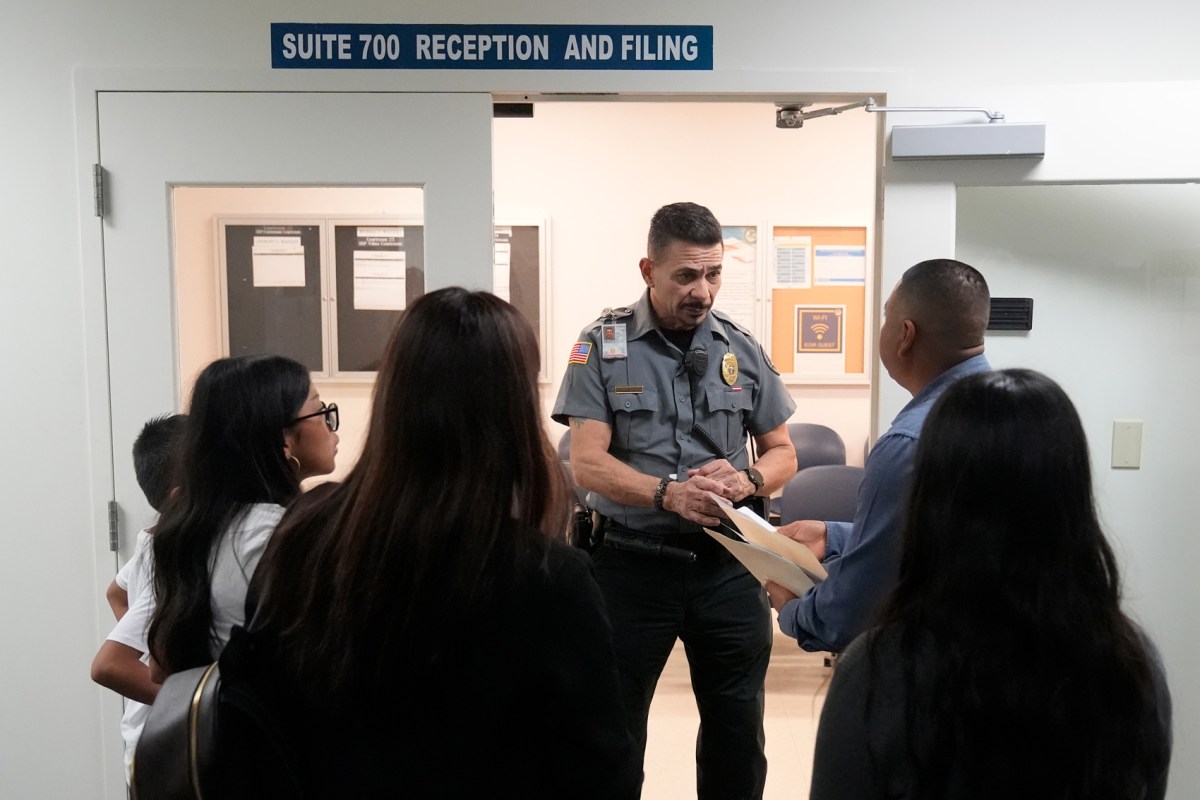
Nery, a 35-year-old Honduran asylum seeker, sat in front of an immigration judge at Houston’s downtown immigration court Wednesday confused and overwhelmed. The chair next to him, where his lawyer should have been, was empty.
Judge Saul E. Greenstein listened patiently as Nery explained that he paid a $400 deposit for a lawyer, but the lawyer didn’t show up.
“He’s given me a lot of time, but it’s complicated to find a lawyer,” said Nery, who is being identified by first name only while his asylum case is pending.
Another day, Greenstein might have recommended that Nery speak with the immigration help desk to get advice on his case, but that program came to a grinding halt Wednesday. The Department of Justice announced cuts to funding for immigration legal service providers Wednesday, including legal services at immigration courts and a program to increase representation for minors.
This announcement ended federal support for programs that help immigrants like Nery understand an inherently convoluted and bureaucratic system. Immigration lawyers in Houston say it will harm individual cases as well as a backlogged immigration court system.
The cuts to the program are just one part of President Donald Trump’s Week One efforts to make it more difficult for immigrants to legally come and stay in the U.S. Trump also ended legal migration programs for four nationalities and the use of an app known as CBP One at the border to seek asylum.
“Instead of facilitating people to get legal status, to come here legally with humanitarian parole or CBP one, they are doing the opposite,” said Naimeh Salem, a Houston immigration lawyer who leads her law firm Naimeh Salem & Associates. “So I just see this as a way of carrying out more deportations instead of helping people to get legal status.”
The DOJ did not respond to a request for comment.
Lack of representation
Immigration lawyers in Houston say legal services at immigration court have ensured immigrants’ right to due process and streamlined a court system where 67 percent of people are unrepresented. When lawyers explain court jargon and immigration bureaucracy to confused immigrants, it helps them better understand their cases. In turn, judges can hear cases quicker.
This has chipped away at the now 3.7 million nationwide immigration court backlog, which includes 100,000 cases across Houston’s three courts. It also increases the chance of receiving relief. Last year, nearly 80 percent of immigrants ordered removed were not represented, according to the Vera Institute of Justice.
“When you look at the statistics, it’s so clear that people who have access to legal counsel are far more likely to obtain relief in immigration court,” said Ross Miller, lawyer and head of the appeal department for immigration law firm Gonzalez Olivieri. “But they’re also a lot more likely to attend their removal proceedings and to comply with the government’s orders and instructions.”
At immigration court proceedings last year, Houston Landing observed presentations where lawyers explained the immigration court system and instructed immigrants on how to fill out basic forms, such as a change in address form. During court proceedings, the judge also instructed immigrants without representation to go to the help desk after to ensure they understood the next steps in their case, such as when they needed to come back and what they needed to bring.
With an immigration lawyer present, judges can often speed through procedural issues within three to five minutes, the Houston Landing has observed. When unrepresented immigrants, this process slows down. Even the most prepared people who come with folders of documents can be confused when the judge asks for a form by its formal name. Others ask for clarification of where to send paperwork or what they need to bring next time, wanting to be prepared.
“Those things are invaluable to the non-citizens, but it’s also super valuable to the court because you just have so much time and resources going into explaining these really mundane procedural things,” Miller said.
At court Wednesday, Nery’s case was slowed down by his lack of a lawyer. The judge gave Nery time to text his lawyer and see if he was coming. When no lawyer appeared and the court room had cleared out, Greenstein issued Nery a third and final continuance to come back in a month. He cautioned that Nery would have to represent himself if he couldn’t find a lawyer.
The lawyer then texted Nery to explain that he didn’t show up because Nery hadn’t paid the full $2000 fee in time.
“I feel cheated,” Nery said. “I’m going to look for another lawyer because I have to come back next month.”
Need for legal aid
Without a help desk, Houston immigrants will have one less resource to turn to when navigating the court system.
“These programs provide critical information to immigrants who cannot afford an attorney and cannot navigate this system without information,” said Elizabeth “Chiqui” Sanchez Kennedy, executive director of legal aid organization Galveston-Houston Immigrant Representation Project (GHIRP).
“Basic information and guidance is huge in accessing due process for these vulnerable individuals,” she said.
While some lawyers worried about the cuts to the program, others believed that it represents just a small portion of legal aid services, and were hopeful that funding for legal aid will increase overall under the Trump administration.
“There’s an outrage by the community in general against how people are being treated, especially in Houston and Harris County because of the large number of immigrants that we have. Other organizations will take up the cause,” said Gordon Quan, a Houston immigration lawyer and head of Quan Law Group.
“There’s going to be people helping to educate individuals.”


