

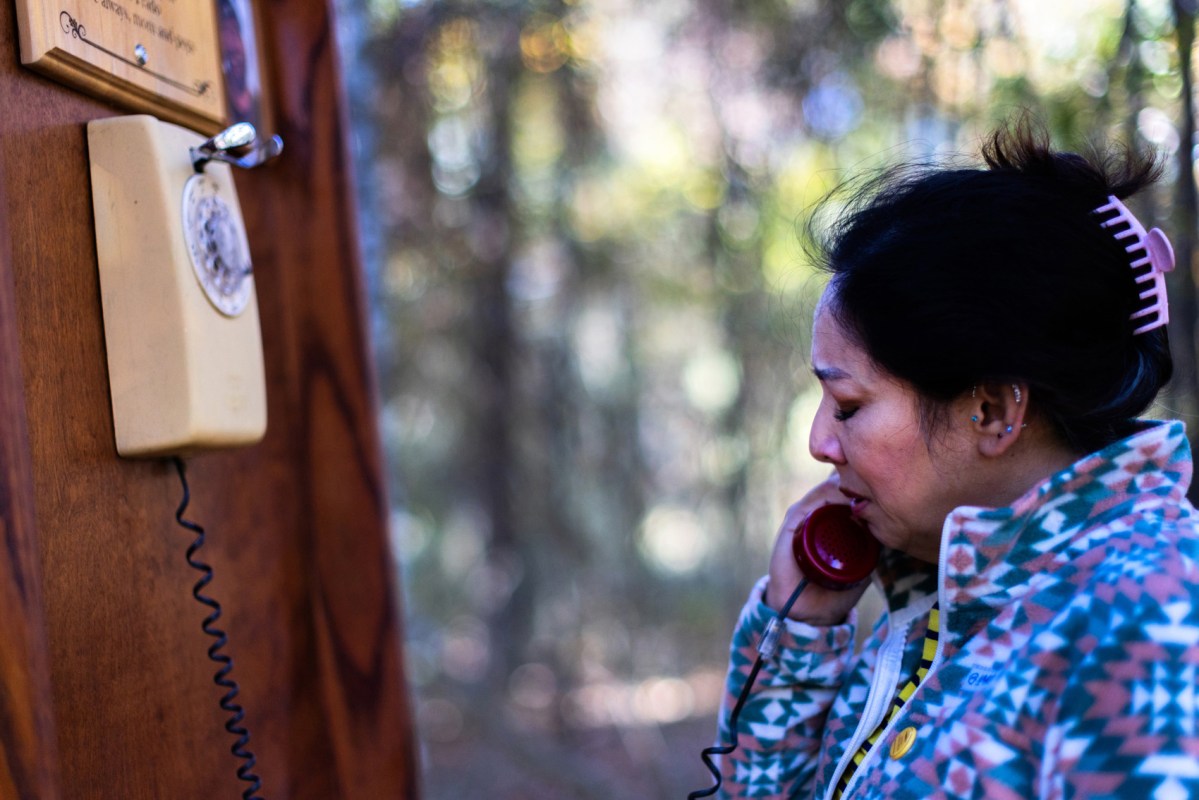
It’s a short walk along the wooded path, but one that allows Nikki Revils to prepare to go from one reality to another.
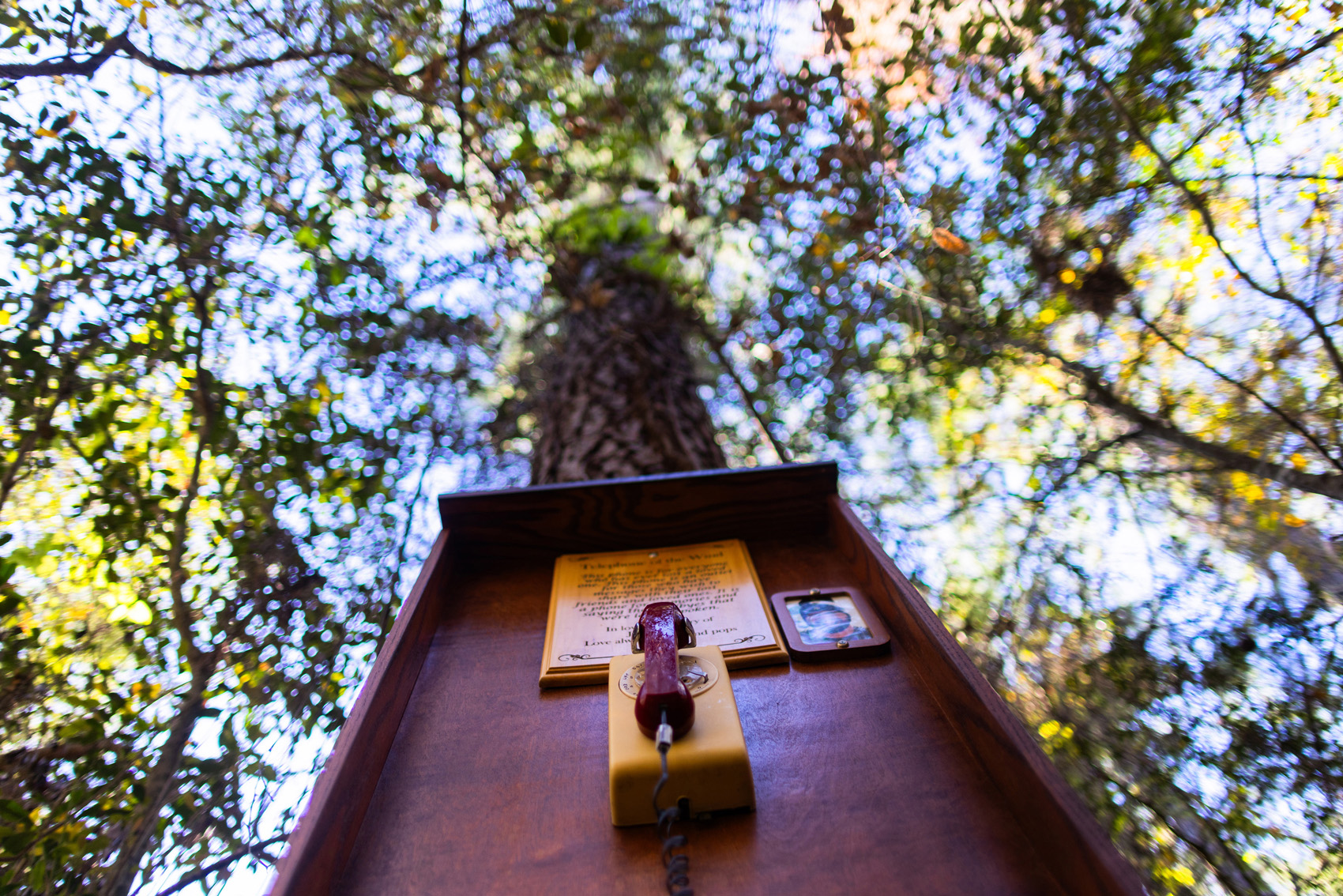
Pine needles and leaves crunch under her sneakers as she makes her way through the woods near her Cypress-area home. Moments later, she stands in front of a towering loblolly pine with flaky bark where the wind phone waits.
Revils takes stock of what others have left: some shells and a rubber duck in a camouflage army outfit. She clears some leaves and dirt off the red chair and brushes her hand across the framed photo of her son.
Deep breaths, she reminds herself. In through the mouth, out through the nose.
She puts the red rotary phone receiver to her ear and nestles into the matching plastic Adirondack chair for the one-way call with her son, Jacob Prado, who died three years ago.
The wind phone in Cypress is one of more than a hundred around the nation and world that help mourners bridge the gap between the living and the dead. More than a decade ago, a Japanese man created the first wind phone and the idea spread as those grieving loved ones took comfort in those conversations.
Itaru Sasaki, from the town of Otsuchi, about 350 miles from Tokyo, was mourning the loss of his cousin. As a way to stay connected, Sasaki installed a rotary phone in his garden. The phone was destroyed in the 2011 tsunami that left more than 20,000 dead.
Sasaki found the wind phone amid the wreckage, reconstructed the phone booth and opened it to the public. He estimates more than 35,000 people from the United States, Australia, Germany and beyond have used the phone, according to an interview from 2021.
Heather Servaty-Seib, a counseling psychology professor who leads the grief and loss research team at Purdue University, said while wind phones only recently have become more widely known, the idea of having conversations with the dead stretches back generations.
Grieving people often look to have “continued conversations” with their lost loved one, Servaty-Seib said, especially if the death was unexpected. It can be healthy, she said, as long as the person keeps in mind that their loved one is physically gone.
“There might be things that need to be said that went unsaid,” she said. “Even sharing daily concerns can be a type of support. It can be a helpful transition tool from not having the physical and tangible support of that person.”
Happy memories
It’s hard to remember a time before Jacob, Revils said. She had him at 17, and the two had been inseparable.
Even as he grew older and moved out, he often would return for dinners and to spend time with his family, including his two younger sisters, whom he adored.
When she pictures Jacob, Revils thinks about his smile — squinting eyes, cherub cheeks and a toothy grin. She thinks about how he didn’t want to grow up. And how sometimes, even at 28, he would hide in his sisters’ closet to scare them.
She tries to picture those things that flood her with happy memories instead of his addiction.
Jacob worked as an instrument man on a pipeline in Midland, setting up tools and monitoring the project. It was there, she said, that he began to use drugs, eventually becoming addicted. After a few stints in rehab, Revils said her son was on the right path. Then, COVID-19 hit and he lost his job.
He burned through his savings, split from his fiancé and moved back in with his parents.
Revils knew her son was upset the night of Sept. 20, 2020, about some belongings that were taken when he moved out. The two talked before going to bed, Revils assured him it would be OK and they made plans for the next day. Prado overdosed on heroin laced with fentanyl that night.
“I relive that day over and over and can’t see what I missed,” Revils said.
Over the next year, the Revils family began to wade through their grief, often feeling like they were drowning.
To keep her mind occupied, Revils would play YouTube videos for background noise while she worked as an engineering program manager. One day in November 2021, a video came on telling the story of a Washington state man who erected a wind phone in the honor of his friend’s 4-year-old daughter.
She knew right then that she needed a wind phone of her own.
When Jacob worked on the pipeline, he often was gone for long stretches of time, Revils said, and she cherished her time catching up on the phone with him. Now, it could continue.
“When you’re grieving, you’re looking for anything, you’re looking for any type of lifeline that is going to help process those feelings,” she said. “We didn’t get to say goodbye. You know, maybe he couldn’t answer me, but I could talk to him.”
After several trips to antique stores around Houston, Revils found a rotary phone. She and husband Anthony, who is a carpenter, set it up along a trail in Russ Poppe Family Park, five minutes from their home, and added a sign to let people know the phone erected in their son’s honor.
Revils said they chose the spot because she wanted to be able to “call” Jacob any time the feeling struck. The sounds of children playing nearby helped, too.

Holiday tradition
Priyanka Johri runs an animal sanctuary and an assisted living home in The Woodlands. She had heard about wind phones, but it was not until the end of 2020 as she worked to protect her residents from COVID-19 that she gave the idea more than a fleeting thought.
“I’ve never talked about death as much as I did in 2020,” she said. “Everyday during COVID, you would hear about someone losing someone.”
One day, Johri was scrolling through Facebook and saw a friend post a message wishing there was a phone to heaven so she could talk with her mother.
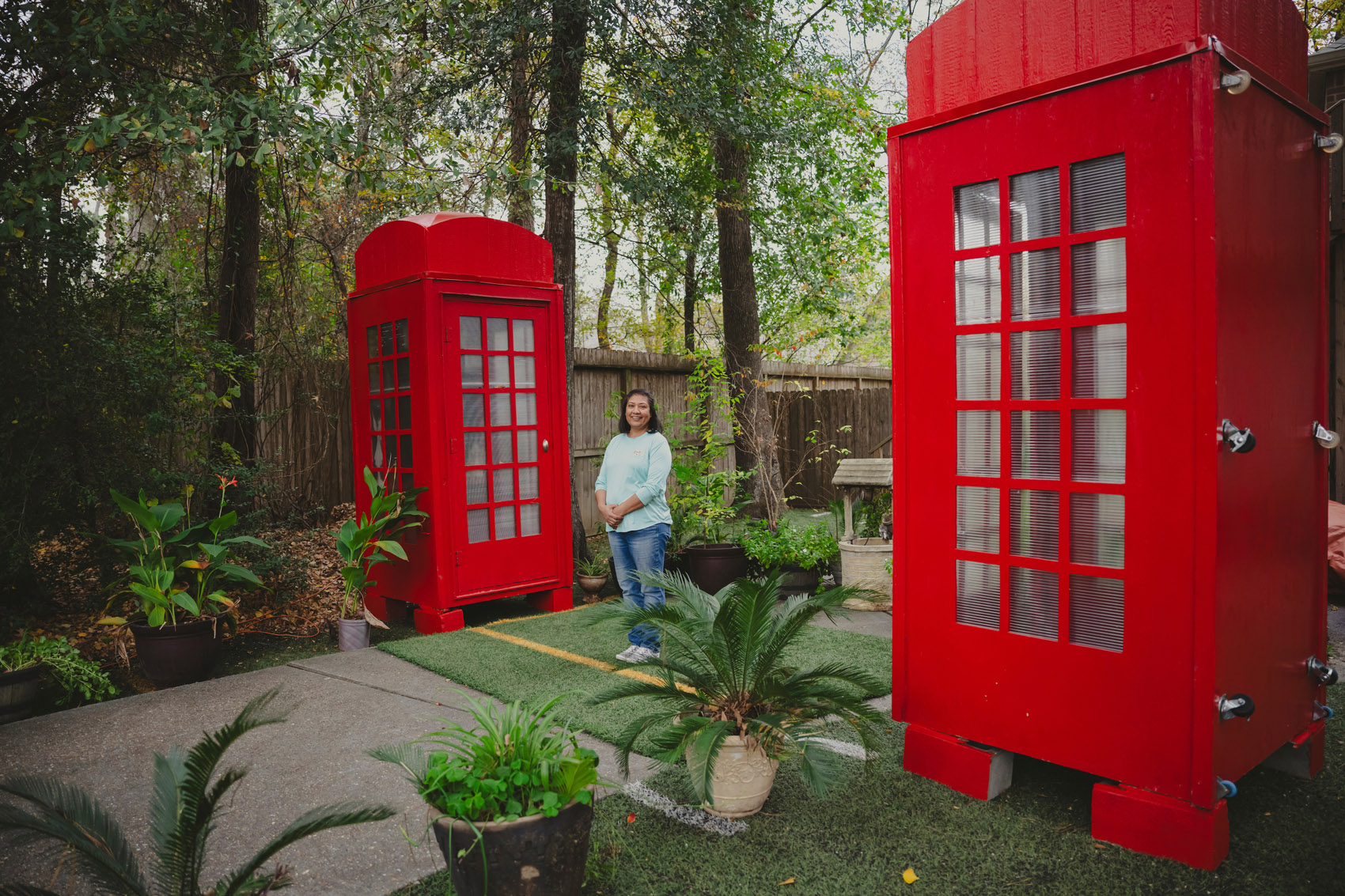
Johri immediately began scouring the internet and Facebook Marketplace for phone booths. She quickly found a school looking to get rid of two enormous red phone booths that resemble those found on the streets of London.
She drove three hours, loaded the phone booths onto a trailer and put them outside of Acorn Manor Assisted Living, effectively creating a new holiday tradition.
Now, each December, she dots the lawn outside the two residential assisted living homes with inflatable snowmen, polar bears and penguins. There is a red and white wooden box, decorated with snowflakes, for letters to the North Pole. And there is a red blow-up “Merry Christmas” arch, anchored by decorated pine trees that lead to the phone booths.
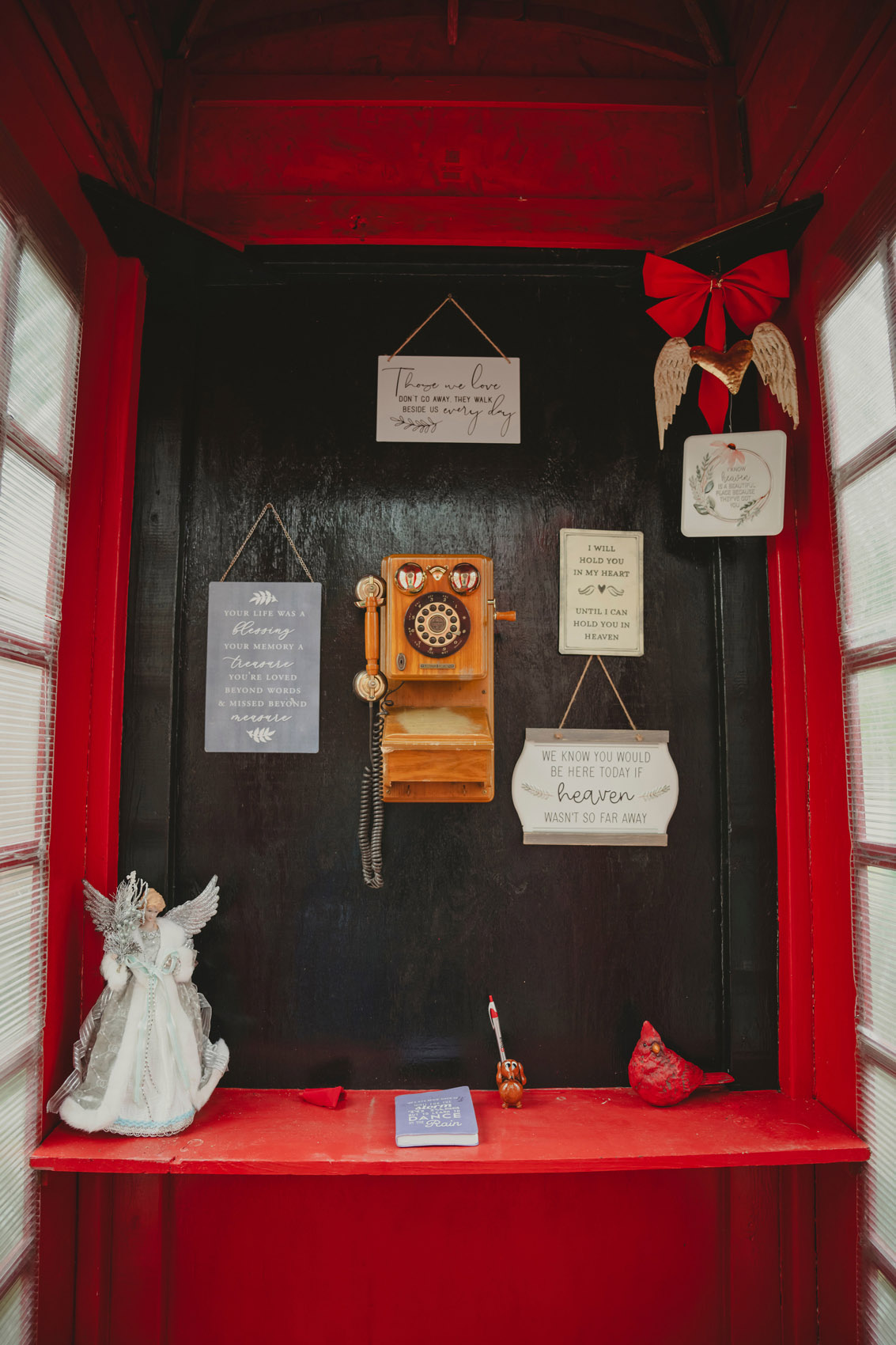
Johri said she wishes she could offer the wind phones year round, but her homeowner’s association will not allow it. As a compromise, she installs them during the holiday season.
Inside each of the booths sits a rotary phone and signs that read “We know you would be here today if heaven wasn’t so far away” or “I will hold you in my heart until I can hold you in heaven.” She also leaves a notebook inside, in case anyone wants to leave a message.
In a note dated Dec. 31, 2021, one visitor wrote that she came to talk with her mother.
“She asked to have no funeral or service, she doesn’t have a burial site — I think of her every day — miss her and wish I’d told her many things including a proper goodbye,” the note read. “I miss sharing her memory, her life with friends and family and I pray she is at peace. Thank you for this opportunity to connect with my mom and for others to connect with their loved ones.”
Johri does not use the phone to connect with people she has lost. Instead she talks with her first dog, a white pitbull terrier named Moti, who died more than a decade ago.
Each winter, Johri prepares for her yearly talk with her beloved pet. She makes sure to remind Moti that she started an animal sanctuary to save dogs because of her. And she apologizes for misgivings in their first few weeks together, when she did not want a dog.
She found Moti tied to a tree, struggling in the Texas heat. Johri tried to take her to a shelter but was told there was no room and the dog likely would be killed. So, Moti came home with her, with a plan to take her to a shelter when spaces became available. Within two weeks, the pair were inseparable.
“I just tell her what I’m doing,” Johri said through tears. “I just hope she’s proud of me.”
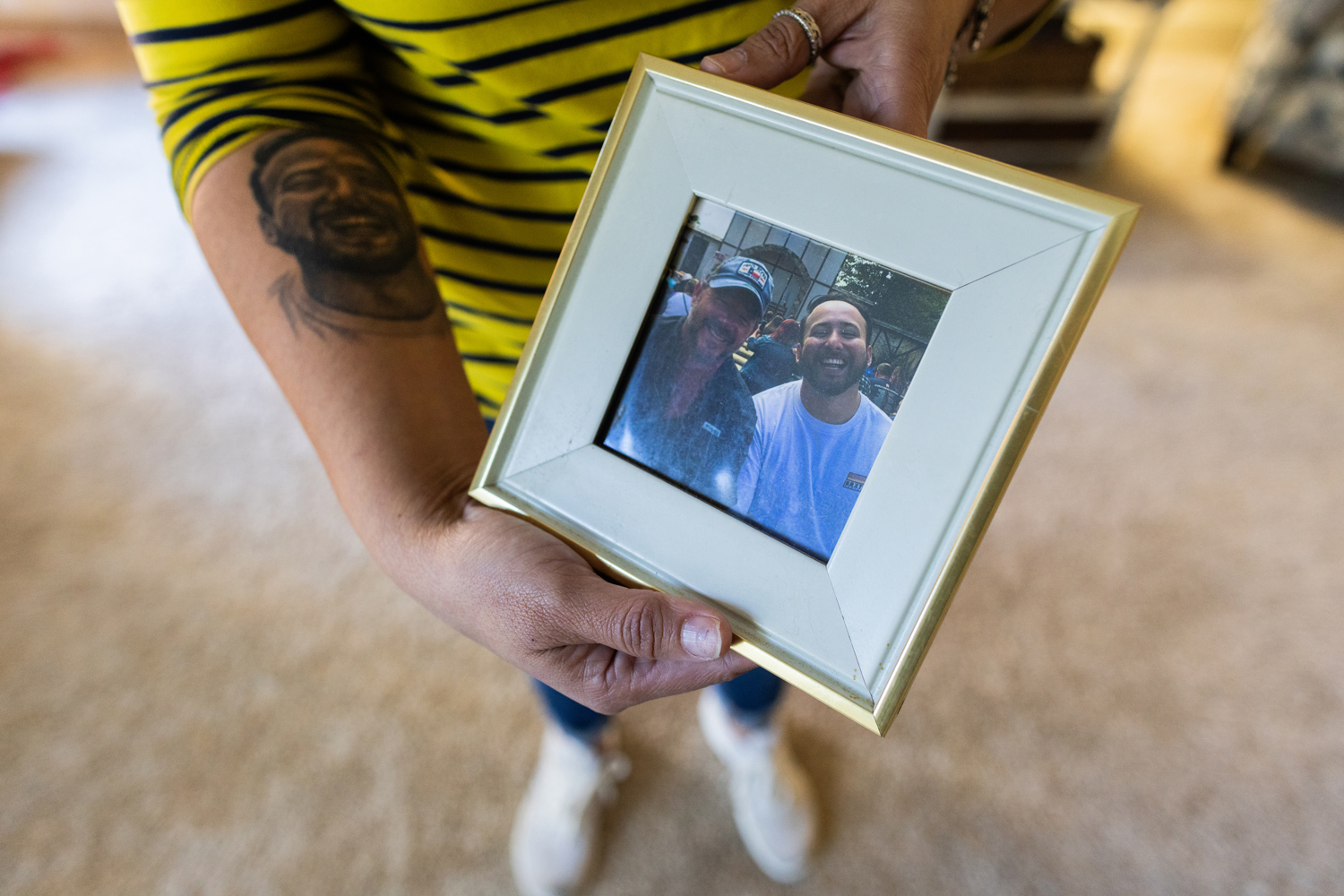
Nikki Revils holds a photo frame with the photo of her son Jacob Prado, right, that inspired the tattoo of him on her arm, Wednesday, Dec. 6, 2023, in Houston. Jacob passed away in 2020 from an accidental overdose. (Marie D. De Jesús / Houston Landing) 
Nikki Revils sits in her living room, Wednesday, Dec. 6, 2023, in Houston, talking about her son Jacob Prado who passed away in 2020. (Marie D. De Jesús / Houston Landing) 
Enlarged photo of Jacob Prado, showing his love for animals and easy smile at the staircase of his parents home, Wednesday, Dec. 6, 2023, in Houston. Jacob passed away in 2020 from an accidental overdose. (Marie D. De Jesús / Houston Landing) 
Nikki Revils closes her eyes as she picks up a red rotary phone receiver and places it to her ear, Wednesday, Dec. 6, 2023, in Houston. The wind phone in Cypress placed at Russ Poppe Family Park is one of more than a hundred around the nation and world that help mourners bridge the gap between the living and the dead. (Marie D. De Jesús / Houston Landing) 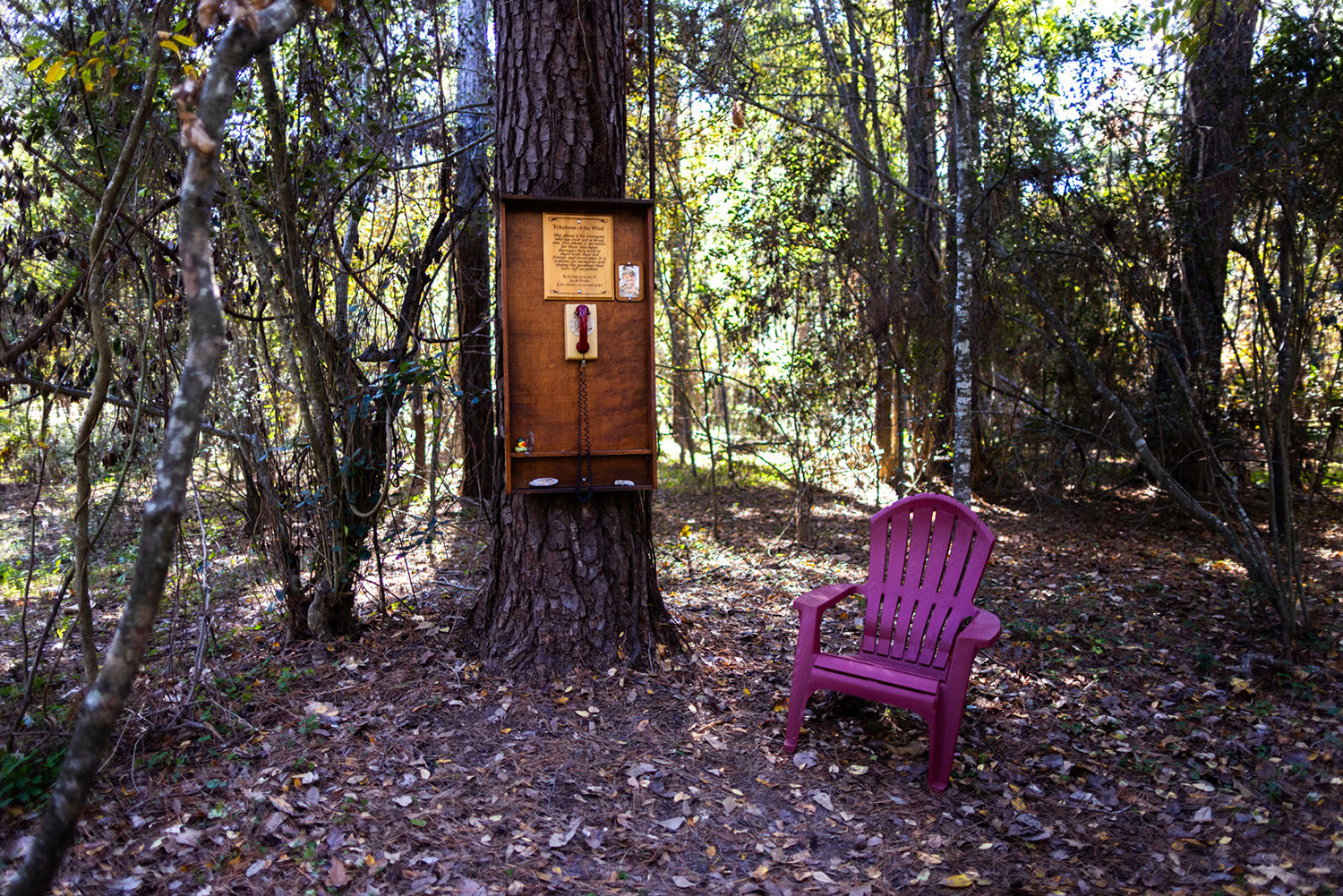
A red chair complements a flaky loblolly pine tree which is home to a wind phone in wooded are at Russ Poppe Family Park, Wednesday, Dec. 6, 2023, in Houston. (Marie D. De Jesús / Houston Landing)
‘I know he hears me’
Every few months, Revils gets a Facebook message or two thanking her for the wind phone. Someone even buried their cat nearby.
Revils did not expect the wind phone to attract so much attention.
“I didn’t think anyone would find it,” she said. “I thought it would just be something that would help us.”’
Anthony Revils has since redesigned the setup, adding a wooden frame so users have a place to leave items.
He also added a sign: “This phone is for everyone who has ever lost a loved one. This phone is an outlet for those who have messages they wish to share with their lost friends and loved ones. It is a phone for memories and saying the goodbyes that were left unspoken. In loving memory of Jacob Prado. Love always, mom and pops.”
Every few weeks, he makes the short drive to the wind phone to rake leaves, wipe the light mahogany frame down and replenish the tissues. It’s his version of taking care of Jacob, his wife says. He never picks up the receiver.
The couple also visit Jacob’s grave about twice a month, Nikki Revils said. To her, the visits serve a different purpose.
At Jacob’s grave, she tends to sit quietly, close her eyes, and “be with him in the last place I saw him.”
When she visits the phone, she updates Jacob on life — his sister recently moved into her own apartment in the Heights. Sometimes, she tells him about her latest travels. She had little stickers of his face made and puts them at landmarks during the trips “so he can go all the places he didn’t make it to.” Other times she screams, cursing at Jacob for leaving. Sometimes she begs him to come back.
Revils tries as best as she can to focus on the positives. Her two dogs and three cats make her smile every day. She’s helping save animals with the rescue group she founded, Fuzzy Texan. Her family is healthy. And she still sees her son.
She sees him in the plump cardinal that visits their backyard. Or when she spots a butterfly. And when his favorite music plays on the radio.
“Every day is a roller coaster,” she said. “But I know he hears me up there.”