


Surrounding the Baytown Nature Center, Houston’s massive petrochemical industry looms across the tidal marsh and freshwater wetlands. The facilities emit a low, constant hum – much like the sound of cars rushing on a highway – and produce flares that flicker in the distance.
Around a half hour before sunrise, J.J. Hitt is already outside the center in his little blue Prius, waiting for the doors to open. As usual, he dons a floppy, wide-brimmed hat and a curved cane for his 2-mile hike through the fall foliage. Most weeks, the 65 year old tries to get out to the Nature Center – a 450-acre peninsula 20 miles east of Houston – three to four times a week.
Today, in mid-December, Hitt takes a slow walk, pausing every once in a while to pop into a bird blind to peek out at the migratory flocks passing through. He wouldn’t call himself an avid birder, but he loves the early morning hikes specifically because of all the birds flitting around: Brown pelicans, laughing gulls, herons.
The experience can often be strange for him, however.
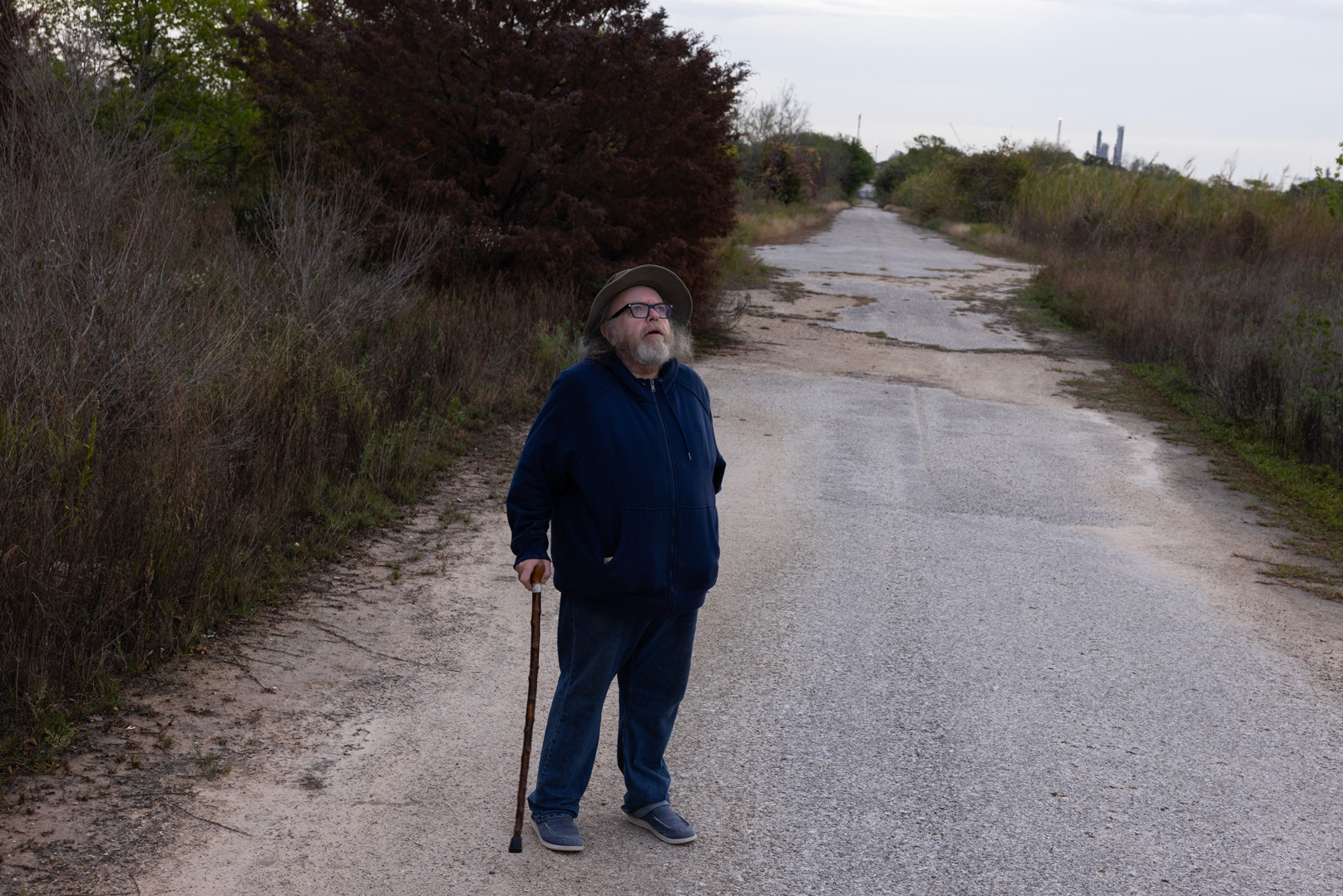
“It feels a little dystopian, actually,” said Hitt, pointing his cane through the trees toward one of the petrochemical plants. “You get used to it, but it’s a bit surreal.”
The Houston metropolitan area holds over 40 percent of the nation’s petrochemical manufacturing capacity and is home to 618 chemical establishments as of 2021. In Houston’s bay area and ship channel, the industry spans about 12 square miles – passing through communities such as Channelview, Deer Park and Baytown.
At the same time, Houston’s bays are critical locations for avian activities. The Nature Center, which is listed on the state-designated Great Texas Coastal Birding Trail, hosts 317 species of resident and tropical migrant birds. Originally, Houston’s bay was mostly coastal marsh with large, thriving biodiversity. Over time, urban sprawl and industry developed and the land available for birds to feed, nest and procreate dwindled. Some birds, such as various herons, gulls and Roseate spoonbills, have adapted to the changing environment, while other bird species’ populations have declined dramatically.
In the past several decades, the number of black skimmers, a black and white seabird known for skimming the water for prey, has fallen about 70 percent in Texas because of loss of habitat and nesting sites. Human activity is also a contributing factor: The birds are easily spooked by outside disturbances, which can cause them to abandon their colonies.
“The negative impacts on Houston’s bird population isn’t overnight, and it isn’t suddenly dramatic,” said Wyatt Egelhoff, a coastal sanctuaries conservation specialist with the Houston Audubon Society. “You have a long-term decline in some species.”
Ecosystems can dramatically or subtly change over time through naturally occurring events such as flooding or fires. This kind of change rejuvenates the marsh and creates new and healthy habitats for the birds. But development and industrial growth in the area can cause the environment to stagnant. Human activity in natural areas can also harm the birds, such as at some Texas public beaches, where people can drive their cars on the sand – running over birds or disturbing nests.
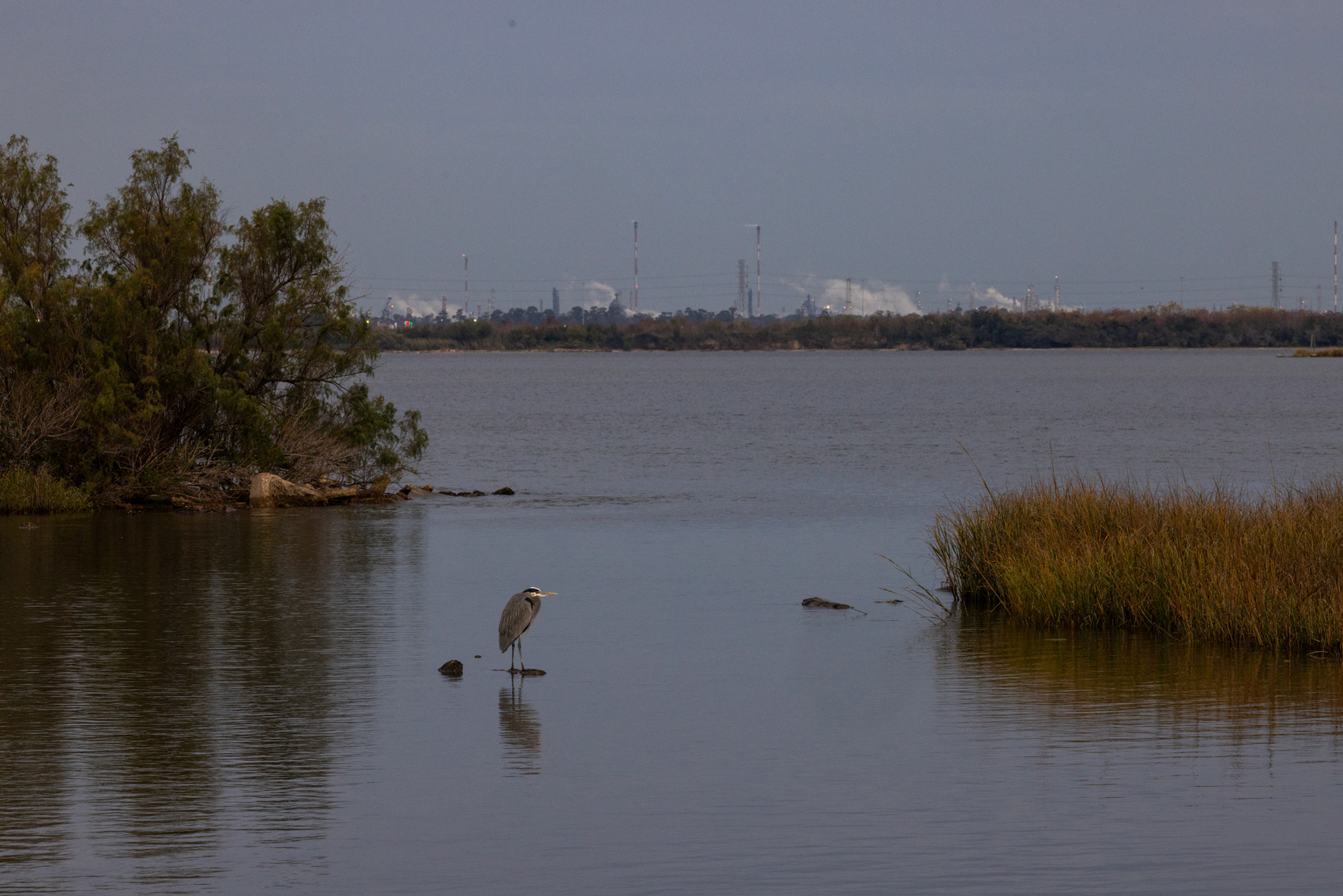
A heron perches on a piece of wood during sunrise with industrial plants in the background at Baytown Nature Center, Thursday, Dec. 14, 2023, in Baytown. (Antranik Tavitian / Houston Landing) 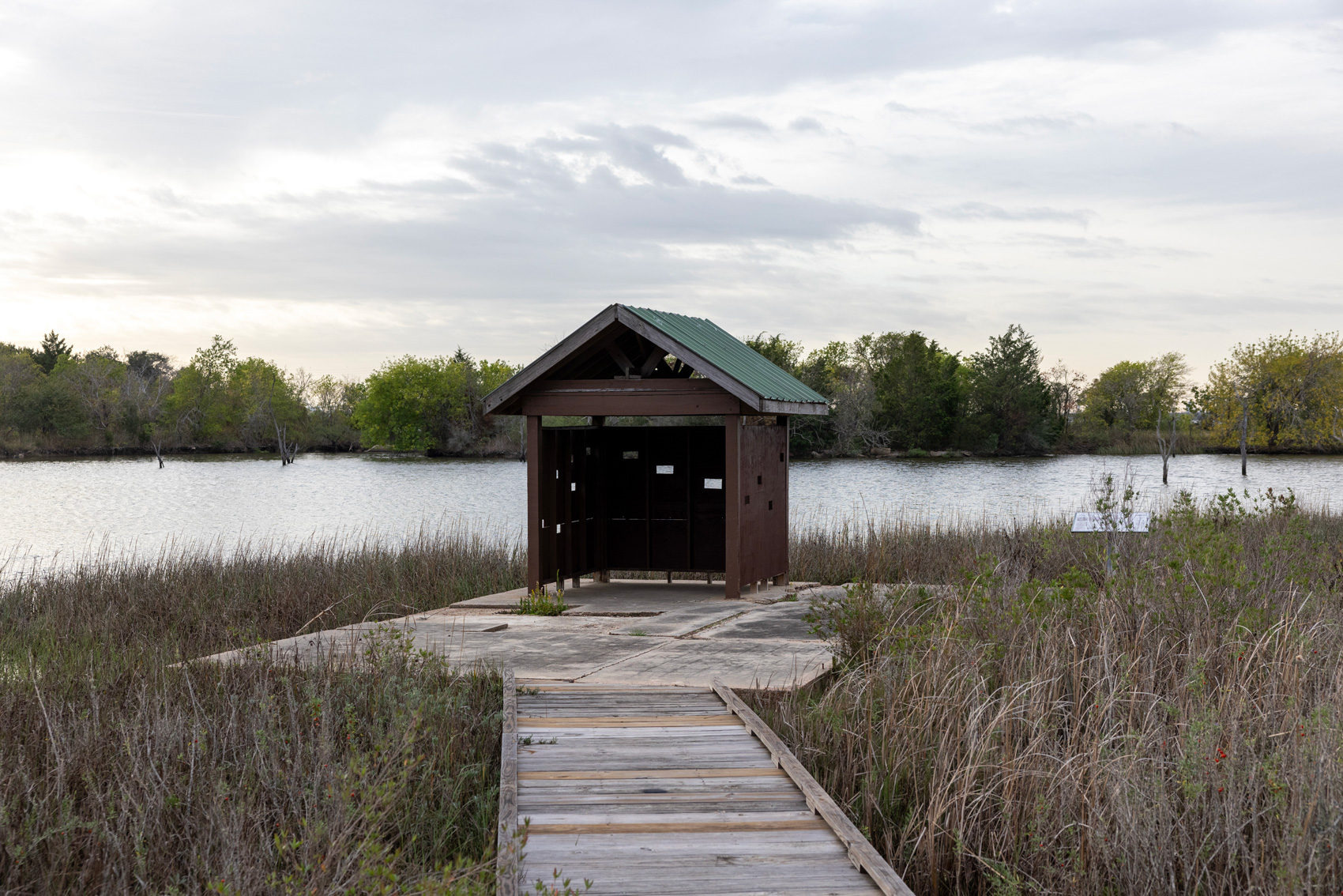
A bird blind built on the foundation of a home at Baytown Nature Center, Thursday, Dec. 14, 2023, in Baytown. The preserve was once home to a subdivision, but after a series of hurricanes and tropical storms, the area became too hard to maintain and was turned into a wetland. (Antranik Tavitian / Houston Landing) 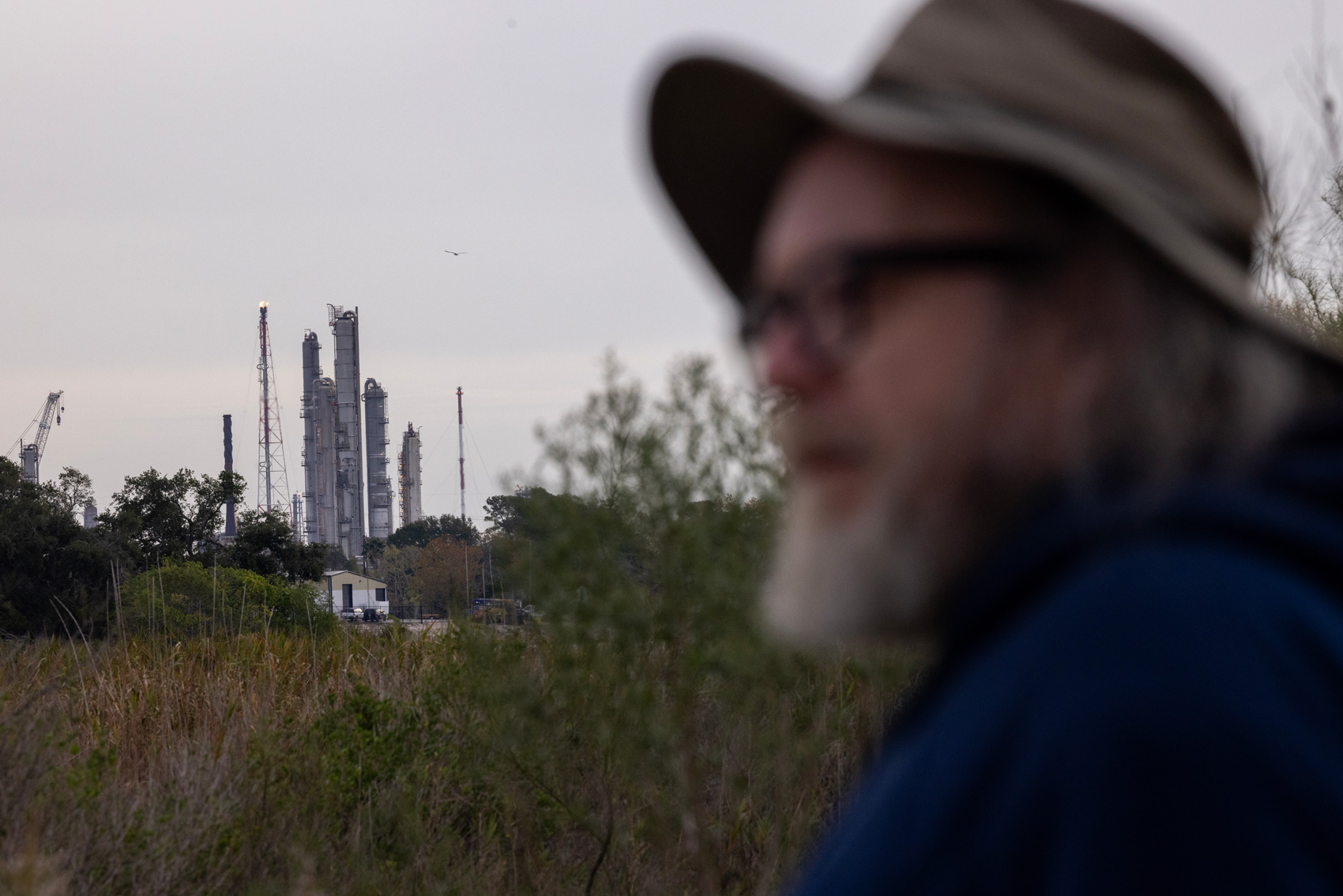
A bird flies past ExxonMobil Chemical – Baytown Technology as J.J. Hitt looks at the sky at the near Baytown Nature Center, Thursday, Dec. 14, 2023, in Baytown. (Antranik Tavitian / Houston Landing) 
A ship passes through a channel near Baytown Nature Center, Thursday, Dec. 14, 2023, in Baytown. (Antranik Tavitian / Houston Landing) 
ExxonMobil Chemical – Baytown Technology is seen from Baytown Nature Center, Thursday, Dec. 14, 2023, in Baytown. (Antranik Tavitian / Houston Landing) 
A pipe sticks out the foundation of a home which is now a platform for wildlife viewing at Baytown Nature Center, Thursday, Dec. 14, 2023, in Baytown. The preserve was once home to a subdivision, but after a series of hurricanes and tropical storms, the area became too hard to maintain and was turned into a wetland. (Antranik Tavitian / Houston Landing)
“It’s not all one thing either,” said Egelhoff, “but you do have all this development from industry or housing and that squeezes the amount of natural space into tighter and tighter corners.”
Along with urban development, rising temperatures and erratic weather fluctuations due to climate change can impact birds in Texas by limiting their ability to find food or mate and reproduce. Wilson’s plover, a tiny coastal bird most often seen racing across the sand in pursuit of fiddler crabs, entirely depends on nesting on the shoreline’s narrow band of sand along the beach. Due to erosion and rising sea levels, the species is losing habitat and nesting grounds.
But several bird species have been able to adapt.
“Some of these birds have done fairly well in response to the human disturbance in the greater ship channel and the Port of Houston,” said Egelhoff. “Humans have created some space for them, and when we stopped using chemicals like DDT (an insecticide banned from agricultural use in the U.S. in 1974), birds were doing well.”
In some areas, the birds are actually more protected from human conflict because they might flock to enclosed, restricted parts of a refinery facility – where they are primarily left alone without disturbance. At some of the facilities’ freshwater discharge ponds, Egelhoff said, birds like the king rail, a chicken-like waterbird, have flocked there in the past.
For example, in Freeport – a coastal town about an hour south of Houston – one of the largest black skimmer colonies along the Gulf Coast nests in a Dow Chemical Corporation parking lot.

Because the parking lot is secluded and restricted from the general public, the black skimmers are left to muck around without any human activity. The parking lot is perfect for nesting, with shell and limestone, and it’s close to feeding grounds such as marshes, bay and harbors, according to the Gulf Coast Bird Observatory.
EBird, a citizen-science website for birders, collects data from people spotting birds, including at Baytown Nature Center. Most recently, birders have logged American white pelicans, brown pelicans and snowy egrets. In late November, one Ebird logger posted that he saw a bald eagle and uploaded photos for proof.
The rumor of the bald eagle made the rounds, so even Hitt – who isn’t an official birder – heard about it. In mid-December, several weeks after the first sighting, he decided to keep an eye out for it. He pauses on a bridge overlooking the marsh and squints at the industry in the distance. Some ducks flutter in the water.
“Some birds just keep coming back here,” he said. “They’re pretty resilient.”