

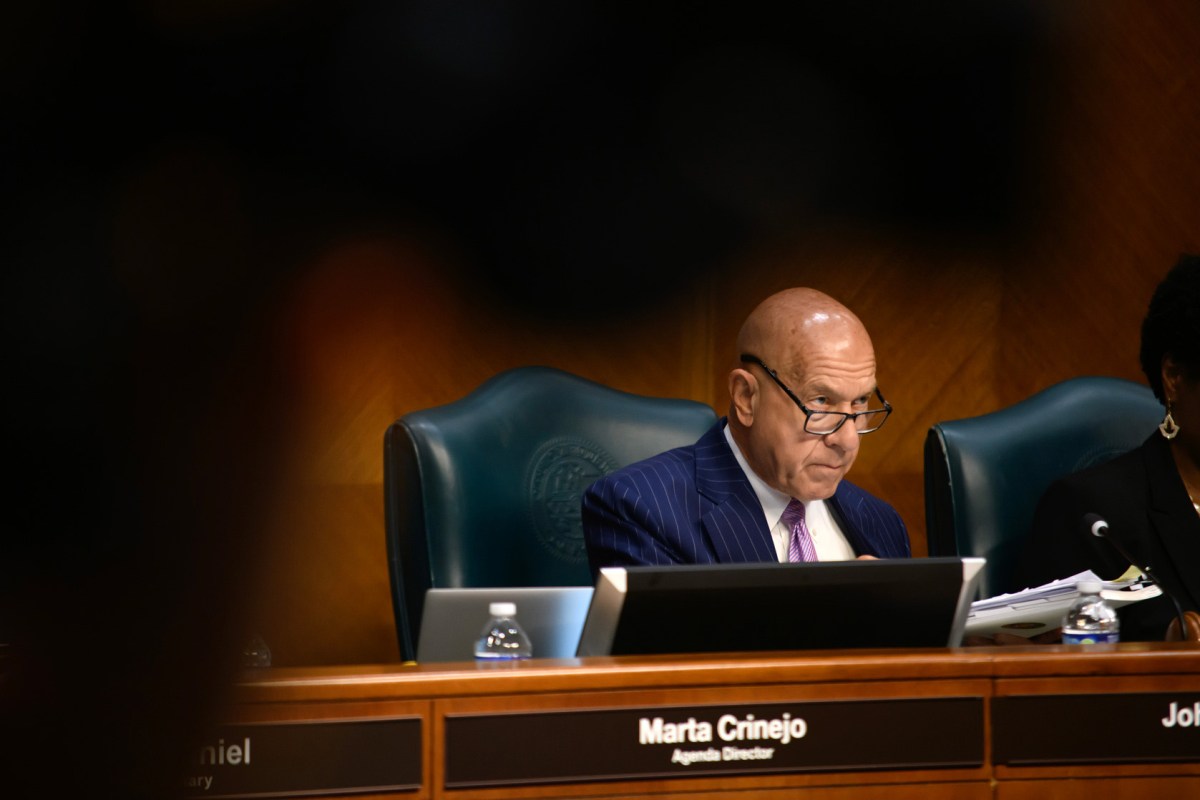
Houstonians will not face a property tax rate hike this year, but the future of the city’s finances remains uncertain as officials wait for audits to reveal potential cuts and sources of revenue to address a projected $230 million deficit.
City Council voted Wednesday to keep the tax rate at 51.9 cents per $100 of assessed value after four members rescinded a proposal last week that would have increased it 5 percent to avoid further budget cuts. The four withdrew the measure after Mayor John Whitmire announced the state will contribute to the city’s disaster recovery following this year’s storms, saving the city around $33 million.
Whitmire has not committed to a plan to offset the rest of the deficit, other than to partner with other governmental agencies and wait for the results of an Ernst and Young audit of city departments. City Council expanded those audits Wednesday to include all of Houston’s tax increment reinvestment zones, or TIRZes, more than doubling the existing contract to $1.35 million.
Originally conceived as a way to kickstart development in blighted areas, tax increment reinvestment zones set a base level of revenue generated by property taxes with designated boundaries. Any property tax revenue collected in subsequent years above that level, known as the increment, is funneled back into the zone for amenities and projects to attract additional development. About 25 percent of the city’s taxable land is included in a TIRZ.
RELATED: Will your property taxes go up next year? Use this simple calculator to find out.
Whitmire said Wednesday the TIRZ audits were a matter of good governance as the TIRZes “spend large amounts of money with little government oversight.”
The city appoints members to the redevelopment authority boards that oversee the tax increment reinvestment zones. It also approves the authority’s project plans.
The city also takes money from certain TIRZes to be used for affordable housing.
The audits are divided into two phases. The first will be a spending analysis of all TIRZes, but the second will dive deeper into any tax increment zone the city determines need more scrutiny.
The contract already specifies that Midtown will be part of that deep-dive, which Whitmire said was self-explanatory due to recent federal corruption charges. The TIRZ former real estate manager was accused last year of misusing $8.5 million meant to further affordable housing efforts.
The audit process should take about five weeks, Whitmire said. However, the council has not yet received the preliminary findings of the first audit of city departments approved earlier this year.
Whitmire repeatedly has said he did not want to raise taxes until seeing the completed audit to eliminate wasteful spending.
EARLIER: Houston council members drop tax hike plan after governor announces disaster relief funds
District F Councilmember Tiffany Thomas was the sole vote against the TIRZ audit, even though she supported the idea.
Thomas tagged the proposal last week to get more information about the status of the current audits. She did not receive the preliminary reports and asked Whitmire for a timeline Wednesday.
He did not provide an answer, saying the reports would come “in due time.”
“You can’t in one breath talk about transparency,” Thomas said after the meeting. “It’s nonsense. It’s all like a massive hallucination. And then not offer transparency on something that’s really significant.”
Thomas said she approved of the idea of looking at where the city should save money before asking taxpayers to contribute more. She said she assumed Ernst and Young would provide recommendations with the audits on how to move forward, but she did not know of a specific plan to bring in more money.
The audits could prompt the City Council to look at the percentage of TIRZ income that comes into the city, At-Large Councilmember Sally Alcorn told the Landing after the meeting.
Alcorn was one of the members who proposed increasing the tax rate as the city considers how to deal with the upcoming deficit. She said she was interested to see the results of the audit and hear Whitmire’s future plans. The TIRZes have to be able to cover their debt service, but Alcorn did not know if the increments could be changed to increase the revenue coming into the city.
“There’s a perception that perhaps there’s a lot of spending going on that’s not just for the projects,” Alcorn said. “So, I think that these audits will, hopefully, explain better where all the non-project money is going.”


