

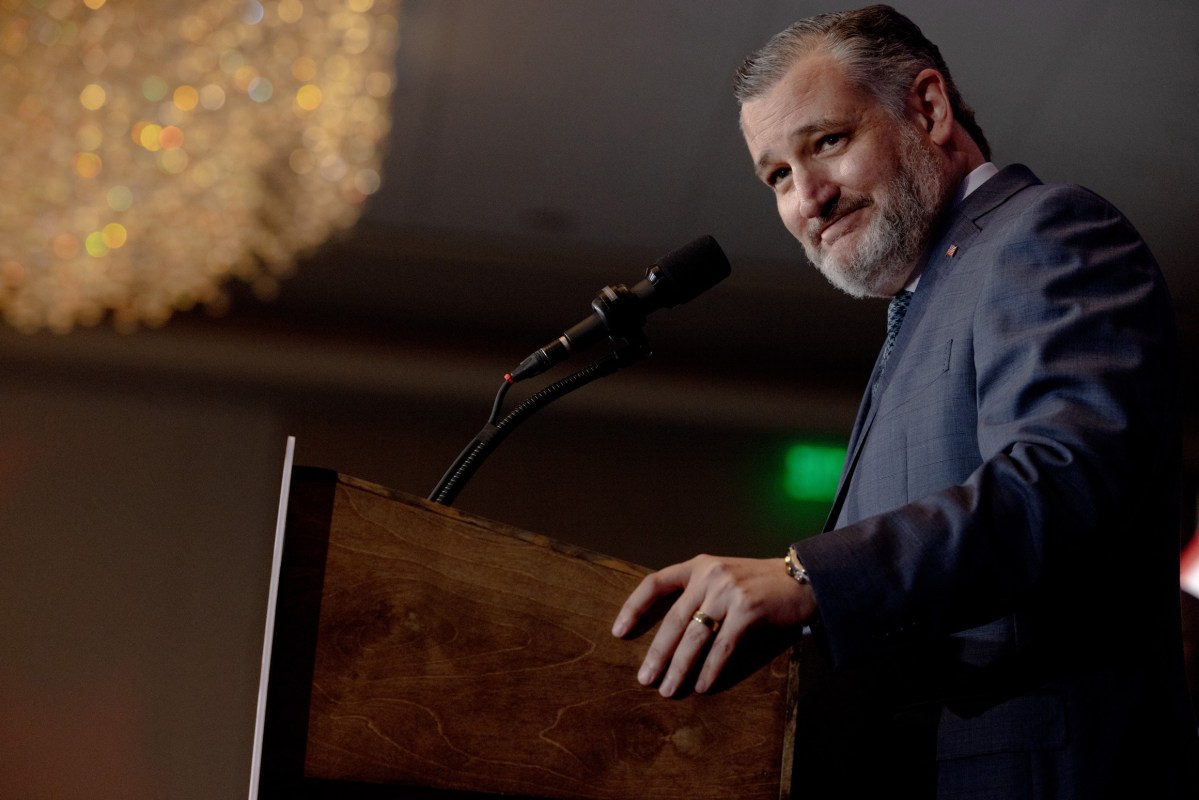
A Fort Bend County man was sentenced Wednesday to one year of probation for threatening to injure newly re-elected U.S. Sen. Ted Cruz.
Isaac Nformangum, 24, had faced up to five years in prison for calling Cruz’s Houston office in June 2022 and leaving a seven-minute-long voicemail in which he said that the senator would be “found and killed.” U.S. District Judge Lee Rosenthal saw fit to grant Nformangum leniency after his attorney said he has autism.
According to a complaint, Nformangum had been upset that Cruz and his Republican colleagues would potentially move to repeal the Voting Rights Act of 1965, which outlaws discriminatory voting practices. The landmark civil rights law, while not repealed, has been weakened over the years by the U.S. Supreme Court, according to the Brennan Center for Justice, a nonpartisan law and policy think tank.
“Every last one of your Republican colleagues to have signed off on that platform is to be found and, is to be found and killed, be it by a bullet to the face or by the smashing of a brick in your skull,” Nformangum said on the call, according to an indictment prosecutors filed in the Southern District of Texas.
Nformangum was found guilty in June of one count of interstate communications with a threat to injure, a felony, following a two-hour bench trial before Rosenthal.
Wednesday’s sentencing before the judge came just over 12 hours after Cruz easily defeated U.S. Rep. Colin Allred, securing a third term as Texas’ junior Republican senator.

It also came after Nformangum’s retained lawyer, Ed Chernoff, asked Rosenthal for leniency, saying his client was recently diagnosed with autism and that the voicemail was an “aberration” in an otherwise peaceful life.
“He’s accepted responsibility early and often. He knows what he did and he knows he’s responsible for every act,” Chernoff said. Nformangum, whom Chernoff said was battling nerves, declined to address the judge.
Prosecutors did not oppose Chernoff’s request for probation. Ralph Imperato said he had spoken to Nformangum at length ahead of the bench trial, a first in his 22-year career as a federal prosecutor.
“I don’t want to insult him in any sort of way, but it’s clear that he has issues… this is not someone who should go to prison,” Imperato said. “The worst thing that can happen to this defendant is having a felony conviction and losing the right to vote.”
The George H.W. Bush appointee agreed, saying probation was appropriate for Nformangum.
“We have a young man here who is in many ways a productive citizen who made a mistake and gave into an impulse that he has clearly regretted and acknowledged. And the sentence should reflect that,” Rosenthal said, who added that she hopes probation will allow Nformangum to receive treatment for autism.
Based on court records reviewed by the Landing, it does not appear that Nformangum tried to evade prosecution or hide what he did.
Shortly after his arrest, four days after the call, Nformangum expressed surprise that such swift action had been taken against him, according to the complaint. He told investigators that he had anticipated being put on a watch list, but not arrested.
The Richmond man turned over his phone to authorities, which showed the seven-minute call to Cruz’s office. Investigators traced the call using caller ID and compared the voicemail to a YouTube recording Nformangum had made.


