


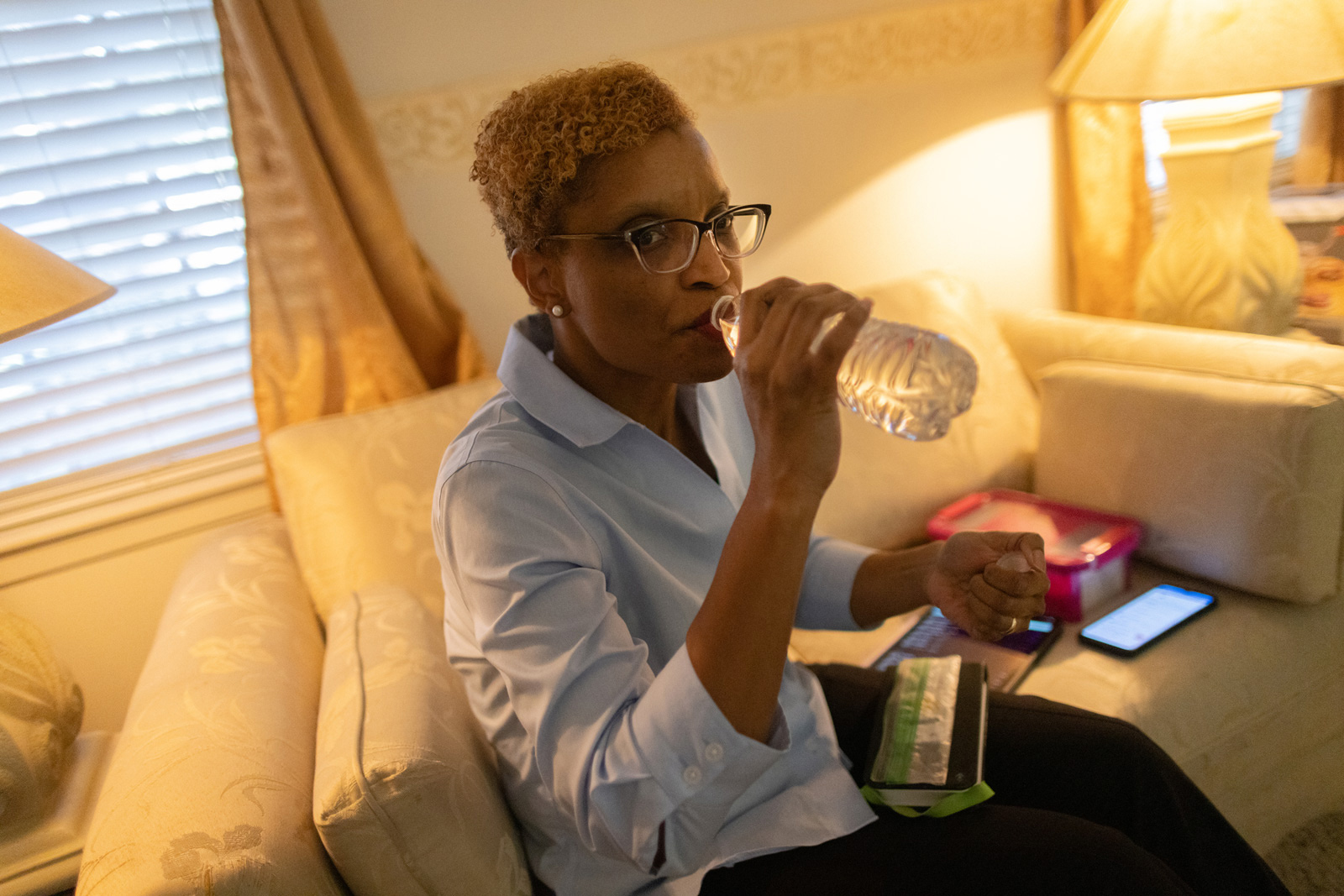
On a recent Monday, as the clock approached 10 a.m., Talitha Humes sat down on the beige couch of her Acres Homes residence, opened her pill organizer and prepared for her daily ritual: three pills first, then another two, and then she stored the remaining three to take 12 hours later.
She has her daily pill-taking routine down to a science now, but it hasn’t always been that way. In 2005, when she learned of her multiple sclerosis diagnosis, her new norm of taking eight pills a day to manage her relapses and memory loss became a challenging job.
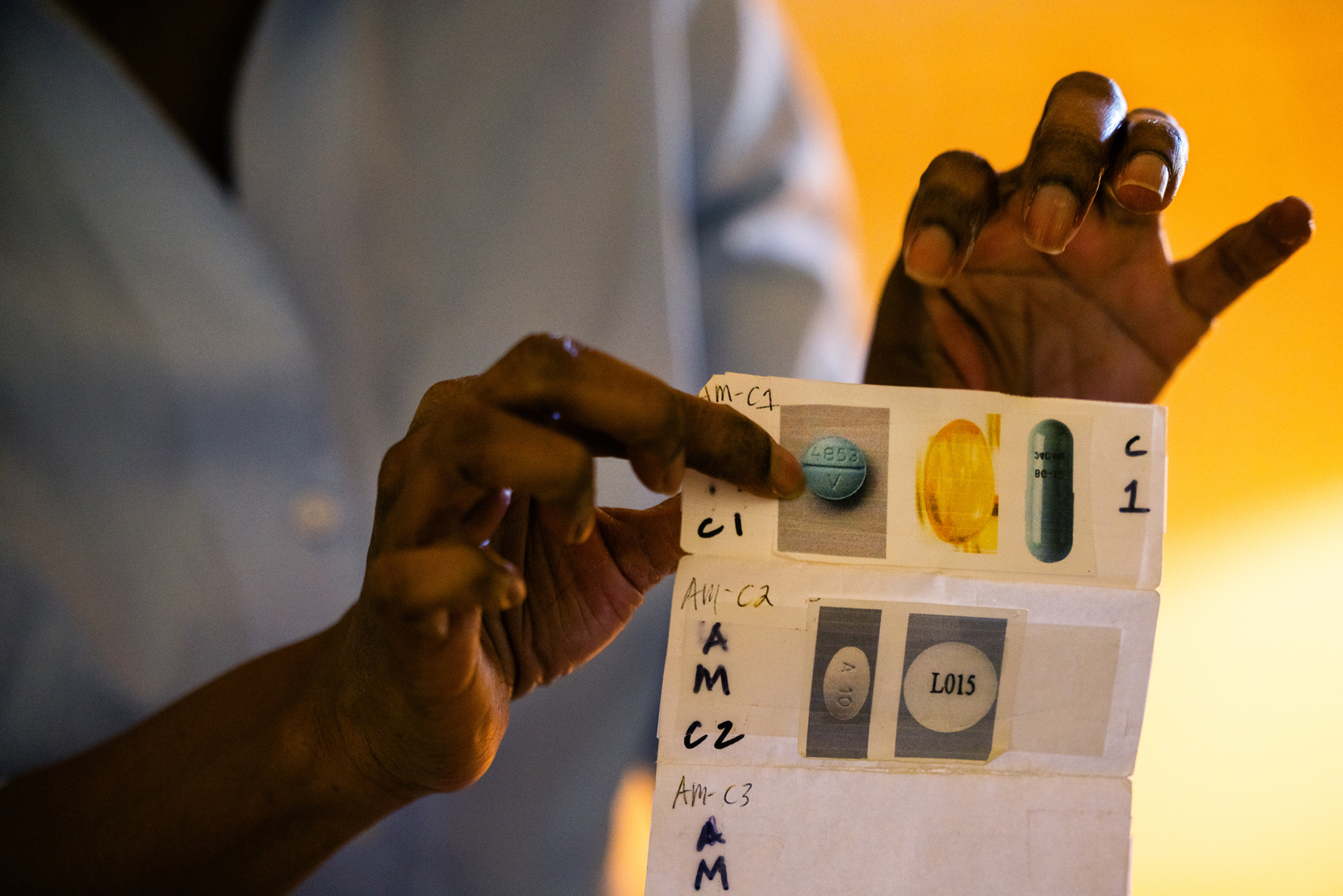
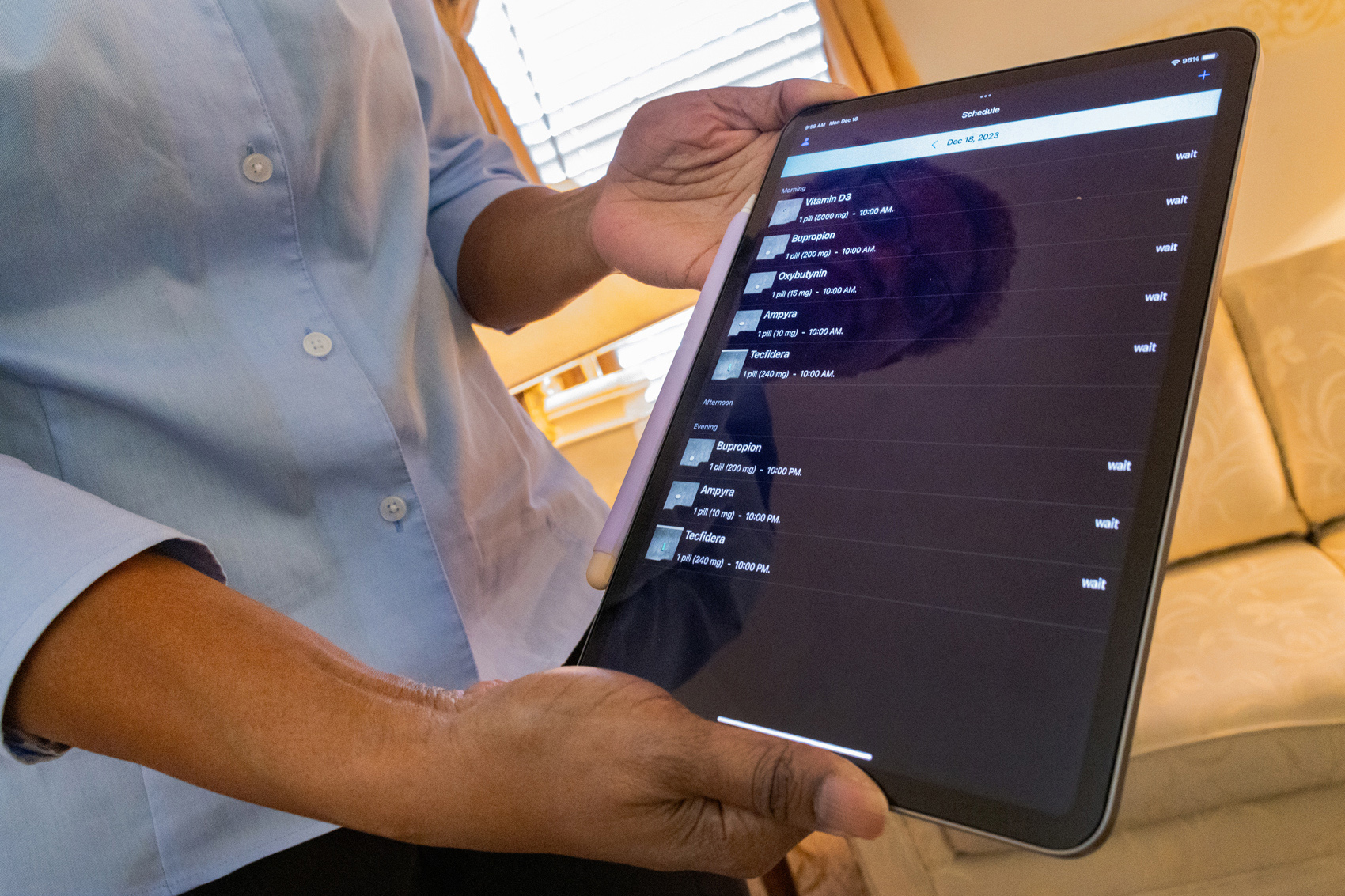
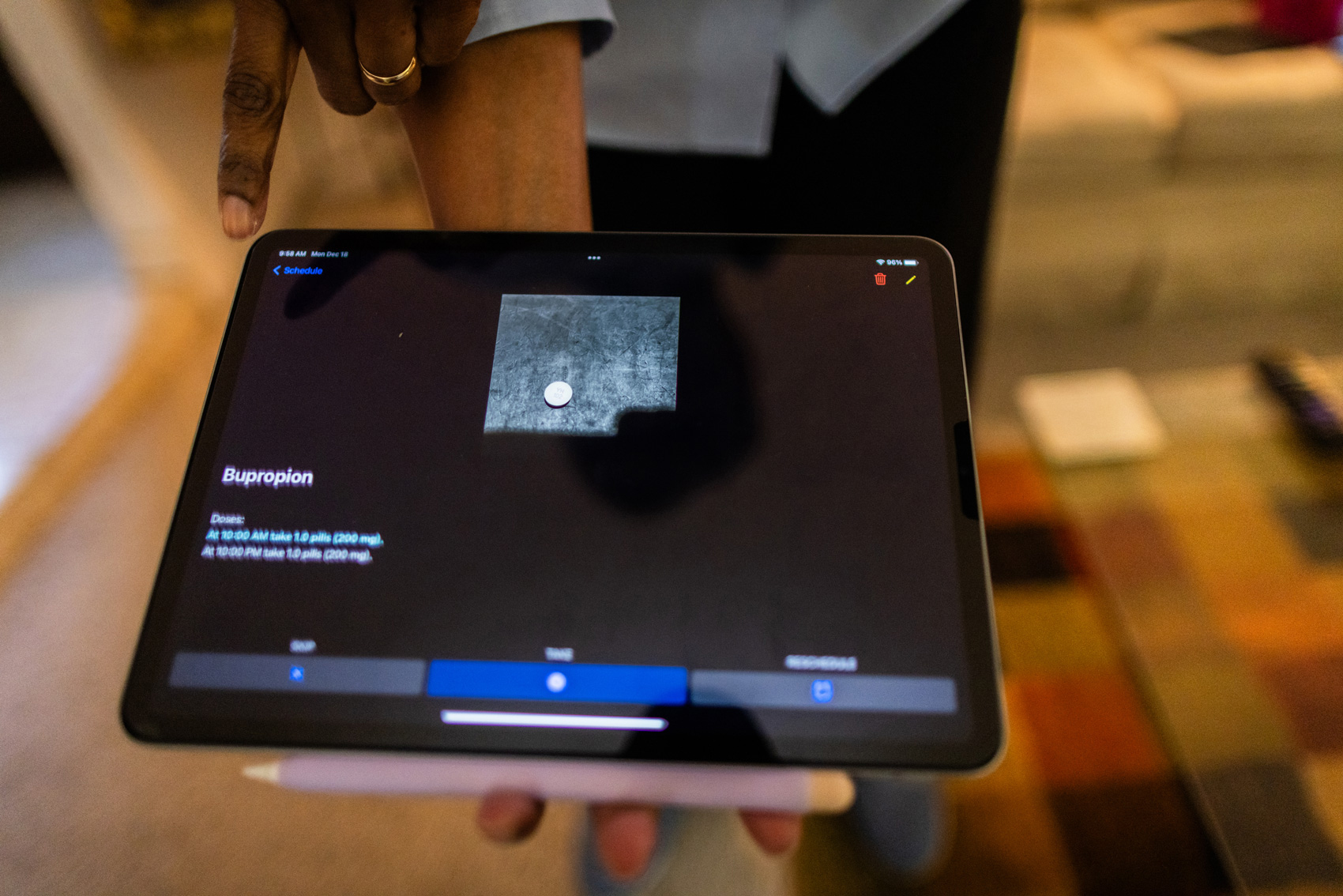
The pills, which vary in size, shape and color, were difficult to track, so Humes, 49, began using Medisafe, a digital app that allows patients to organize their medications and receive reminders. But the app started to let her down, because the generic-brand pills didn’t match the picture of the brand-name pill shown on the app. So she went online to find pictures, printed them out and created a document she called her “cheat sheet.”
“I had to get organized because it was just too much,” Humes said.
But her “cheat sheet” would soon fail her too, once her pills changed again. “When that wouldn’t work, I said, ‘You know what, I need to create something,’” Humes said.
That desire to invent is what led her and dozens of other prospective and current entrepreneurs to a free course at Houston Community College aimed at addressing inequities faced by underrepresented inventors when applying for patents.
In 2021, Humes created a medication reminder app called SeeMeds. It caters to patients with multiple medications like herself, and allows them to take a picture of their pills – rather than automatically generating one like Medisafe. She paid a computer programmer $1,800 to develop the app. The next step, friends and family told her, was to get a patent. Like many inventors, she didn’t know where to start, or if a patent was needed, so she signed up for the course.
The HCC class aims to “level the playing field” to ensure that everyone can have an equal opportunity to protect and be compensated for their ideas, said Carlyn Burton, a patent attorney with Osha, Bergman, Watanabe and Burton LLP who facilitated the three-week virtual course called Inventor’s Patent Academy. The course breaks down the nuances of intellectual property, from the basic qualifications to apply for a patent, to the varying types of claims. It also provides tips to prepare inventors for interacting with an attorney.
‘This isn’t a cheap proposition’
From Dec. 2022 through Nov. 2023, nearly 114,000 patents were filed by small business owners under the “micro entity” category of the U.S. Patent and Trademark Office (USPTO). These constitute a minuscule fraction of all patents filed; The majority of patents — 73 percent — were filed by large entities with more than 500 employees.
Small businesses owners are in the minority of patent filers, and so are women. As of 2019, women made up just 13 percent of all inventor-patentees in the U.S., according to a 2022 report from the USPTO.
Perfectionism, Burton said, can sometimes stifle women from submitting patent applications at large corporations. “They almost hold themselves to a higher standard before they submit their ideas,” she said. “And, anecdotally, men tend to throw everything on the wall and see what sticks.”
A 2018 Harvard University study found that women – especially Black and Latina women – obtain patents at significantly lower rates than men. It also found that people of color and individuals from lower-income families get approved for patents less often than white people or those who grew up in affluent families.
The inequality in patent approvals may be related to the low representation of women in Science, Technology, Engineering, and Math (STEM) fields, according to a report from the Institute for Women’s Policy Research. Black, Latina and Native American women are particularly underrepresented among STEM degree holders.
Burton believes access to capital is the biggest barrier of entry.
“For small businesses, it’s expensive. This isn’t a cheap proposition,” she said. “And that’s a reality for any small business, whether it’s a person from an underrepresented group or not.”
Obtaining an attorney to help prepare, file and usher a patent application though the system can cost anywhere from $10,000 to $20,000, Burton estimated, and that doesn’t include the associated government fees.
Discounts, free legal help
Fees for micro entities are discounted significantly, Burton said: It costs micro entities $364 to file, compared to $1,820 for large entities.
The USPTO has a patent pro bono program to assist under-resourced inventors in obtaining free legal help with 21 regional, independent nonprofit programs, including the Texas Accountants and Lawyers for the Arts (TALA), which is based in Austin.
Since the pro bono program began in 2011, the agency has reported improvements in representation. USPTO data from 2022 shows that 43 percent of those who participated (and chose to identify) identified as women. 35 percent of participants identified as Black, and nearly 14 percent as Hispanic.
“In creating that program, they have found that it is really targeting the populations who have been underserved by the system and indicating that there has been a financial barrier to entry into the IP (intellectual property) ecosystem,” Burton said.
Data suggests that Houston is one of the more inclusive cities for inventors.
A 2022 USPTO report shows that Harris County is among the top women-patenting counties, with the number of female patent recipients in the field of fixed constructions (buildings, structures, earth drilling and related materials) rising by 2,045 percent from 1990 through 2019.
Although Burton says Houston is “lucky” that there are ample opportunities for entrepreneurs to get the information they need, access to resources is still limited.
“Generally there is not a lot of IP (intellectual property) education in our educational system,” Burton said. “It tends to be things that people find out about once they’re in the field when they’re working; when they have need.”
That’s part of what sets HCC apart, Burton said. “I am not aware of other community colleges that are offering this type of program,” she said.
Many local institutions offer classes to students on patent law and inventorship, but HCC’s program was geared towards underrepresented inventors in the community.
“Community colleges across the country really are there to educate students, but also people in the community that want to come in and expand their skills or their talents or change careers — that’s what community colleges are all about,” said Maya Durnovo, the associate vice chancellor at HCC.
She said the majority of the roughly 30 attendees in the 2023 course were Black or Latino and female, and none were HCC students or alumni.
“My work along with my team is all about helping to start businesses and to grow businesses,” she said. “We have a number of programs geared towards that mission. And of course, because we live in Houston, the population that participates is the population of Houston, which is of course the most diverse with a lot of ethnic minorit(ies).”
Durnovo, who is in charge of all entrepreneurial initiatives at HCC, said the institution has had a longstanding relationship with Qualcomm, the technology company that sponsored the course, and she was thrilled when she learned they offered an interactive patent course.
“It’s really giving a whole new population the opportunity just to learn about the process,” Durnovo said. “And then to decide, ‘Is it something that I should patent? Is it something I should copyright? Is it a trademark?’”
‘Do I even need to do this patent?’
Those are the answers Humes so desperately craved and the reason she took the course with her pill-identification app in mind. But the more she learned with each class, the more overwhelmed and discouraged she became.
“It’s just depressing because, it’s just like, ‘God, do I even need to do this patent? Do I need to? I might have to, but I don’t know,’” she said after the second class.
Unlike others who dropped out after the first class, Humes stayed through the end of the course, and at the last class, she got her breakthrough — a trademark is her best bet.
Humes could’ve easily wasted tens of thousands of dollars to obtain a patent that she didn’t need – if it wasn’t for HCC’s course. A trademark will cost her roughly $800 to $900, she estimated. Although she became overwhelmed midway, Humes is glad she took the class. Now, her next step is to find out what class, or classes, she should take for her app. She also wants to contact the pro bono legal service she learned about from the course.
“But before I do that, I want to make sure I know what I’m talking about before I go to them. It’ll be a faster, better process. You don’t want to waste their time.”
Hi there! I’m Monique Welch, one of Houston Landing’s Diverse Communities reporters, and I focus my reporting on Black, Asian, Asian American, or Pacific Islander, LGBTQ+ and People with Disabilities communities in our area. What stories do you think I should cover? You can also reach me by email: monique@houstonlanding.org.

