

This Q&A is an installment of Houston Landing’s Who are HOU? series that aims to tell stories celebrating the melting pot of communities, cultures and experiences that define this city. From personal histories to challenges to everyday triumphs, each story is told in the words of the person being interviewed to capture their voices and the journeys that shape Houston’s identity.
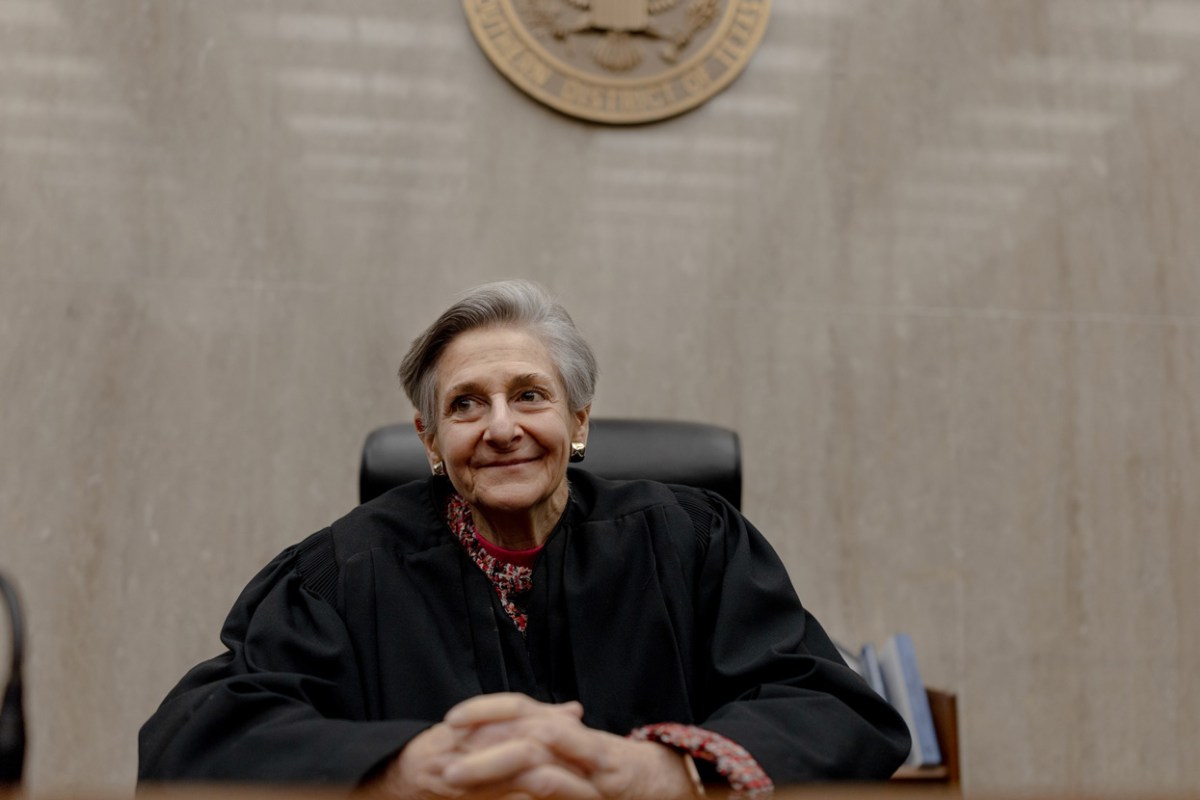
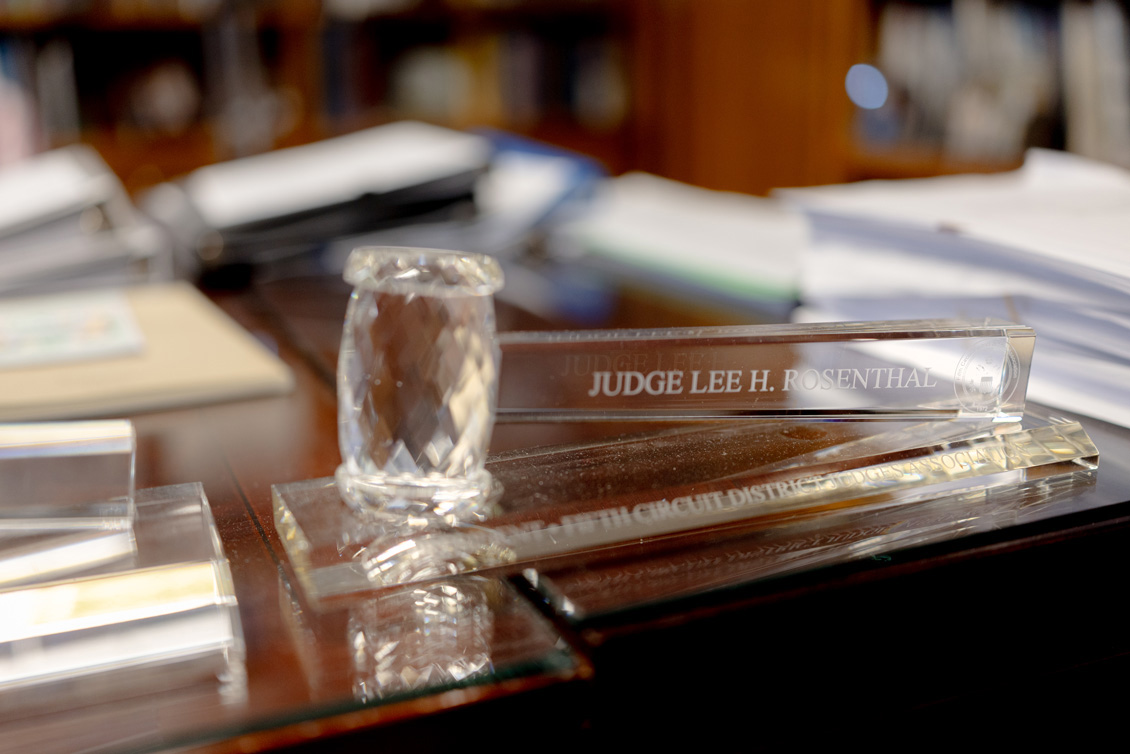
If you were to ask people in legal circles to name the best judge currently serving on the federal bench, a few names would come up. One of them would likely be Lee Rosenthal, who’s been a district judge in Houston since 1992.
Law professors, former federal judges, local criminal defense attorneys, and former Rosenthal law clerks the Landing interviewed for a story about the judge taking senior status said she has a reputation for fairness and impartiality.
“She’s extremely well-respected and well-regarded in the community,” said Josh Blackman, a professor at South Texas College of Law Houston.
Statements by Blackman and others are backed up by biannual surveys of Houston-area judges conducted by the city’s bar association. Over the years, attorneys who complete them have consistently given Rosenthal “excellent” marks for, among other things, decisive and timely rulings and preparedness.
While Rosenthal is by no means hanging up her black robes — she plans to continue hearing a full complement of cases for the time being — we thought the judge’s designation change presented an opportunity to get to know her better. The following Q&A was lightly edited for clarity.
Thank you for taking the time out of your busy schedule to talk with us. What sets the Southern District of Texas apart from other district court systems around the country? Is there something that is particularly unique to this district, as opposed to others, or the types of cases that you hear?
Yes, I think that there is. I think we have the best caseload in the country, particularly in the Houston division, because we are a border court. We have a seven-division district. That’s a very large district, and our district covers a very large amount of territory. And as you can imagine, the caseload in each division is not the same as the caseload in every other division. So Houston, big city, third or fourth largest city in the country, incredibly diverse, big port, lots of big employers, a lot of oil and gas, a lot of banking, and the medical center generates a lot of interesting litigation. We have a rich docket. (It’s) a very, very varied docket. The divisions that are along the border have a much higher percentage of criminal cases, as you might imagine.
And we have a large immigration docket in Houston. The immigration side of the dockets along the border in those divisions is, as you would imagine, much higher. So, the caseloads are different. It’s unusual to have a district in which the caseloads vary so much depending on which division you are in in the district. It’s unusual to have such a large district, and it’s unusual to have a district that has such a variety of different kinds of locations within the district.
What’s your one favorite thing about being a federal judge?
That’s a really good question. I think it would be … it’s the combination of having really interesting issues, legal issues that come up. We’re dealing with the same questions of law that the Court of Appeals gets. But we have the added advantage because we get the people, we get direct interactions with people on both the criminal and civil sides of the docket. So, we really do see who’s going to be impacted, directly, by what we do. And when people are in court before you, you learn a whole lot about them. It’s fascinating. And the legal issues are great in this area. Given the varied nature of our docket, we are often dealing with issues that have no clear answer.
So, it is both intellectually interesting, it’s interesting in terms of the different kinds of people you meet and the stories they tell you. Stories they wouldn’t share with most people, but in this unique setting in which they have to tell me things about their lives, their business, and what they’ve done… it makes it fascinating. And before you ask me what my favorite kind of case is, it’s really hard to pick, because when you have to be right in deciding an issue or a case, they all get pretty interesting.
Can you describe what one needs to do to become a federal judge? Do you have to submit your name for consideration, and what does that process look like?
Everybody who is on the federal bench has a different story about how they got there. There used to be a television show way back in the mists of time in which the line was, ‘There are 1000 stories in the Naked City. This is one of them.’ Every judge has that kind of story, and it’s a combination of a process that is interesting because you really don’t have much control over whether or when. Most people, they’re lawyers. They’re working at some position in the law. A lot of people who become federal judges do so through political activities since it is a process that involves political figures. So, in order to be nominated, you have to have the support of a senator, and then you have to be able to make it through the confirmation process and the scrutiny that it brings. So, a lot of people come to the attention of the senator who nominates or recommends them to the White House by doing political activities.
I did not do any of that. I had four kids, as I said, and they were all young, and I was trying to make partner and then I made partner, and that brought additional challenges. I had no time to attend political activities or participate in them. I was very lucky. What was then called in 1992 the “Biden Bill,” because, at the time, then-Senator Biden was the head of the Senate Judiciary Committee. In order to address the problems of cost and delay in the civil side of the federal court docket, the bill provided for additional judgeships. We are now seeing another bill being considered for the same purpose that would give our court badly needed additional judgeships. But at the time, five new judgeships were created, and because there were five that had to be filled at the same time, that created an opportunity for somebody who didn’t have the usual political credentials to be considered. And I was very lucky to be able to get that slot.
You first moved to Houston when your dad got a job at Rice University, where he and your mom worked for many years. Do you remember what Houston was like back then?
I had been in a small high school in a university town in downstate Illinois. And then I came to Houston, which is huge, really hot, and I was at Bellaire High School for one year. I came in as a senior, and Bellaire High School was about 1000 times larger than the school that I had been attending before. So it was a huge change. Houston, I remember as being just sprawling, endlessly sprawling. Although I do remember when the Galleria opened and going up the escalator at Neiman’s, which was a huge field trip and an exciting new development in Houston. And it was the outer edge of the city at that time. There really wasn’t that much that I remember beyond it. There probably was, but not, certainly not the way it is now.
What makes Houston so unique? What’s your opinion of what makes Houston so unique?
Diversity, and the willingness of the city to embrace newcomers. The city really does reward people who don’t have connections here, are new, didn’t come from money, didn’t come from connections that might exist if you were born and bred. It’s wide open. If you can do whatever work it is you choose to do well, you’ve got opportunities here. And that makes Houston, I think, quite special. And with the energy provided by the energy sector, the medical center, and all of the different businesses that make up the Houston economy, from large to small, the place is just buzzing. And that’s exciting. To watch that grow, and grow, and grow, at the same time that the city became more and more diverse, with waves of people coming in from all over the world… it’s a terrific city. It is just a terrific place to live, and it’s an easy city for people to get around.
The traffic — everyone complains about the traffic. But for people who are balancing the demands of work, the demands of family, and trying just to make it through an average day… you get in your car, you get to where you want to go, and then it makes it a much more convenient place for you to get what you need to get done, done. And for me, that was a huge advantage. I had four young children. I was working here. Before that, I was a partner at a large law firm. My oldest daughter is special needs. My youngest two are twins. So, there are years in which the day, the part of the day before I actually got to work, is really quite fuzzy. But Houston made it much easier to do than it would have been in most large cities that afford comparable professional opportunities.
I read in a New York University interview that you were pregnant with your twins when you met with then-Texas Senator William “Phil” Graham. You sort of waddled into the room, sat down on the couch, and interviewed with him.
I was very pregnant. (laughs) Usually, he would interview people in Washington, but I couldn’t get on a plane at that point. So, he very graciously allowed me to waddle into his office, somehow get on his couch, and even more mysteriously, get up again. It was very kind of him.
What do you love most about Houston?
The people. Definitely the people. It’s just a welcoming place, and there are so many interesting people doing all sorts of different things in this city. It makes it a real pleasure.

