

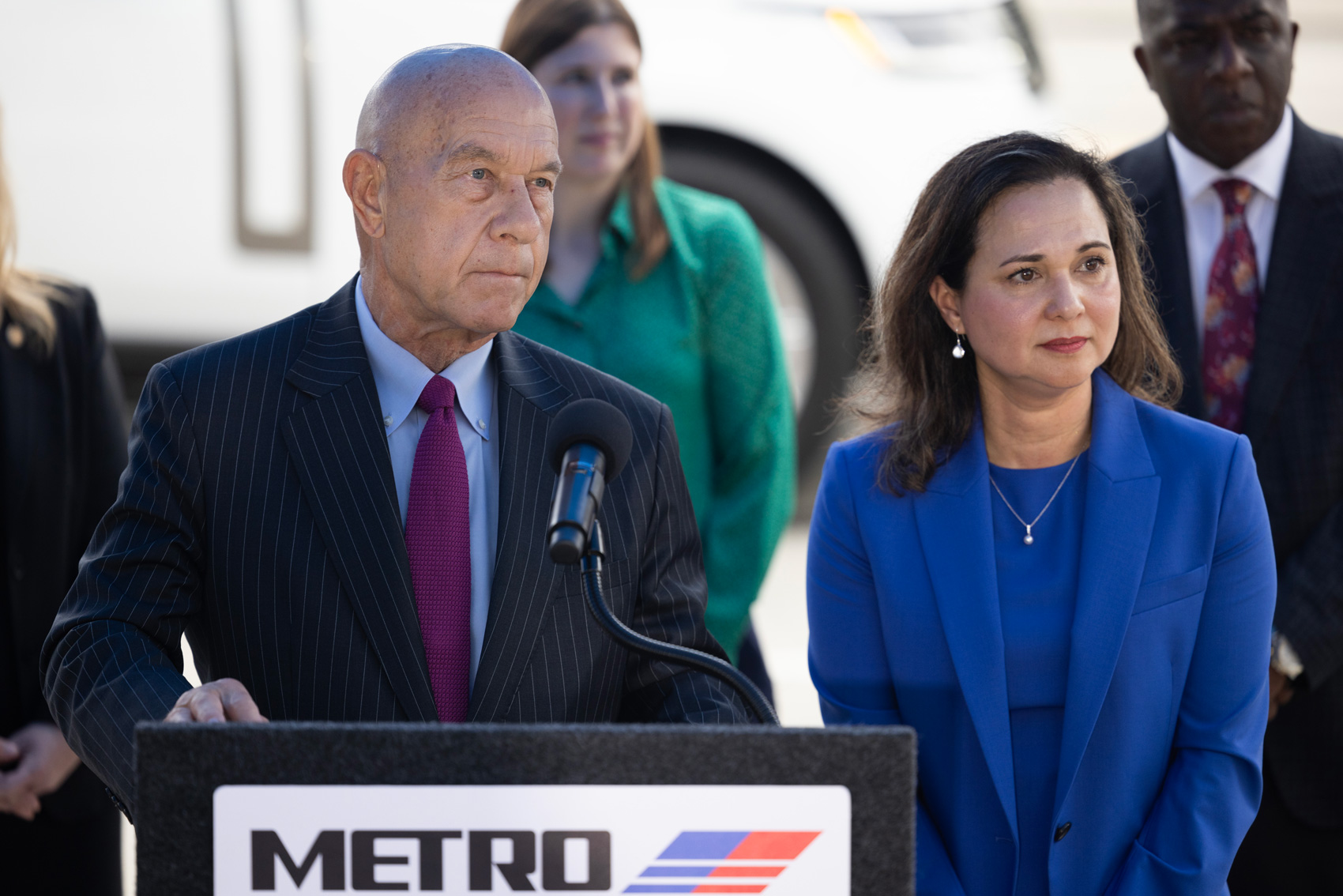
The Metropolitan Transit Authority unveiled new details Monday on its MetroNow initiative, the seeming replacement for the voter-approved MetroNext plan.
MetroNow first was announced as part of budget discussions for fiscal 2025 when the agency announced it would be investing $33.6 million of its operating budget and $173.8 million of its capital budget toward initiatives that focus on the customer experience. At the same time, the agency announced cutbacks in plans associated with MetroNext.
Those initiatives now have coalesced into a broader plan with a stated focus on increasing ridership and improving the customer experience. At a launch event for Metro’s new direction on Monday, agency leaders discussed safety, cleanliness, reliability and accessibility.
“We are calling this set of initiatives MetroNow because before we develop anything else, we are going to take care of some crucial issues, fundamental issues now,” Metro board Chair Elizabeth Gonzalez Brock said.
Those focuses square with what advocates say are fundamentals of an effective transit system, but the details will be key, one advocate said Monday.
“We want to make sure that all of those things are implemented in a way that truly prioritizes riders and uses Metro funds to serve their customers,” said Peter Eccles, director of policy and planning for transit advocacy group LINK Houston.
RELATED: Metro adopts budget focused more on customer experience and service, less on expansion
Ridership, according to Eccles, already had reached pre-pandemic levels across the bus and rail system as of last October. In December, the agency reported approximately 19.4 million boardings across its fixed-route system.
Still, Brock found comparisons to pre-pandemic ridership lacking.
“The reality is we’ve grown, and we need to be making an assessment that informs us about what we need today,” she said.
To that end, the agency will be contracting with an outside firm to audit Metro’s performance and how best the agency can use its resources. The details of that audit will be announced in the next three to six months.
A major focus of MetroNow is on public safety, and Brock spoke about increasing the number of officers in the Metro Police Department. Other measures include utilizing drone technology along with upgrading and replacing security cameras.
“We understand when you do not feel safe, you will not ride Metro,” Brock said during her remarks.
Public safety on the transit system isn’t just about boosting police presence on transit or at bus stops and train stations, Eccles said.
“It’s not just safety on board buses and trains, but feeling safe crossing a busy thoroughfare,” he said. That includes bus stops with better lighting and streets with traffic-calming measures and safe crosswalks.
Brock announced a bevy of investments in partnership with other entities around the region, including $10 million to Mayor John Whitmire’s homeless initiative.
Other investments announced by Brock include $100 million in major thoroughfare improvements, including sidewalks and crosswalks, with Harris County Precinct 3, a $200 million traffic relief plan for the Inner Katy freeway in partnership with the Texas Department of Transportation and the city of Houston, and $300 million on a Gulfton revitalization project in conjunction with the city and Harris County Precinct 4.
Both Inner Katy and Gulfton originally were slated for bus rapid transit lines as part of MetroNext, but changes will be coming. Gulfton still could include a BRT component, but the agency is relying heavily on community input via Harris County Precinct 4 Commissioner Lesley Briones’ office on what its involvement in a revitalization project would look like.
The same cannot be said for the Inner Katy project, which Brock said largely will be driven by TxDOT’s design of the managed lanes project. As part of Metro’s budget last fall, the Inner Katy project was referred to as a high occupancy vehicle, or HOV, project.
“We’re having to work around (TxDOT’s design), but we’re also desperately prioritizing direct access into downtown,” Brock said.
EARLIER: Need to get somewhere in Houston on time via Metro bus? Good luck with that.
Despite the changes in terminology and planning, Eccles said he was encouraged that parts of the voter-approved MetroNext plan remain in the planning process for the transit agency.
MetroNext was a plan that previous agency leadership said would drastically change public transit in Houston, including the development of three BRT routes and multiple BOOST corridors. In 2019, voters approved $3.5 billion in bonds for the initiative, none of which have been sold.
After Whitmire took office and appointed Brock and other new board members, the transit agency shelved plans for the University BRT line and altered plans for the other two. Instead, the agency has focused largely on public safety and being more frugal with tax dollars.
“A lot of key components of MetroNext are still moving along,” he said, pointing at the development of BOOST routes – a program to improve sidewalks, bus shelters, and accessibility along certain high-ridership routes. “Some version of a project in Gulfton and Inner Katy were also key parts of MetroNext, and that seems to be moving forward.”
During her remarks, Brock pointed out that more than 700,000 commuters travel to Houston every day from other regions, and that Metro wants to focus on improving access into downtown. That includes prioritizing direct routes from Hobby and Bush Intercontinental airports to downtown and the George R. Brown Convention Center.
Focusing on moving people into downtown makes sense to Eccles, as it remains the single biggest destination for riders on the system. Details of how that downtown movement occurs would be key, he said.
“Are we moving people on transit? Are we making transit attractive?” Eccles asked. “I think we’re all curious to see, what are the details of this Inner Katy project.”
During their remarks, both Brock and Whitmire talked about Metro’s responsibility to repair roads due to damage caused by buses. Eccles pushed back on that, saying that Metro resources should go toward benefiting Metro customers.
“Metro is taking a greater role at improving the pavement immediately around bus stops. I think that makes sense,” Eccles said, emphasizing that most of the damage done by buses occurs near bus stops. “The responsibility of Metro to be repaving entire streets, that’s less clear to me.”
Metro invests in street projects every year through the General Mobility Program, which started in 1988. As part of the program, the agency diverts roughly a quarter of its sales tax revenue to member municipalities for street improvements and other mobility projects. In fiscal 2025, that amount was $217.5 million.

