

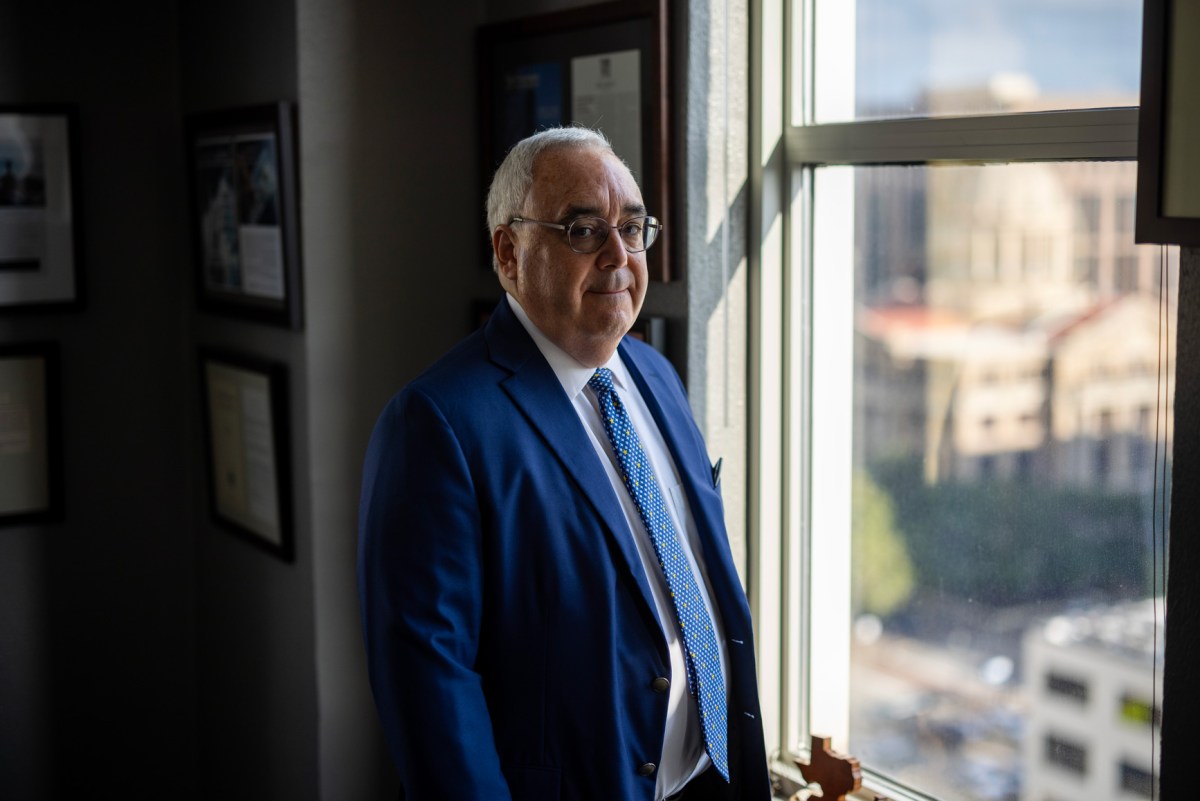
Amid pushback against its multi-million dollar budget cut to the Harris County District Attorney’s Office, Harris County Commissioners Court quietly increased funding last month for a different justice system agency: the Harris County Public Defender’s Office.
Public defenders provide legal representation to criminal defendants who cannot afford a lawyer, called “indigent” in the justice system. In its budget for the new fiscal year, Commissioners Court allocated $13 million in additional funds to the office — the latest step in an aggressive, multi-year expansion that has seen the public defender’s budget explode by a whopping 419 percent since 2019.
However, despite the infusion of funds, Chief Public Defender Alex Bunin says his office is unlikely to meet the county’s goal for public defenders: to handle half of all indigent cases by the end of 2025. The reason? Even as the public defender’s office has grown, so too has the county’s need for criminal defense — so quickly, in fact, that Bunin’s office has been unable to keep pace.
“If you just make a pie out of all the cases filed in Harris County, that pie has been growing” since the public defender’s office started taking clients in 2011, said Bunin at a budget hearing last month. “So, while we’ve increased the number of cases substantially that we handle, our percentage of cases has not been able to keep up.”
Between 2019 and 2023, the number of Harris County’s new indigent cases jumped by 22 percent, according to county data. So, while the number of cases represented by public defenders more than doubled in that time frame, its share of the total caseload has stalled around 15 percent. Private, court-appointed lawyers handle the remainder of cases.
According to Bunin, a “realistic” target for his agency within the next year would be to take on about a quarter of Harris County’s indigent cases, with the goal of reaching half within five years as new hires join and develop their skills.
“If everything were to go perfect… we could get to the potential to get to 50 percent,” Bunin said. “In other words, we could probably get close to hiring enough people — but that potential will not be actualized until all those people are at a point where they can take enough felony cases to meet (a full) caseload.”
Daniel Ramos, executive director of the Harris County Office of Management and Budget, said the growth at the public defender’s office, which far outpaces most other county agencies, was necessary to keep pace with demand.
“We would have spent that money anyway,” he said. “We are constitutionally mandated to pay for representation for (indigent) people. We are making a policy choice to do it through the public defender.”
In a statement to the Landing, Precinct 1 Commissioner Rodney Ellis stood by that policy choice, but acknowledged that meeting the county’s goal would be challenging for the public defender’s office.
“Representation by a well-funded and high-quality public defender office remains the most important tool we have to provide indigent representation and ensure all people receive equal justice under the law,” he said. “The timeline for this work may shift because of the inherent challenges that come with breaking down an entrenched system with limited resources, but we cannot and will not lose sight of our goals or our commitment to equal justice, fair defense, and due process for all people in Harris County.”
Likewise, Precinct 4 Commissioner Lesley Briones told the Landing in a statement that the delay would not compromise the mission of the expansion.
“We look forward to working with the public defender’s office to ensure they achieve all goals set by Commissioners Court and do so in a manner that maximizes justice and public dollars,” she said.

‘Unjust and unsustainable’
The pressure on the public defender’s office to increase its share of indigent cases stems from a simple calculus: they provide better legal representation to the poor than private, court-appointed lawyers, according to advocates for the expansion.
For example, a 2020 study commissioned by Harris County suggested defendants see better outcomes when public defenders are involved.
Public defenders, the study found, were more likely than court-appointed lawyers to take their clients’ felony cases to trial, and they were more likely to win; they were also more likely to get their clients’ cases dismissed.
“A larger percentage of the (public defenders’) felony defendants exit the system without a record or penalty for the charge(s) than other counsel types,” the study’s authors wrote.
However, with public defenders handling less than one in five of Harris County’s indigent cases, commissioners and community advocates have raised concerns that the poor face uneven access to justice.
“Everyone deserves equal protection under the law when their freedom is on the line,” Ellis said. “Our current appointment-based system is unjust and unsustainable.”
A key concern expressed by Ellis and others is that private attorneys appointed by the courts and funded by taxpayers face little quality control or regulation, allowing lawyers to take on unmanageable caseloads that boost their earnings.
For example, data compiled by the Harris County Auditor shows more than 16 percent of private, court-appointed lawyers working in Harris County took on indigent caseloads in excess of state recommendations in 2023. One lawyer, Kelly Benavides, resolved 570 felonies and 248 misdemeanors last year — and indicated that that work consumed less than two-thirds of her time. Benavides did not reply to a request for comment.
“Our recommended caseloads say that 5.5 people should be doing that work for 100 percent of their time,” said Joel Lieurance, a senior policy analyst with the Texas Indigent Defense Commission, which monitors defense for the poor statewide.
The caseload data did not come as a surprise to RoShawn Evans, organizing director for Pure Justice, a Houston-based nonprofit that advocates for equity in the criminal justice system. Evans said because court-appointed lawyers are financially incentivized to take as many cases as possible, they wind up with little time to provide quality representation.
“I have people calling Pure Justice regularly because they don’t know who their lawyer is… or they know who the lawyer is and can’t get in contact with them,” said Evans.
Harris County public defenders, meanwhile, adhere to strict caseload standards aligned with guidelines issued by the Texas Indigent Defense Commission, according to Bunin.
“There’s only so many hours in the day,” said Bunin. “A lawyer can’t do a good job if they have too many cases.”
‘There’s nobody else’
However, not everyone agrees the court-appointed system is a problem — or even that an expanded public defender’s office is necessary.
For Joe Vinas, president of the Harris County Criminal Lawyers Association, the sheer need for indigent defense that has kept the public defender’s office busy is reason alone to maintain the private, court-appointed system.
“We just have a shortage (of lawyers), especially when you get to the higher level — your capital murder-eligible lawyers, your first degree (felony)-eligible lawyers, especially when you’re talking about Spanish speakers,” Vinas said. “The courts contact these lawyers and ask them to take these cases. They would not do that if there wasn’t a need, and there’s nobody else to fulfill that need.”
In Vinas’ view, the steep caseload numbers documented by the county auditor are misleading — instead of abuse, they represent an overwhelmed justice system short on qualified lawyers.
“Not all lawyers are created the same,” he said. “Not all cases are the same. If you have somebody who just handles (low-level) felony drug cases, a seasoned lawyer could handle way more of those… than somebody who’s got child sexual abuse cases or murder cases. When you compare caseloads and you compare lawyers, it’s not an apples-to-apples comparison.”
Vinas, who earned about $250,000 in 2023 on an indigent defense caseload well within the state’s recommended guidelines, also said that enlarging the public defender’s office would deny indigent defendants representation by the “extraordinarily talented people” who work in private criminal defense in Harris County.
“The more you expand the public defender’s office, the more you cut them out of cases,” said Vinas. “These people who are charged with crimes right now have access to some of the best lawyers around.”

