

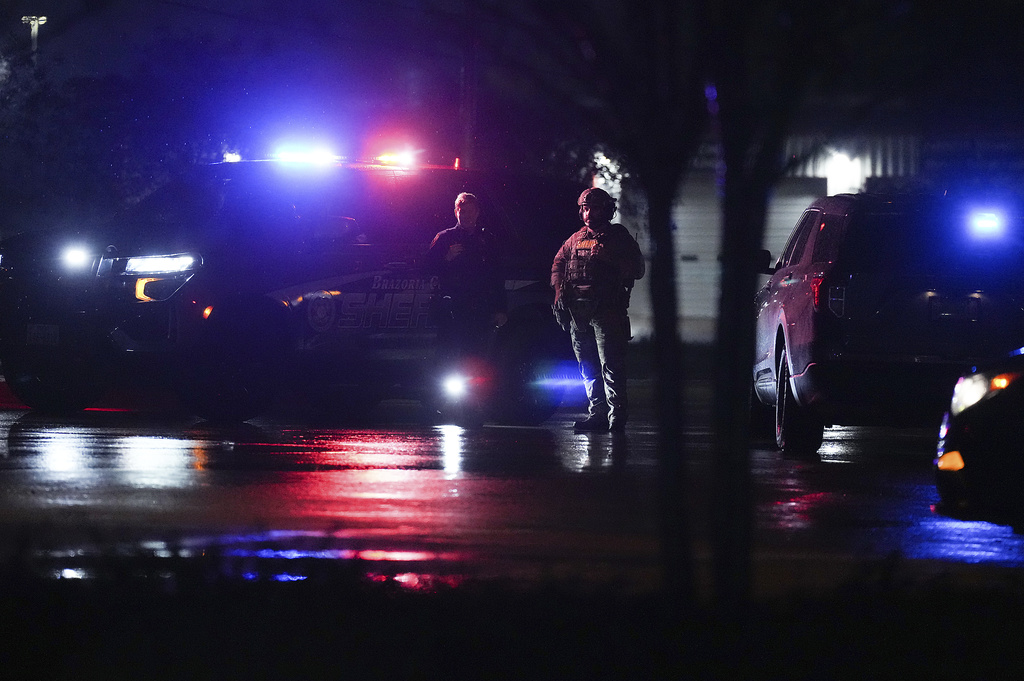
At least three Houston-area law enforcement agencies have canceled their upcoming classes with a private police training company recently investigated for promoting discriminatory and unconstitutional policing tactics, a probe that drew attention to the minimal oversight of such organizations.
The Brazoria County Sheriff’s Office, as well as the Katy and Jersey Village police departments, confirmed to the Houston Landing that they will not host Street Cop Training in the coming months after learning about a New Jersey government report that documented instructors teaching inappropriate classes there in 2021. The agencies originally planned to partner with Street Cop Training for classes on various policing practices, with officers in attendance receiving credit toward state-mandated training requirements.
In their report, published earlier this month, New Jersey comptroller’s office investigators documented multiple disturbing statements by Street Cop Training officials. One instructor used a meme of a monkey while discussing the arrest of a 75-year-old Black man, according to the investigative report. Another described “eye f—ing” female drivers during motor vehicle stops. Street Cop Training instructors also advised officers to stop motorists “for no reason” and illegally prolong stops.
“We don’t want to put out that bad publicity and (have) our name associated with it,” Jersey Village Police Lt. Danny Keele said.
The reversal by local law enforcement agencies spotlights the nominal federal and state regulation of private police training agencies, which are subject to virtually no government review. Most Texas law enforcement officers must take at least 40 hours of training every two years, including mandated courses on responding to active shooters and new laws passed by the state Legislature, among others.
The Texas Commission on Law Enforcement, or TCOLE, which regulates policing statewide, relies on local law enforcement agencies to vet companies like Street Cop Training and decide whether their courses are eligible for required continuing education credit. TCOLE audits private training companies only in response to complaints, and then only when the company’s courses have been submitted for credit by a law enforcement agency.
“With over 2.8 million officer credit hours (in Texas) per year, it’s nigh impossible for us to review every bit of that,” said Gretchen Grigsby, TCOLE’s director of government relations.
Michael Sierra-Arévalo, an assistant professor of sociology at the University of Texas at Austin who studies police culture and behavior, described private training as an “utterly unregulated” space that allows instructors to “kind of say whatever (they) want to say.”
“It’s all operating with the veneer of expertise and legitimacy, but really, once you dig on it, it’s a house of cards,” Sierra-Arévalo said.
Street Cop Training did not respond to the Landing’s request for comment. However, in a video addressing the report, founder Dennis Benigno said his company conducts diversity, equity and inclusion and sensitivity training, and it has implemented “quality control measures” since 2021 to “foster a cooperative environment” at the organization.
“I personally take responsibility and apologize for any inappropriate or offensive language that was used by a few of our instructors in the 2021 training session that was the sole focus of this report,” he said. “We do important work, and there is no place for demeaning, harassing or hateful words or jokes in our training.”
Reputation on the mind
When New Jersey officials published their report earlier this month, Street Cop Training was scheduled to provide eight sessions for five Houston-area agencies in 2024: the Brazoria County Sheriff’s Office, and the Bellaire, Katy, Jersey Village and Texas City police departments.
The Brazoria County Sheriff’s Office was set to host trainings on Texas case law and “effective policing skills and tactics.” Officers in Katy were scheduled to learn about “body language for law enforcement” and “recognizing pre-attack indicators,” while Jersey Village’s training would have addressed “identifying criminal vehicles and occupants.” The Katy and Jersey Village police departments had previously used Street Cop Training.
Keele said he attended a Street Cop Training course on patrol tactics earlier this year and found it “very professional.” But, he added, videos from the 2021 conference published by the New Jersey comptroller “didn’t look good.”
Bellaire Police Chief Onesimo Lopez, whose agency has also hosted Street Cop Training in the past, said his administration is reviewing its relationship with the company. The department is scheduled to host a training on “legal use of force for the law enforcement professional” in January.
“We, of course, want to make sure that anything that has the Bellaire name on it is in keeping with best practices,” Lopez said. “And if we feel that it is not, then of course it’s not the kind of thing we would host.”
Texas City police officials, who are scheduled to host a class on “fundamentals of report writing” in June, did not respond to a request for comment. The four agencies that commented to the Landing said they were under no financial obligation to Street Cop Training if they canceled classes.
Not much support
Like many states, Texas provides little help to local police agencies tasked with facilitating educational courses. Texas offers no uniform vetting guidelines or standards that law enforcement agencies must observe when deciding whether to host a private training group.
Most states, including Texas, also lack a regulatory entity for evaluating companies, said Mike Becar, executive director of the International Association of Directors of Law Enforcement Standards and Training, or IADLEST.
“Things are being taught that are not legal, or they’re racist, or they’re discriminatory, or they’re warrior-type training that makes officers afraid to make a stop without 15 backups,” Becar said.
Becar’s organization offers a national certification program for law enforcement training, which he said is needed given that most states don’t have the staff, time or expertise to adequately review police instruction. About 200 individual instructors are certified through IADLEST. One of Street Cop Training’s 21 instructors listed on its website has received IADLEST certification.
In New Jersey’s report on Street Cop Training, the state comptroller raised the alarm over possible consequences of the state’s failure to monitor such companies.
“The costs of attendance for training like this (are) small in comparison to the potential liability for lawsuits involving excessive force, unlawful searches and seizures, and harassment and discrimination,” the comptroller wrote.
Sierra-Arévalo, who attended the 2021 conference in Atlantic City that drew the attention of the New Jersey comptroller, expressed similar concerns. Street Cop Training, he said, often promotes a hard-charging “enforcer” attitude toward policing that can be problematic.
“This is one thing where you would actually want the state to really own this and do it really well and have it be really transparent,” he said. “But instead … we are not providing the infrastructure for police to do real evidence-based, transparent, research-informed training.”

