
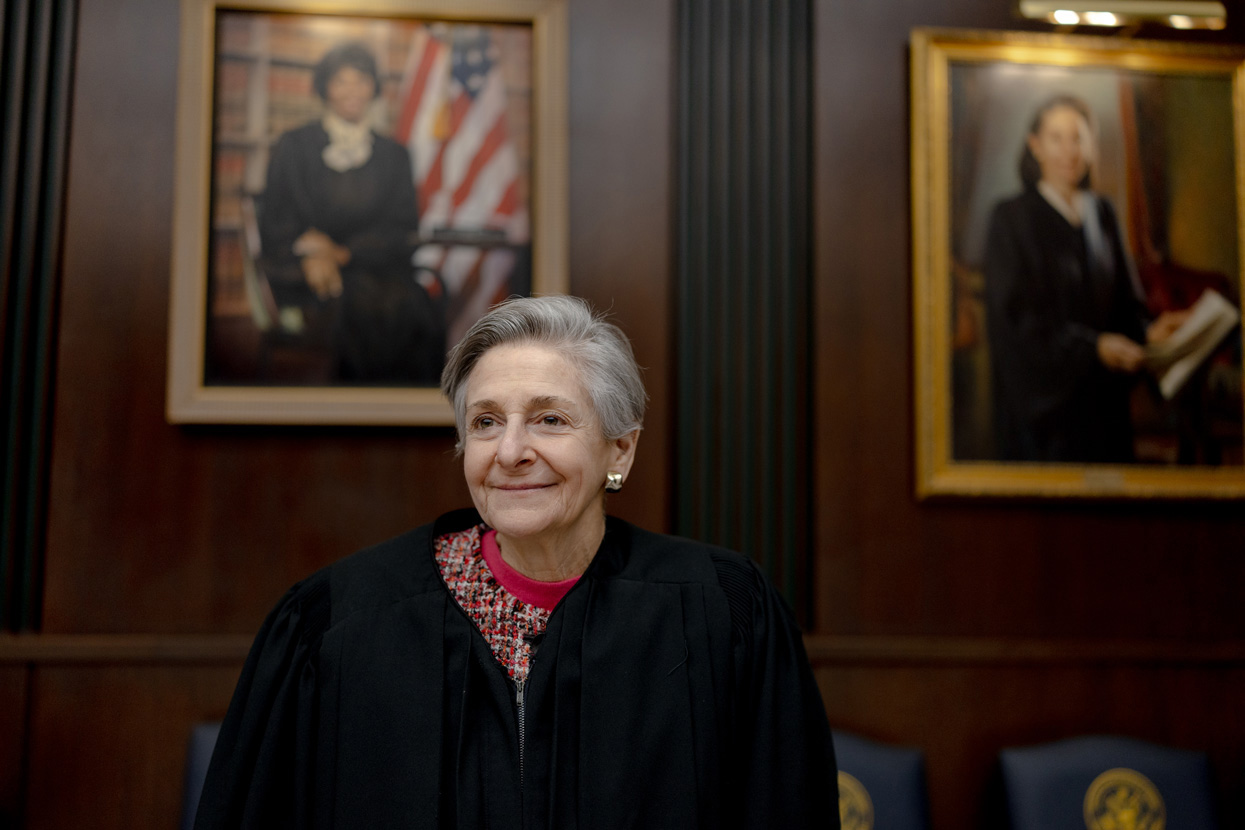

When federal judges take senior status, they typically offload a portion of their cases onto other judges.
But Houston-based U.S. District Court Judge Lee Rosenthal says she has no intention of doing that – at least not until her replacement is named and confirmed by the Senate.
Rosenthal, appointed by President H.W. Bush in 1992, took senior status on Sunday, creating a vacancy for President-elect Donald J. Trump to fill. She announced her intention to assume the status in September.
Senior judges, who must be at least 65 years old and have served for at least 15 years on the bench, can decide the types of cases they handle and how many. But for the time being, Rosenthal will continue hearing a full compliment.
“I like what I do very much, and I like the variety of what I do,” Rosenthal said in an interview.
U.S. District Court Judge Andrew Hanen, who also plans to assume senior status in January, declined an interview request from the Houston Landing.
Rosenthal, who turned 72 on Saturday, is consistently rated among Houston’s top federal judges, who preside over everything from drug violations to constitutional challenges. In polls conducted by the Houston Bar Association, Rosenthal receives high marks for her timely rulings, courteousness, impartiality, and preparedness.
David Levi, a former dean of Duke Law School and a former federal judge who is a friend and colleague of Rosenthal’s, described the Richmond, Indiana native as a consummate judge before whom lawyers are eager to appear.
“There’s a sense of calm people have when she is in charge because they know they will get their chance (to be heard),” Levi said. “She’s not going to shut them down or out.”
Houston criminal defense attorney Charles Flood estimates he has had 20 cases before Rosenthal since he gained admission to the Houston division of the Southern District of Texas in 1997, including three or four jury trials. He described the judge as “exceptionally fair,” “intellectually curious,” and “intellectually confident.”
“She’s tough on the government, she’s tough on the defense, and when it comes to sentencing, she’s fair and compassionate,” Flood said. “She doesn’t ever let her opinion get in the way of what the legal thing to do is, which is really hard.”
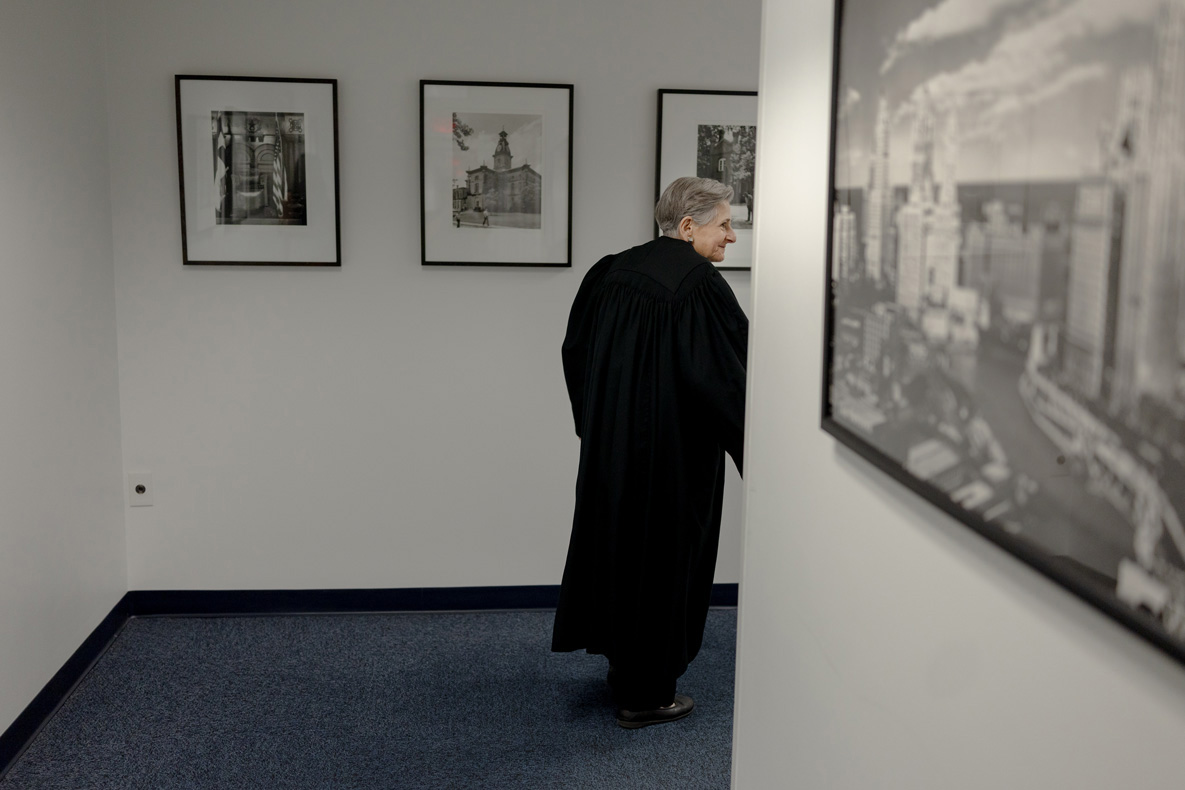
Catherine Bratic, an international arbitration attorney at Hogan Lovells who clerked for Rosenthal, said the judge is widely considered to be one of the best in the country.
“When you start to talk about clerkships and who is the most respected district judge in the country, who were the best ones to work for, her name was always at the top of those lists,” Bratic said.
Bratic said Rosenthal told her and other law clerks, who help judges review pleadings and draft opinions, that taking senior status was a way for Texas’ Southern District to get an extra set of hands.
The district, which spans 43 counties and includes Houston, Galveston, Victoria, Corpus Christi, Brownsville, McAllen, and Laredo, has 575 weighted filings per judgeship and 770 pending cases per judgeship. According to fiscal 2024 data, only 20 of the 93 district courts in the country have more weighted case filings per authorized judgeship.
Rosenthal, who served as chief judge of Texas’ Southern District from 2016 to 2022, said the district needs at least three if not four, additional district judges to handle the current caseload, which she anticipates will only rise as the area’s population continues to grow.
Her vacancy joins the two created when Houston Judge Lynn Hughes and McAllen Judge Micaela Alvarez took senior status in February 2023 and June 2023, respectively.
The United States Judicial Conference considers Hughes’ vacancy an emergency because so much time has passed without a replacement. By the time Hanen will assume senior status on January 2, Texas’ Southern District will have four vacancies for President-elect Trump to fill.
In addition to serving as a district court judge for what will be 33 years in May, Rosenthal is a visiting judge who sits on the Ninth Circuit Court of Appeals once a year, in large part to help with the appellate court’s backlog of immigration cases. Rosenthal has previously sat with the Second, Third and Fifth Circuit Courts of Appeals.
“She likes to sign up for extra work,” Bratic said with a laugh.
Rosenthal is also well-known in legal circles for chairing two committees that create and amend the rules governing federal courts. In 2003, then-U.S. Supreme Court Justice William Rehnquist appointed Rosenthal as chair of the Judicial Conference Advisory Committee on Civil Rules. She was appointed in 2007 to the Committee on Rules of Practice and Procedure by current Supreme Court Chief Justice John Roberts.
“I know that might sound boring to a non-lawyer, but the rules of procedure really define how the courts operate and I think it’s significant that Chief Justice Roberts trusted Judge Rosenthal to supervise all those matters,” said Josh Blackman, a law professor at the South Texas College of Law Houston.
Rosenthal called serving on the committees one of the most rewarding parts of her judicial career.
“It restores your faith in a real deliberative process in which people check their six-shooters at the door and come in, not trying to put a thumb on anybody’s scale. Not trying to advantage a particular group or disadvantage some group, but really trying to figure out collectively, what’s going to make the system better all over, all around,” Rosenthal said.
The Biden Bill
Rosenthal was born in Richmond, Indiana, in 1952 and moved frequently as a child since her father was a history professor. When she was 15, Rosenthal and her family came to Houston, where she completed her senior year at Bellaire High School. Rosenthal said the school was considerably larger than the one she previously attended in downstate Illinois. She also remembers the heat and how Houston was “endlessly sprawling” even then. Rosenthal’s parents both worked at Rice University for much of their careers.
Rosenthal went on to receive undergraduate and law degrees from the University of Chicago and then clerked for John R. Brown of the Fifth Circuit Court of Appeals, who played an important role in decisions that enforced desegregation during the Civil Rights Movement.

Upon moving back to Houston, Rosenthal took a job as an attorney at Baker Botts, where she worked for 14 years until she was nominated to the federal bench in 1992. Rosenthal’s seat, along with four others in Texas’ Southern District, was created by the Civil Justice Reform Act of 1990, also known as the “Biden Bill,” as President Joe Biden was at the time chair of the committee that confirms federal judges. The bill was the last major expansion of federal court judgeships, according to the Federal Judiciary Center, the federal court system’s educational and research agency.
Rosenthal said she was unlike most other judicial appointees in that she did not have political connections.
“I had four kids, and they were all young, and I was trying to make partner, and then I made partner, and that brought additional challenges,” Rosenthal said. “So, I had no time to attend political activities or participate in them. I was very lucky.”
Unparalleled work ethic
For some judges, clerks can expect to work an eight-hour shift from nine to five. That’s not the case for Rosenthal, at least during the year Bratic clerked for her. Clerking for Rosenthal meant late nights and weekends, and lots of travel when Rosenthal would serve as a visiting judge, Bratic said.
But Bratic knew what she was signing up for. She said Rosenthal was her top choice for whom to clerk for, and the judge is notorious for her work ethic.
“It was a ton of work, but it was a really incredible experience because you were kind of drinking from a fire hose and getting all of these incredible opportunities, even beyond what I would have gotten in a regular clerkship because I was getting the appellate side,” Bratic said.
That work ethic was particularly evident when Rosenthal broke her arm during a hiking accident in South America more than a decade ago, Bratic said. The injury required surgery and lots of bed rest, but Rosenthal continued to work from home and had her staff shuttle papers back and forth. She also attended hearings remotely, Bratic said, noting it was during a time when Zoom was not commonplace.
Bratic also said Rosenthal is known for going through several drafts and rewrites of opinions before she’s satisfied with them. For particularly important cases, she had Bratic and the other clerk at the time write different versions of an opinion.
“It really made me a much better writer, because you felt like through that process, it really did get to be a better-reasoned opinion and a better-drafted opinion,” Bratic said.
Of the rulings Rosenthal has made over the years, she is perhaps best known for her 2017 decisions that found Harris County had violated the constitutional rights of those charged with low-level crimes by charging excessive bail, and that Pasadena had violated the rights of its Latino residents by deliberately diluting the power of their vote. Both were largely upheld by the Fifth Circuit Court of Appeals, which covers Texas, Louisiana and Mississippi.
Bratic said when Rosenthal is preoccupied with a case and can’t sleep, she turns to baking.
“You’d come to the office having, like, worked all night, and somehow, she would have had time to make muffins on top of it. She always made sure we were fed. She’d have muffins, brownies, pie… I’ve never left her chambers without a to-go platter of baked goods,” Bratic said.
‘A judge’s judge’
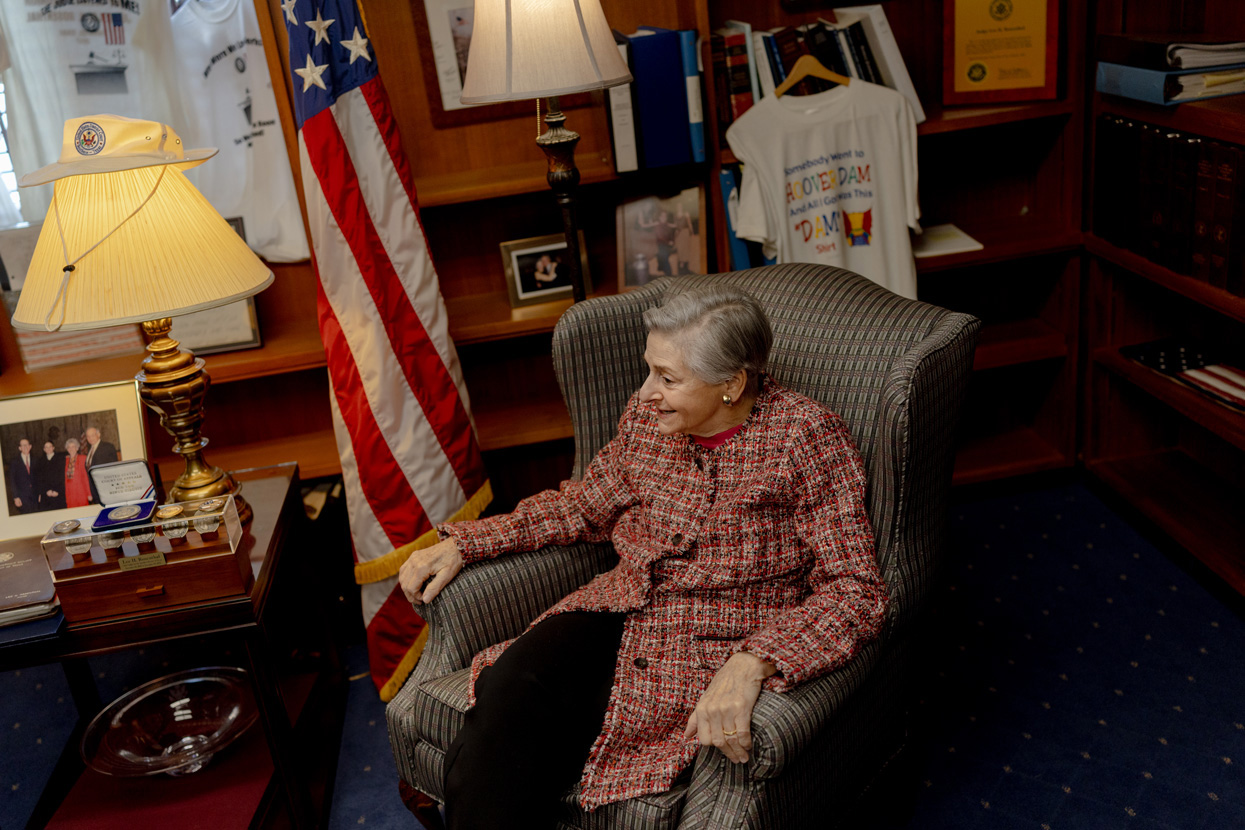
Rosenthal’s office is located in the Bob Casey Federal Courthouse on Rusk Avenue in downtown Houston. The walls are lined with bookshelves filled with innumerable photographs of colleagues, family and friends, tokens of gratitude like T-shirts and coffee mugs from colleagues and former clerks, and binders containing files from old cases.
Blackman, of South Texas College of Law Houston, said Rosenthal routinely visits law schools around the state, often bringing other judges with her.
In addition to being a full-time judge and visiting judge to appellate courts, Rosenthal is the first vice president of the American Law Institute (ALI), a nonprofit that simplifies and clarifies esoteric aspects of the law.
Levi is the president of ALI and said Rosenthal helps guide the organization and is an influential voice in deciding which projects to tackle. Levi added that Rosenthal epitomizes what it means to be a leading figure in the judiciary.
“She’s a judge’s judge. She’s a jewel in the crown of the federal judiciary,” he said.

