

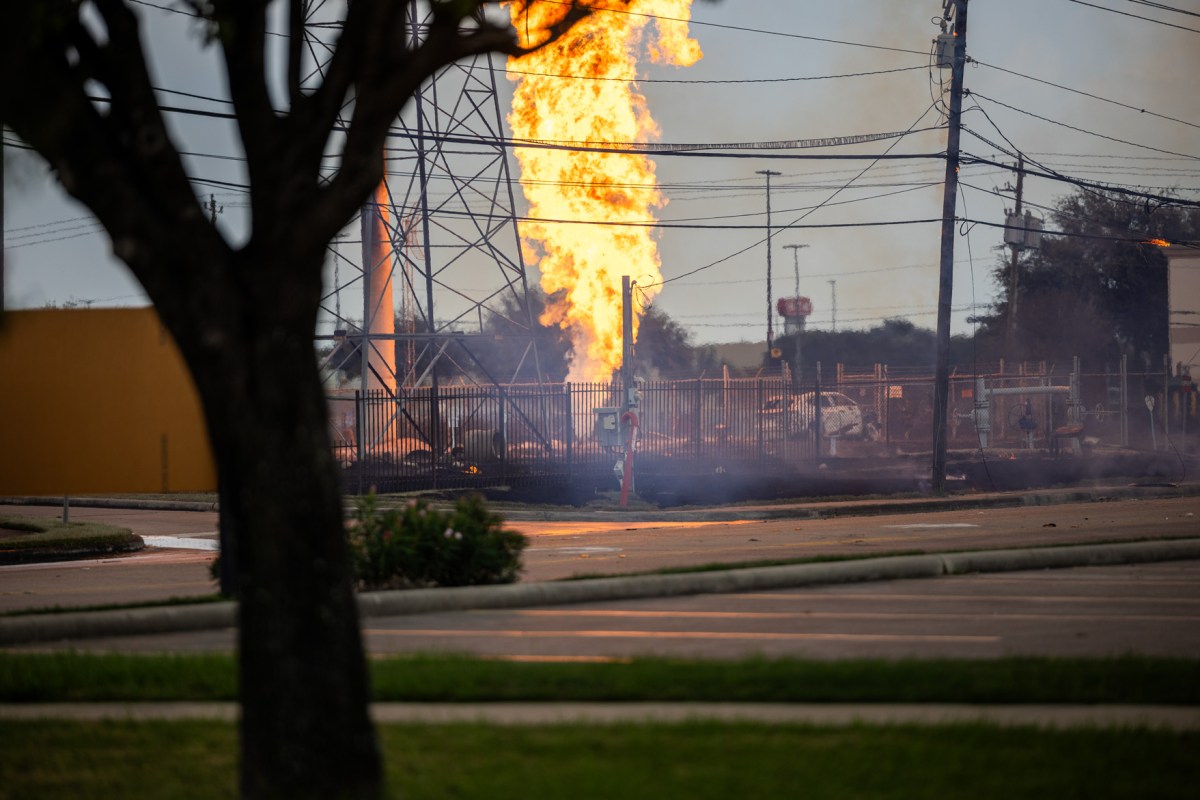
An investigation by Texas regulators into the massive pipeline explosion in Deer Park last fall has found no safety violations by the pipeline’s operator Energy Transfer Company – a determination drawing outrage from people who had to flee their homes during the inferno.
“I’m stunned,” said Brandi Gardner, who said her sense of safety has been shattered by the terror of the pipeline exploding just beyond her family’s backyard. “That valve should have been protected all along with barriers… especially knowing that it was so close to a residential area.”
The investigation report from the Texas Railroad Commission provides little information explaining how the state pipeline safety agency reached its “no violations” conclusion, beyond saying that inspectors met with company officials and reviewed various records. The Railroad Commission did not grant interviews or answer Houston Landing’s questions on Monday.
Energy Transfer’s above-ground pipeline valve carrying natural gas liquids exploded on Sept. 16 and burned for nearly four days after an SUV crashed into it, killing the driver, burning and melting nearby homes, cars and power lines, and forcing the evacuation of hundreds of homes and businesses in Deer Park and La Porte.
Although the pipeline valve was located in a heavily populated area, next to busy Spencer Highway and adjacent to a high-traffic Walmart Supercenter parking lot, it was surrounded with only a chain link fence, archived Google Street View images show.
It is unclear from the Railroad Commission’s vaguely written report how inspectors deemed chain link fencing to have been adequate protection against vehicle strikes. About 25,000 vehicles a day travel that stretch of Spencer Highway.
Bill Caram, executive director of the Pipeline Safety Trust, a national safety advocacy group, said the lack of any violations being cited in the Deer Park explosion illustrates a critical problem with the nation’s pipeline safety laws.

related
Houston has lots of pipelines. Here’s how to locate lines near you and help make them safer.
by Alison Young / Staff Writer
Pipeline safety rules say each valve must be “protected from damage or tampering,” Caram said, but they give operators the latitude to determine how to best achieve the result.
“The code is frustratingly vague about the types of protection operators need to have around valves,” Caram said. “I would have thought that the level of loss and destruction we witnessed was enough proof that Energy Transfer’s efforts fell short of requirements.”
Spokespeople for the Railroad Commission issued a short emailed statement that said in part that the commission thoroughly investigates each incident. But they did not respond to numerous questions about how they assessed the adequacy of the barrier around the pipeline valve and how investigators reached their conclusion that no state or federal safety rules were violated.
“The details of our investigation are what is outlined in the report,” the statement said. Federal pipeline regulators at the Pipeline and Hazardous Materials Safety Administration did not respond to a request for comment.
The Railroad Commission’s report, which appears to have been quietly uploaded into the agency’s online regulatory database on Friday, has just three sentences of findings and contributing factors for the explosion.
The regulatory report cites Energy Transfer’s investigation as determining that the root cause of the pipeline rupture and fire was due to the vehicle crash. The report then notes: “To minimize the possibility of recurrence, [Energy Transfer] added additional concrete barricades (jersey barriers) around the valve site and other similar locations. After records review, no rules violations were cited.”
Energy Transfer, in a brief emailed statement to the Landing, said the company was in compliance with all rules and regulations at the time of the SUV crash and that “there are no required actions to be done before an event that is unforeseeable (an intentional act by a third party).”
The Harris County medical examiner recently ruled that the driver of the SUV that crashed into the pipeline died in an act of suicide. Caram said safety rules require pipelines to be protected against both accidental and intentional damage.
After the pipeline valve exploded last fall, Energy Transfer replaced its previous chain link fence with the concrete barriers. Last year, Energy Transfer told Houston Landing that the installation of the concrete barriers was because of the construction activity and that they “served as a boundary for the construction crews.” At that time the company said it was unclear “if or when they may be removed.”
On Monday evening Energy Transfer said “the barriers will remain.”
The Railroad Commission’s report also says Energy Transfer is installing concrete barriers “at other similar locations,” but neither regulators nor the company answered questions about this, including explaining how they are defining a similar location and how many such sites are receiving concrete barriers.
Beyond Energy Transfer’s exposed pipeline valves, it is unclear whether the Railroad Commission is taking any action to ensure concrete barriers are installed around other above-ground pipeline structures that are located at or near the explosion site and that are owned by other companies.
Houston Landing has previously reported that there are several pipeline valves operated by other companies, including Shell Chemical L.P., that are located next to busy Spencer Highway and that carry flammable and explosive chemicals yet are only protected with chain link fencing. The commission didn’t answer questions about this.
Some residents of Deer Park said there is a disconnect between the recently installed concrete barriers at the explosion site and regulators saying there was no violation of safety rules that require pipeline companies to protect their lines from damage.
“If they didn’t think there was something wrong with the situation, why did they put barriers around the pipeline?” asked Marian Rodriguez, whose home is next to where the explosion occurred. “I think since the get-go there should have been concrete barriers,” she told the Landing on Monday.
While Rodriguez said her home was spared from catching fire by firefighters dousing it with water as the burning gas produced a tower of flames that lasted for days, it suffered significant water damage that insurance will never fully cover. She is still living in temporary housing.
Vincent Gardner, who is Brandi Gardner’s husband, expressed frustration that it seems there is no local, state or federal agency that is trying to help their neighborhood recover or taking action to protect against future pipeline explosions caused by vehicle crashes.
“This is all being swept under the rug. They want this to go away as fast as possible. It’s obvious. They want business to go on as usual,” Vincent Gardner said.
A Houston Landing investigation published in December found there have been at least 36 reported incidents of cars, trucks and other vehicles crashing into above-ground hazardous liquid and gas transmission pipelines across the country since 2019. Twelve of those pipeline crashes occurred in Texas. Those crashes have caused three deaths, more than $21 million in property damage and resulted in evacuations, fires, gas and oil leaks and environmental contamination.
The number of crashes is likely higher because operators don’t have to report incidents where damage is minimal. In many cases, the Landing found that pipelines carrying hazardous and flammable chemicals often had little protection against damage from vehicles driving on nearby roadways and parking lots. Rules let pipeline operators determine what kind of protection their pipelines need, and many that have been hit by vehicles had only a chain link or wooden fence, records show.
“Performance based regulations can be effective if failures are strongly enforced,” Caram said. He noted that if the Texas Railroad Commission had heavily fined Energy Transfer, it would have sent a message to the industry that pipelines need to have adequate protection against damage or tampering.
“The combination of performance-based standards and weak enforcement is the worst scenario for public safety,” Caram said. “I can’t imagine any operator is going to feel like they need to go around protecting their valves and other infrastructure as a result of this failure.”

