


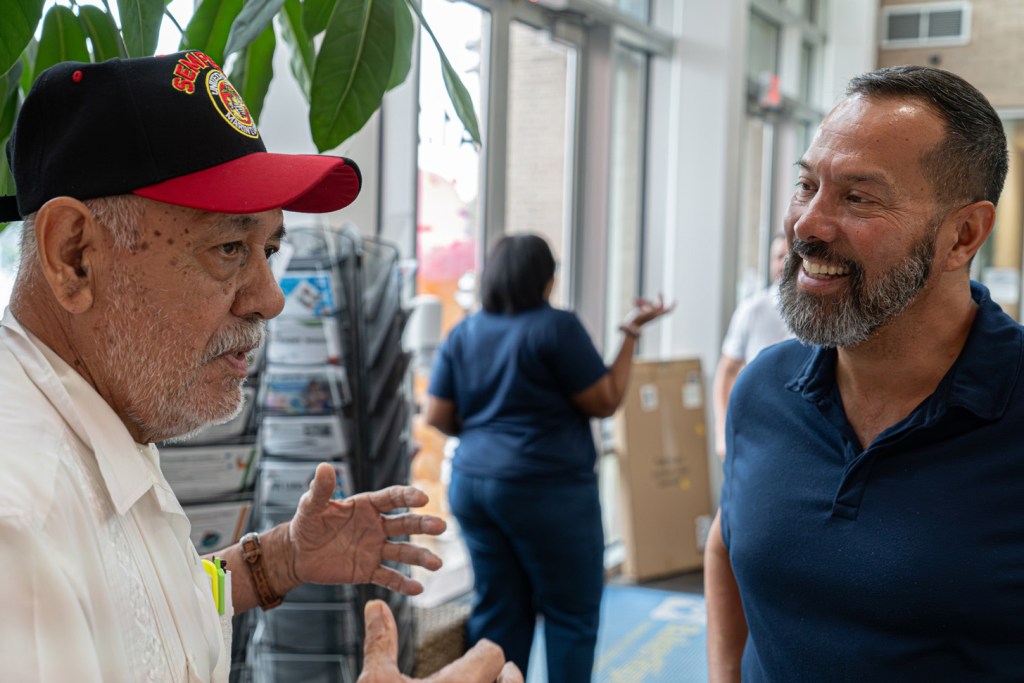
Early Saturday morning, Jose Sierra walked into the Baker Ripley House on Navigation to ask for information on the funeral services of Felix Fraga, a former city councilman and lifelong community advocate who devoted his career to address the needs of Houston’s Mexican-American residents.
To his surprise, he was greeted by none other than Bolivar Fraga, son of Felix Fraga, who in true Fraga fashion immediately wrote down the information to his father’s services for that weekend for Sierra to attend.
Sierra, who’s in his 80s, met Felix Fraga when he moved to Houston from San Antonio when was about 15 years old. Felix Fraga was key to helping him get connected to his new community in the East End, he said.
“We all need a role model,” Sierra said. “He had a lot of charisma, he listened to you…he was a listener. I’ve never seen Felix upset about anything. He’s almost to me like the founder of Houston, Texas.”
Felix Fraga died July 22 at the age of 94 after battling Alzheimer’s disease.
He is survived by his wife Nelly Fraga, sons Bolivar and Carlos Fraga, grandchildren Amanda, Damian and Nicolas, and brother Thomas “Tommy” Fraga.
Felix Fraga devoted his life to enriching the life of the Mexican-American community in Houston, through his social work at BakerRipley, and later on, at the Houston Independent School District, where he served as a board member for four years. He also served as city council member for District H, representing his East End neighborhood along with the northside of Houston.
It’s not rare to find a person with a story about Felix Fraga, especially in Houston’s Second Ward, or Segundo Barrio, where he grew up. He was known for knocking on doors asking people what they needed, helping people get civically involved, volunteering his time to drive buses to take children to classes, camps or field trips.
He saw past the immediate need, his friends and family say, to focus instead on what a family or person could accomplish if only they had one less hurdle in their lives.
“Si la comunidad está bien, mi familia está bien,” Bolivar Fraga recalled his father saying as a way to reassure his family that the work he did to open doors for the community around them, was also meant to better their own lives.
He always saw his father go above and beyond for everyone around him, Bolivar Fraga said. And even though it could be said that his family shared Felix Fraga with the entire community, Bolivar Fraga never felt like he missed out on any important moments with his father.
“He was larger than life,” Bolivar Fraga said. “I felt like I had a father who was there 110 percent.”

A history of service
Felix Fraga opened doors for the community through education, jobs, civic engagement, and fulfilling other everyday needs. Much of this work was done through BakerRipley, the organization that saw him grow as a person and as a social worker.
“The walls of BakerRipley just echo his emotion, his selfness, his desire to help,” said Claudia Aguirre, president and CEO of BakerRipley. “Every day, I’m sure, he woke up thinking, ‘We need to make this community better.’”
Felix Fraga was born in Houston’s Second Ward Oct. 30, 1929, to parents Felix Fraga Sr. and Angela Zamarron. He liked to joke about his untimely birthdate as it fell the day after the stock market crash leading to the Great Depression and a day before Halloween.
Despite growing up in poverty, Felix Fraga’s life was full of firsts. He was the first in his family to graduate high school and later college, he was one of the first baseball players of Mexican descent at the University of Houston, and he became the first Mexican-American professional hire at Ripley House, as it was known back then.
“He was great at connecting people,” Aguirre said. “He was great at finding the people in the community that cared about lifting up our low income communities.”
Felix Fraga’s father had immigrated to the U.S. from México, fleeing the Mexican Revolution in 1913, and settled in Houston where he worked for the railroads. Once Felix Fraga Sr. met his wife, Angela Zamarron, the family first lived in Baytown and eventually settled in Houston’s East End in the late 1920s, where they found community among the Mexican families that had made the East End their home.
Felix Fraga was one of six Fraga children who grew up playing soccer and baseball along Navigation Boulevard.
The family found support and community at the Rusk Settlement House, which focused its services on the Mexican-American community. It eventually operated alongside BakerRipley House, a community center that initially focused on services to white families living on the East End.
As a teen, he contemplated dropping out of school to start working to help the family.
Felix Fraga confided in then BakerRipley’s Director Franklin Harbach about his plans to leave ninth grade, and it was then that he was presented with one of the most life-changing opportunities.
“They told me that I could work there as long as I stayed in school. So I had to graduate,” Felix Fraga recalled in an oral history interview published by the Portal to Texas History in 2016.
“And when I graduated they said, ‘If you want to go to college we’ll find you a scholarship and you can keep working here.’ I took them up because I didn’t know where I was going to get a job.”
He started college at the University of Houston on a scholarship from the Pan American Roundtable and eventually landed a spot in their baseball team, which also provided a scholarship to help him finish his degree in social work.
“He played first base and was the first person of Mexican descent to play baseball for the University of Houston,” said David Contreras, a national historian with the League of United Latin American Citizens, or LULAC.
Contreras worked on a project that sought to document Mexican-American baseball players in Houston, and that’s how he met Felix Fraga and his family. It was during an interview for that project that Contreras said Felix Fraga asked if he knew anything about doing taxes. When Contreras answered that he did, Felix Fraga put him to work helping families file their taxes.
“He just had this passion to help others and the underserved communities,” Contreras said. “He had a very, very genuine and very strong passion to help people.”
David Contreras’ wife Millie Contreras, also recalls the day Felix Fraga knocked on the door of her family’s home in Houston’s Northside. She was about 10 or 11 years old, and didn’t know the man who had a simple question for her mother.
“¿Qué necesita?” Millie Contreras recalls Felix Fraga asking her mother. “We didn’t know who he was. He was just a man asking us what we needed, and it was hot in my house, so he goes, ‘Do you have an abanico? And my mother said no, and he goes, ‘Well, we are going to bring you one.’”
Felix Fraga left, she recalls, leaving the family thinking he would show up with a fan to help ventilate the home. To their surprise, he showed up days later with a window air conditioning unit.
“He was a hero,” Millie Contreras said. “He was always somebody’s hero.”
His legacy
It was this work — knocking on doors, looking for ways to better serve the community — that many remember Felix Fraga for. His first formal job during graduate school once again came at BakerRipley, as he was invited by Harbach to complete his social work fieldwork with the organization.
In the early 1960s he became BakerRipley’s assistant director of Neighborhood Centers, and by 1970 he was named director of RipleyHouse, a position he held for 20 years.
“He wanted people to see the best of the East End. He wanted people to see the best of his community,” Aguirre said. “And I think because he lived amongst the community, he never lost touch with the challenges that arose.”
It was at BakerRipley that Felix Fraga met his wife Nelly Moyano, and the two married when he was 39 years old.
In 2021, at the age of 91, Felix Fraga was diagnosed with Alzheimer’s disease. He had fully retired a few years prior as the signs of the disease started to show, and was eventually placed in hospice care as the disease progressed, Bolivar Fraga said.
It was hard seeing his father lose his ability to be out there with the people, his son said, but some of the key features that made him Felix Fraga – his welcoming smile, his ability to treat everyone with kindness – never left.
“He always had that great smile,” Bolivar Fraga said of the years when his father’s health declined. “He would always talk about the community. He would ask about his programs… the word that he said over and over again was, ‘Help, helping, helping, helping.’”
As senior manager of civic engagement at BakerRipley, Bolivar Fraga now walks the same halls at BakerRipley as his father did for decades. Before his death, Felix Fraga was able to see a mural of his family’s history when it was unveiled at the center in November.
Bolivar Fraga often meets people like Sierra, who have a story about his father that he had never heard, and is reminded of the impact his father continues to have.
“I hope they remember him as someone who loved the community and tirelessly worked to make Houston and the world a better place,” Bolivar Fraga said.


