


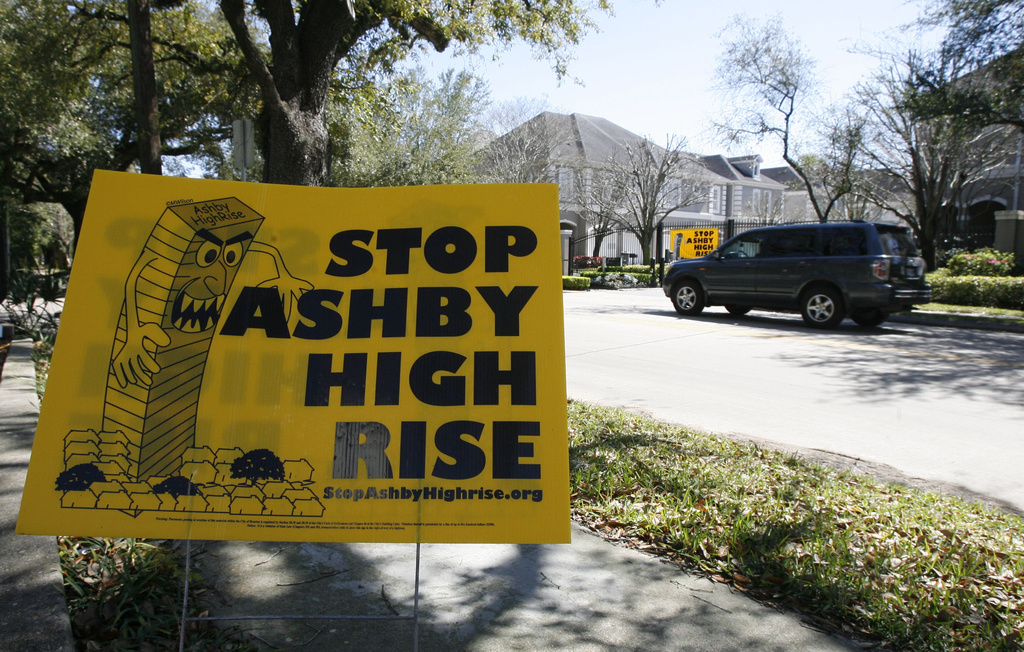
For nearly two decades, the residents of the Boulevard Oaks neighborhood just west of the Museum District fought the development of a 23-story residential building on Bissonnet Street. The property, called the Ashby high-rise, planned to have 228 units – concerning residents over density and traffic in a primarily single-family residential area.
Protests, lawsuits and public meetings transpired over years, which quashed the original plan, but despite this opposition, a separate development – a 134-unit building called the Langley – is under construction, scheduled for completion in 2026.
During this time, conversations about land-use regulations, deed restrictions and housing inequity loomed large in the nation’s fourth largest city, driven by one simple fact: Houston is the largest city in the United States without zoning. (Fun fact: Neighboring Pasadena is the second largest.)
Supporters say the lack of zoning laws provides flexibility for city planners, developers and housing efforts.
Critics say some neighborhoods have used that flexibility to create their own restrictions and build barriers not unlike cities with top-down zoning laws.
What is zoning? How does it impact Houston?
Put simply: zoning laws determine how land can be used.
This can play out in subtle ways, say, when you visit a city and see five car lots on the same stretch of road. It also can have an impact on more complicated designs, such as the integration of a grocery store and restaurant on the first floor of an apartment complex.
City councils and zoning boards throughout the country spend hours every week listening to neighbors argue over whether a fast-food restaurant at the edge of a subdivision would create too much traffic, or why a funeral home and crematorium should not be near a school.
Houston faces far fewer debates.
That is because in Houston, most development projects are considered “by right.” In other cities, developers and landowners have to use their property in designated ways.
Cities primarily have different zones of development – meaning there are separate areas for single-family homes, multi-family apartment complexes, industrial sites and businesses.
Developers have to ask their local governments for exceptions when they want to put a new project in an area not already zoned for it.
Questions regarding lot sizes, parking minimums and rights-of-way around a development fall to the city’s Planning Commission.
Marlene Gafrick, Houston’s assistant chief policy officer and former planning director, said the city has regulations to establish criteria to “protect neighborhoods from incompatible development, such as hotel/motel, cell towers and high-density development,” even though Houston does not have formal zoning laws.
Why doesn’t Houston have zoning?
Unlike other cities, Houston never successfully voted to put zoning restrictions in place.
“The lack of zoning started at the Big Bang, the creation of the universe,” joked Matthew Festa, South Houston College of Law professor and land use attorney. “…We’ve never had zoning, so it didn’t really start. It just never happened.”
The city charter requires a binding referendum vote from residents or a six-month waiting period for public comment and debate of a zoning ordinance. Houston officials brought it to the ballot in 1948, 1962 and 1993. Voters rejected it each time.
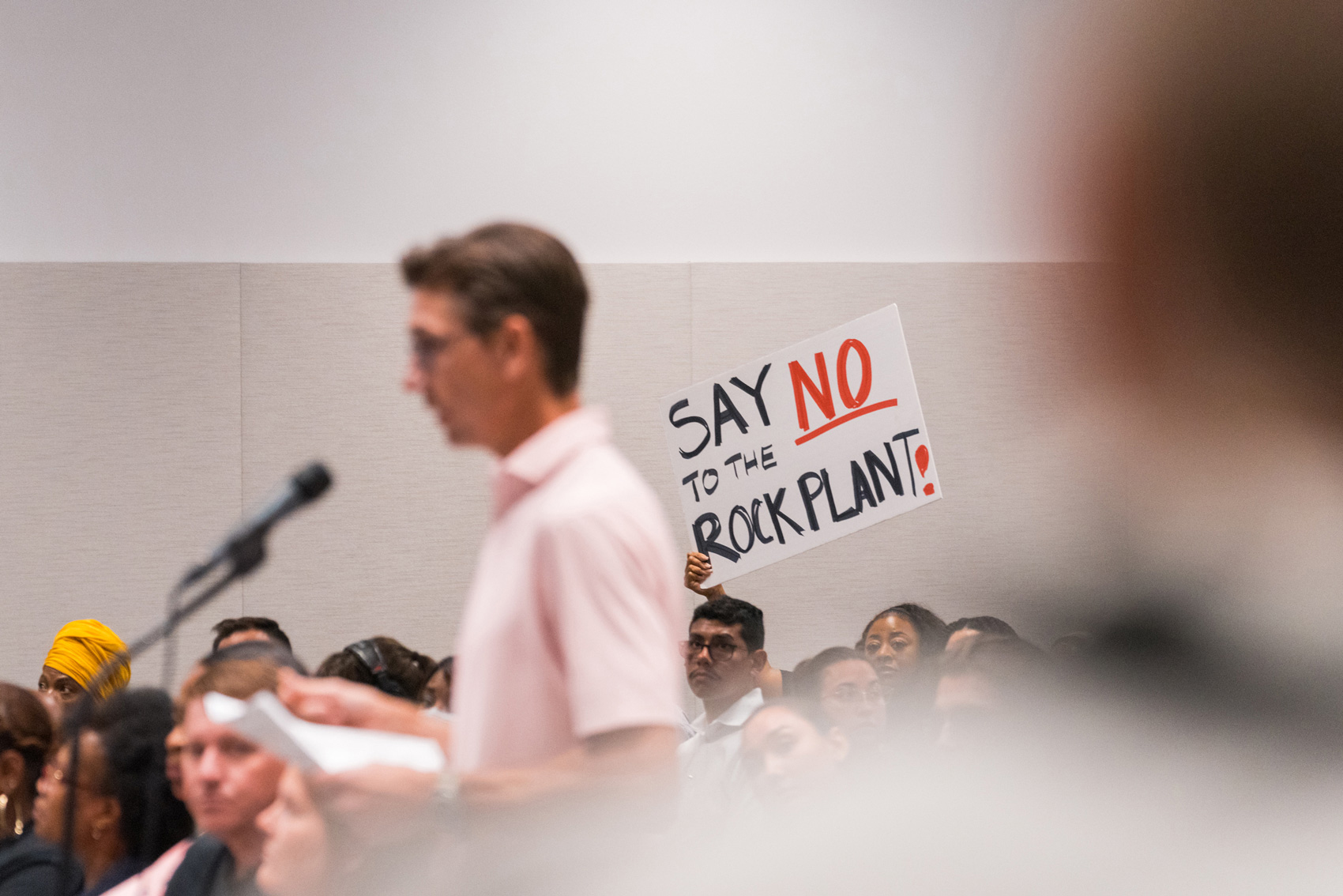
For Christian Menefee, the county attorney, the lack of zoning makes his work more difficult. Just this year, the Harris County Attorney’s Office – led by Menefee – sued the Texas Commission on Environmental Quality for approving a permit for a concrete batch plant across from a hospital in Kashmere Gardens. A move that would be far more difficult or impossible with zoning laws.
“We have numerous concrete batch plants in Fifth Ward and Near North Side,” said Menefee. “(No zoning) makes our lives fighting these situations difficult because then we have to go and try and seek every legal remedy at the state level.”
Still, Festa said Houston still regulates some aspects of land use – just without using the “z-word.”
City ordinances and the Planning Commission do regulate some aspects of land use, including building height, development density, population and the percentage of land being used. Additionally, some neighborhoods employ a work-around to the city’s lack of zoning: deed restrictions.
Deed restrictions are rules residents put in place that restrict or limit activities in their neighborhoods. They can exist in perpetuity or expire and can prevent businesses from moving into purely residential areas. Developers have to sign an affidavit when filing permit applications acknowledging they are not violating any existing deed restrictions.
“That’s what people do to fill the (zoning) gap,” Festa said. “Like well, the city’s not going to stop my neighbor from having a rusted-out Ford F-150 on cinder blocks in the front lawn. So, I’m going to move someplace where there’s rules against that.”
How do Houston residents use deed restrictions to their advantage?
Deed restrictions can be more powerful than zoning regulations, Festa said, and Houston is one of the only major cities where the government can enforce deed restrictions.
Deed restrictions also have a complicated and, at times, problematic, history – some neighborhoods used them to prevent people of color from moving into white neighborhoods during desegregation, for example.
Robert Bullard, founding director of the Bullard Center for Environmental and Climate Justice, said zoning should segregate areas into different categories, such as residential single-family homes, multi-family, commercial, light industrial and industrial.
“With no zoning, that means that the deed restrictions are designed in a way not to allow a chemical plant next to a single family residential home,” Bullard said. “That’s theory. In practice, we see it mostly enforced in more affluent areas where deed restrictions are renewable. Other times, in neighborhoods of color, the deed restrictions have been allowed to lapse over time and industry can come in.”
What needs to happen, Bullard said, is the same level of protective support in a neighborhood like Boulevard Oaks needs to be a priority in other neighborhoods before market forces drive it.
That is something that Lindsey Williams, a former planner for the city of Houston and current director of community development at Houston Land Bank, is well aware of. As a planner, she helped residents facing displacement use deed restrictions to their advantage.
Developers wanted to move into neighborhoods where lot sizes could be made smaller – which could increase the number of homes they could later build.
Williams would counsel neighbors, who hesitated to sell their properties, on their ability to use deed restrictions to maintain the lot sizes which lessened developer interest.
“I do think the lack of zoning does provide some flexibility that allows for innovative development models or for neighborhood driven decisions,” Williams said. “Unfortunately, the capital that usually is needed to back certain developments are not always within the hands of those neighbors.”
During the Ashby high-rise case, residents were able to secure a restrictive covenant in 2012 – which like a deed restriction can limit a property on how it can be used. The covenant detailed what could be built by way of density and size.
How does zoning affect the environment?
Without zoning, Bullard said industry historically has been built in lower-income communities of color in Houston.
Between the 1930s and 1978, 82 percent of Houston’s trash was disposed of in primarily Black neighborhoods, according to a report Bullard authored in 1983, even though Black residents only made up for 25 percent of the population.


All five of the city’s landfills, six out of eight city-owned trash incinerators and three of the four privately-owned landfills were located in Houston neighborhoods with a large Black population, according to the report.
This was before the United States had federal environmental regulations. Even after the creation of the U.S. Environmental Protection Agency, Bullard found these areas of Houston kept being unofficially zoned for trash.
Today, lower-income communities of color still deal with the brunt of the waste operations.
“Even though we don’t have zoning, there are informal ways of the planning and allocation of resources and financing to certain kinds of development,” Bullard said. “These ways still determine where infrastructure and trash will go and where it won’t go. It doesn’t happen accidentally.”
The lack of zoning also means there is “a potential for brownfields everywhere” because a property could have been something completely different than whatever its current use, Williams said. Brownfields are abandoned properties that are contaminated from prior industrial or commercial use.
How does zoning affect Houston’s affordable housing efforts?
Ideally, a city without zoning could create opportunities for more housing due to a lack of regulatory challenges. It cuts down the time developers are waiting on bureaucratic zoning steps, allowing them to start work more quickly.
While Houston does have relatively lower median housing costs compared to other cities, it does not have sufficient affordable housing, according to a report authored by Texas Housers, a nonprofit focused on housing needs across the state.
Houston has fewer rental units available and affordable for the lowest income households than comparable Texas cities. Residents have better access to affordable housing in Boston – a largely more expensive city.

“Land use deregulation and zoning reform alone is at best only a partial answer for increasing housing affordability,” said Ben Martin, research director for Texas Housers and co-lead author for the reporter. “You really need more public sector intervention in addition to any of these reforms in order to make housing affordable.”
A primary reason for this is Houston’s use of private restrictive land use controls, such as deed restrictions or covenants, for racial and economic exclusion.
“Even without zoning, there’s still this loophole potential for exclusionary communities to maintain lower density,” Martin said. “Ultimately, keeping those neighborhoods very expensive and unaffordable.”
Williams said solutions to these issues need a holistic approach, such as infusing more incentives into affordable housing and multi-family projects.
“I think it’s really just a strategic, cohesive plan that has to happen,” Williams said, expanding that Houston is not the only city with affordability issues.
“We are all susceptible to (economic issues) so really working together in partnerships and utilizing tools and understanding that we only have different goals of what level of affordability we’re trying to reach or what sector of the population we’re trying to serve, but it’s all really important.”