
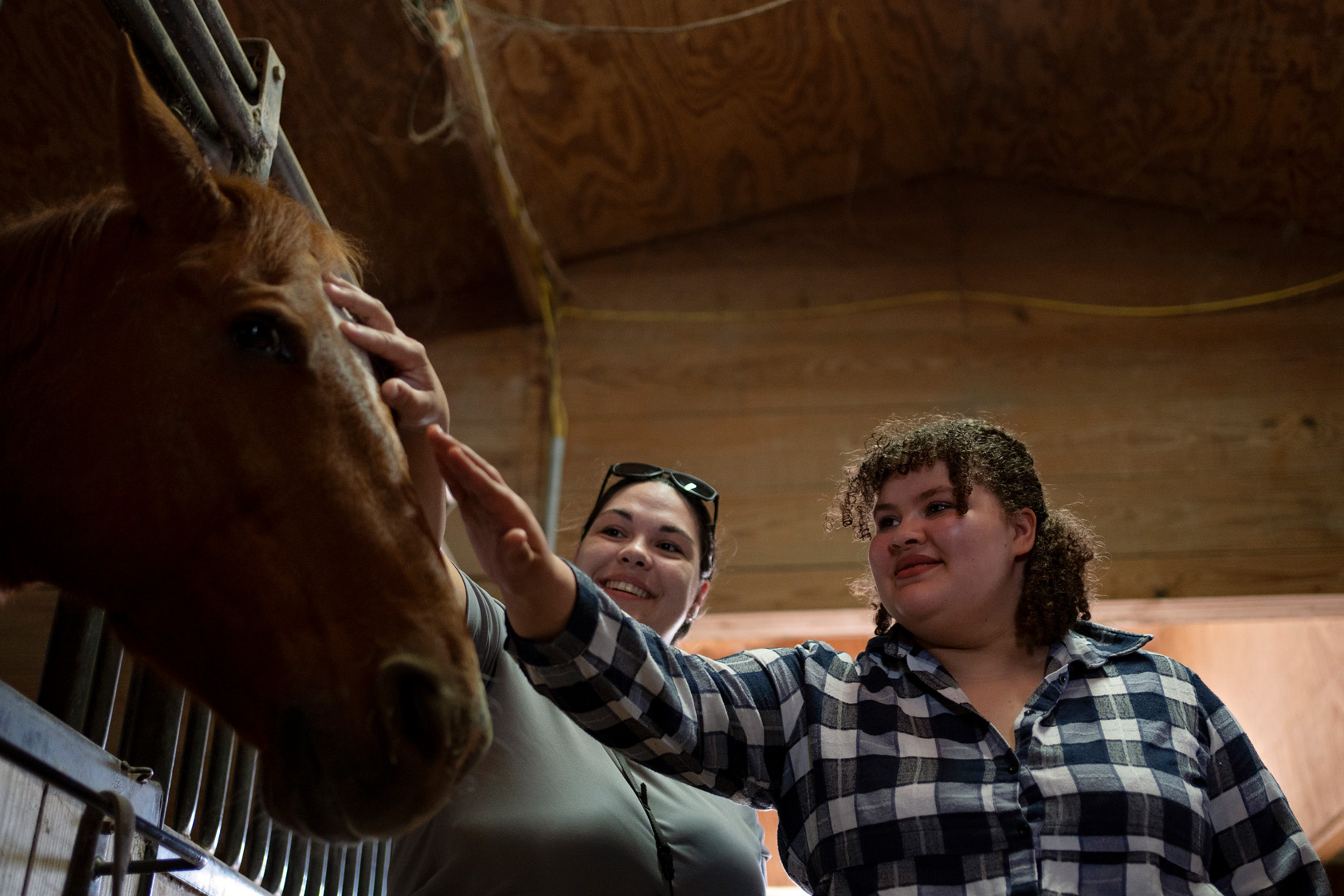

As the wind swirled sandy dirt in the air and sprinkles of rain showered over Paloma Trails ranch in Katy on a recent Monday morning, ranch owner Paige Clough gave a barn tour teaching horse behavior and safety tips to a handful of children who have autism.
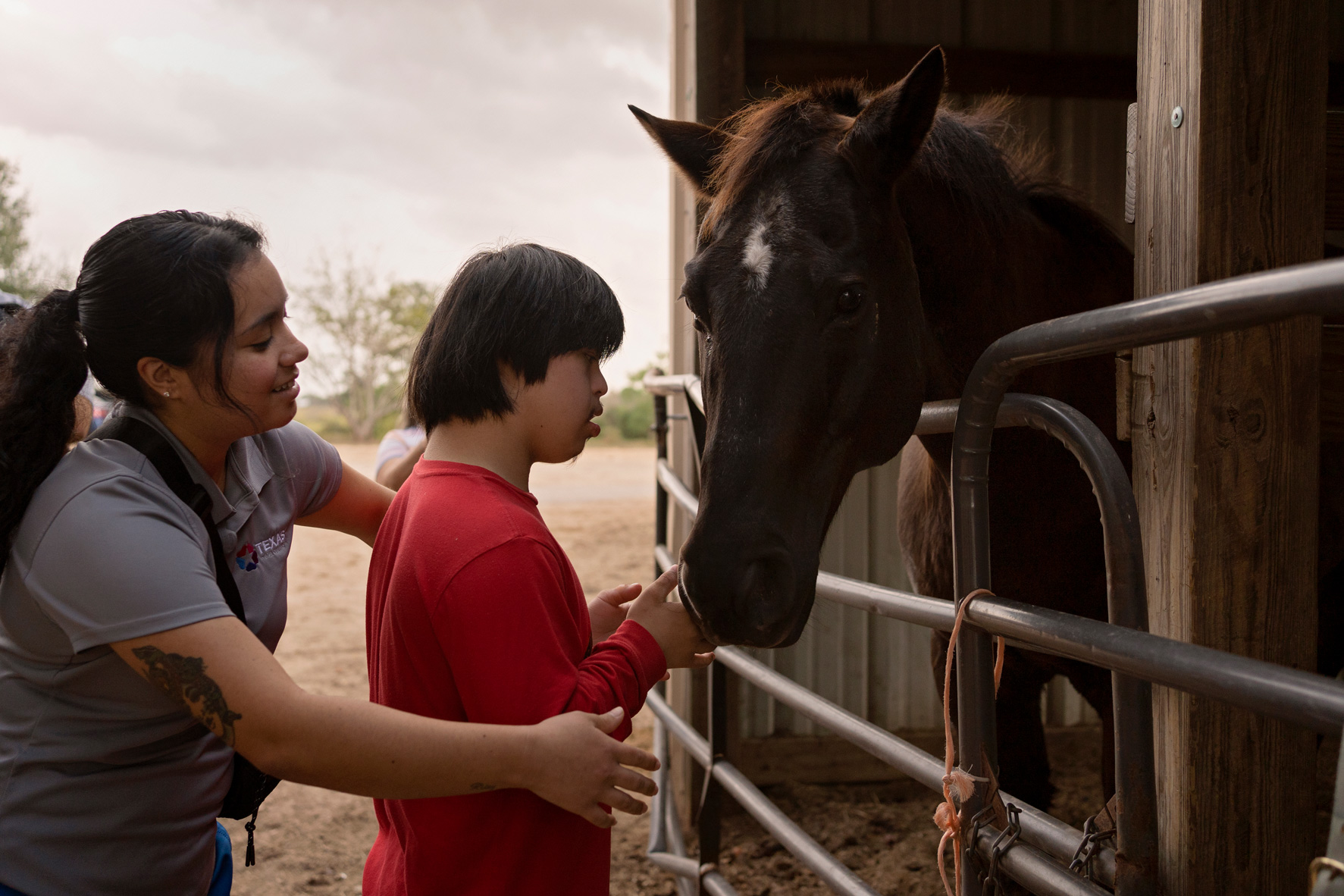
While some kids, who are clients of Texas ABA Centers, jumped at the opportunity to pet the horses, others didn’t want anything to do with the animals. For children with autism, new environments such as horses at a ranch can be overstimulating, Clough said.
“Usually they start off shy, and by the end, they’re warming up to the experience,” said Clough. “It’s the horses that draw them in.”
Equine therapy at Paloma Trails is just one of many quarterly community engagement events that Texas ABA Centers hosts for its clients with autism to encourage social interaction with peers and the community, and supplement their applied behavioral analysis therapy treatment.
Texas ABA Centers recently opened its first Texas clinic in Katy in July and is planning two more within the Houston region: one in Pearland and another in Sugar Land by early 2025. The Katy clinic is the company’s first ABA therapy care center of its kind in Texas providing diagnostic evaluations and autism care services to children of Harris and Waller Counties from 18 months to age 23.
It took some time for 6-year-old Franco to warm up to pet any animals at the ranch. Eventually, thanks to ample patience, encouragement and positive reinforcement from one of Texas ABA Centers’ registered behavior technicians (RBT) and its board certified behavior analyst (BCBA), Franco agreed to brush a pony. Afterwards, with fists raised toward the sky, he celebrated his hard-earned carriage ride.

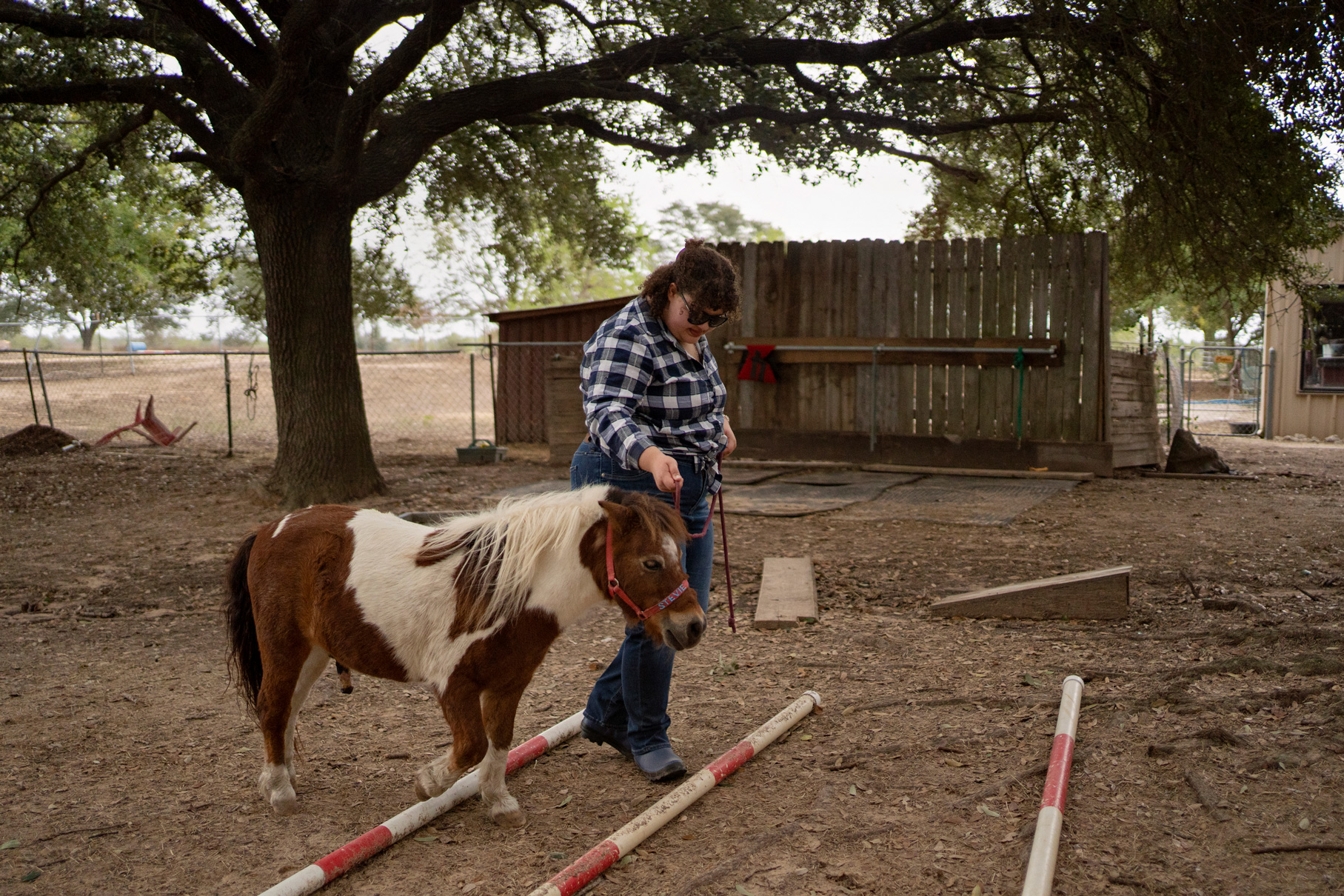
That’s the norm at Texas ABA Centers in Katy. Its individualized, play-based approach, aims to provide children with autism — a neurological and developmental disorder that affects how people learn, communicate, interact, and behave — with an immersive and engaging environment to help them navigate life on the spectrum and teach them the tools to achieve a fulfilling future. That environment can be in-home, in the clinic, in-school if schools allow an ABA therapist, or a day in the community engaging with horses.
“Being able to meet the clients where they are is really important,” said Executive Director, Brittani Vincent. “We want it to be natural. We want it to fold into their lives and be relevant to their lives and what they’re trying to build for themselves.”
Texas ABA Centers’ nearly 8,700-square-foot clinic offers two gyms, a game room, a chill room, arts and crafts room to examine motor skills, a learning center for virtual learning, a discrete trial training room used to teach skills with tangible reinforcements and a social skills cafe to practice dining, ordering and paying for food.
Short supply, high demand
The center also prides itself on providing timely diagnoses and treatment and not having a waitlist. Clients typically receive a diagnostic evaluation within three days and treatment within 47 days from the time initial contact is made, said Selma Ward, Texas regional vice president of operations, combating a nationwide, industry crisis where families on average have to wait several months to years to receive a diagnosis and treatment. The largest part of the wait at Texas ABA Centers, Ward said, comes from verifying insurance coverage with companies.
A recent study by the Center for Medicare and Medicaid Services found that more than 61 percent of centers in the U.S. had wait times longer than four months for autism evaluations while roughly 15 percent of centers reported waits exceeding one year or with waitlists that were so full they were no longer accepting new referrals. Meanwhile, one out of every 36 children in the U.S. has a diagnosis of autism spectrum disorder according to the U.S. Center for Disease Control and Prevention.
“There is an incredible amount of need and not an incredible response system to fill that need,” Ward said recently from the Katy clinic.
“When a family is [saying], ‘I know something’s there, I know something’s wrong’ but has to wait six months or a year to even get the diagnostic evaluation, that’s hard on a family because not only do they not have an answer, they can’t get a response. And so we wanted to fill that gap.”
Delays in evaluation can cause many children to miss the opportunity for early intervention in the critical early neurodevelopmental window where therapies have the greatest life-changing impact, the study found.
As a result, an overwhelming number of providers focus primarily on early intervention and stop providing treatment at age 8 even though data shows a rise in the overall prevalence of autism among 8-year olds, said Adriana Crostley, director of statewide education and outreach with Autism Society Texas. She’s an advocate for the continuation of ABA therapy for autistic individuals as they grow older and transition to adulthood, go to college and live on their own and manage their finances.
“ABA skills can be applied to anything,” Crostley said. “We’re always going to advocate for early intervention. It’s the key for kids to try, but it doesn’t end there.”
She said she hadn’t heard of Texas ABA Centers previously, but was thrilled to learn that there’s a new provider that provides continuation of care through adolescence and early adulthood. That coupled with the fact that it does in-house diagnostic evaluations is rare, she said.
“Of the hundreds of companies I know, I only know about two or three that do their own evaluations,” Crostley said. Usually diagnostic evaluations are administered by a separate doctor, pediatrician or psychologist, and then families begin the process of finding a provider, she said.
Surprised by their quick turnaround time for services, Crostley is now looking forward to adding them to their resource list to refer families who are seeking evaluations and treatment.
How do they do it?
One of the ways that Texas ABA Centers is able to avoid waitlists, Ward said, is by hiring well in advance to ensure that an RBT is in place once their treatment plan is ready so that clients can start receiving care immediately. The center also prioritizes and invests in professional development to encourage more RBTs to become BCBAs, a role that experiences a lot of workforce shortages. More than 69 percent of centers experience shortages of specialists who complete evaluations, the study found. They offer an apprenticeship program for RBTs enrolled in a master’s program to receive supervision from one of their clinical directors, and they offer tuition reimbursement, and RBTs can apply to receive a fully paid scholarship to Temple University to study to get their master’s degree and become a board certified behavior analyst.
“Burnout is real, you have to have a lot of patience. You have to be strong-willed, be open to a lot of the kids that we get here, because [there’s] no perfect child on the spectrum,” said Destiny Daniel, an RBT at Texas ABA Centers.
RELATED: Groups seek pay hike for caregivers of people with intellectual, developmental disabilities
As a result of that investment, Ward said they’re able to build a culture where employees love to come to work and one that encourages quick progression for clients within just a couple of months of treatment.
“The change is so apparent and it’s so apparent, so quickly that it’s hard to describe the type of joy and satisfaction that I get from this work,” Ward said.
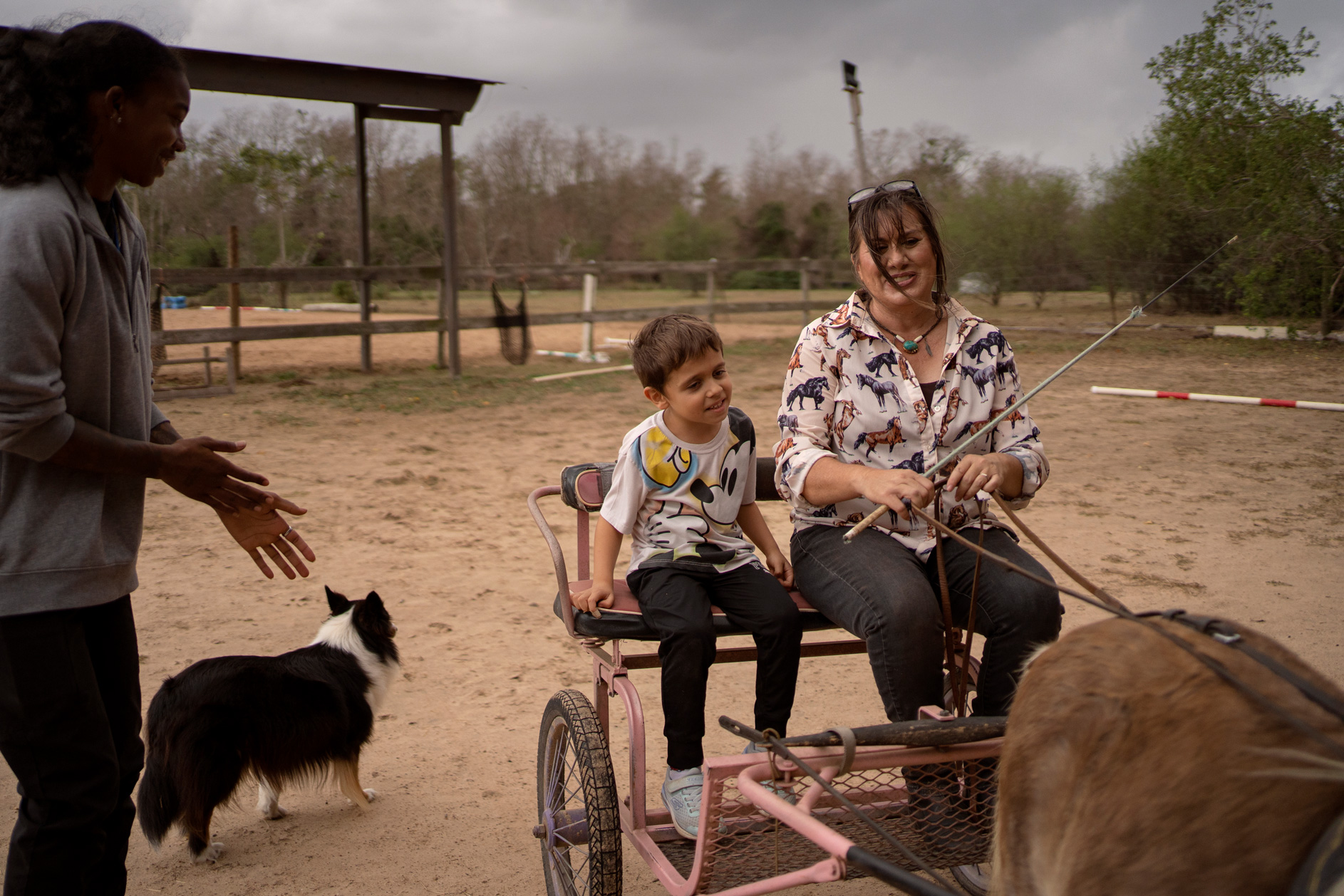

Franchesca Valenti and her husband noticed a quick improvement in Franco’s speech ever since he started receiving in-home ABA therapy in June. Even Franco’s kindergarten teacher told her that she noticed a difference in his behavior just two days after school started this year, she said.
“He makes a bigger effort to use his words and he gets out of behavior easily,” Valenti said. “Every kid has tantrums, but he gets out of them more easily [and] he tries to narrate some stuff. He may miss connectors, but I see him building sentences and he used to not say anything.”
Before his level one diagnosis roughly over a year ago, as a psychologist, she said she noticed some signs that her son struggled communicating and forming sentences. She chalked it up to an effect from the pandemic when he wasn’t socially exposed to anyone. She also thought it was something he’d grow out of.
She had initially struggled to find the right treatment for Franco, consulting two other providers until she discovered the Texas ABA Centers near her neighborhood in Katy.
The biggest issue she ran into was a lack of flexibility. One provider only accepted kids ages 1 to 6, and had limited hours from 9 a.m. to 5 p.m. Monday through Friday with small periods of time in the common area to play. She was also told that her son would spend eight hours in an office with an RBT based on his evaluation.
“I wanted him to socialize better, not to be with an adult eight hours a day,” Valenti said.
Texas ABA Centers offered her flexible options, individualized care and Franco could play with other children. He goes twice a week.
Texas ABA Centers operates Monday through Friday from 9 a.m. to 7:30 p.m. and Saturdays from 8 a.m. to 5 p.m. It’s close to Valenti’s home in Katy, and Franco wouldn’t have to miss school in order to receive ABA therapy.
“We don’t think that our family should have to choose between the academic side of things and ABA services that kiddos medically need,” Vincent said.
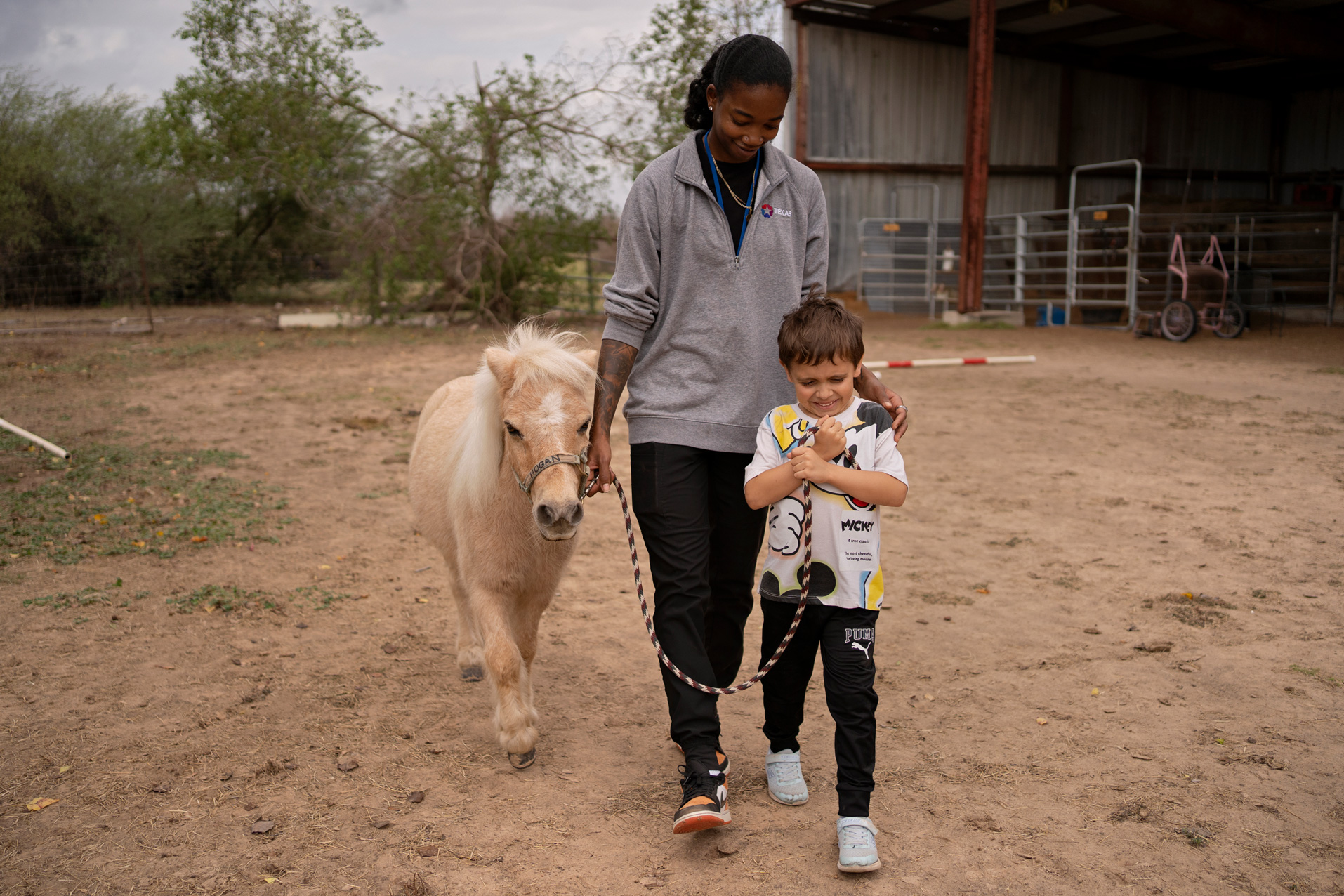
Valenti was thrilled to learn that Franco eventually warmed up to the horses and gravitated so quickly toward his RBT, often holding her hand, hugging her and clinging to her tightly as she carried him around the ranch.
“That wouldn’t have been possible before,” Valenti said. “He would’ve just not wanted to do the activity.”

