


Hispanic- and Asian-owned businesses could be transferred out of parts of the city of Houston’s minority subcontracting program, a move advocates criticized as a detriment to the progress minority businesses have made, but city officials say may be necessary to continue the program.
A recommendation to move those businesses out of certain categories and into a race-neutral small business enterprise program, as well as other changes to Houston’s decades-old program, were contained in a disparity study discussed at a city council committee this week.
An ongoing lawsuit claiming the minority- and women- owned business enterprise program illegally gives money on the basis of race has put Houston on a deadline to consider changes to the program. Without implementing the recommendations of the most recent study, the program could be forced to shutter, officials said Wednesday.
“I’d like to say without adopting the updated ordinance that supports the findings in the study, we do risk a 40-year setback,” said Cylenthia Hoyrd, director of the city’s Office of Business Opportunity. “So, be very clear that the findings in the study narrowly tailor this program, and we are at a kind of crossroads of having the study and going to litigation.”
RELATED: Houston minority contracting program may be at crossroads with new study, lawsuit
Houston’s MBWE program, which began in 1984, was conceived as a way to broaden access to city dollars for minority- and women-owned businesses that historically had been at a disadvantage when it came to winning government contracts. Over time, the city’s program has expanded to include enterprises run by minority, women, disabled, LGBTQ and small business owners.
Though sometimes criticized as a set-aside program, the city requires contractors and bidders to make a good-faith effort to hire certified subcontractors for a certain percentage of the work. The percentage varies by the type of work being contracted.
Disparity studies, like the one presented to the council committee this week, provide the legal basis for such programs across the country.
The city last produced a disparity study in 2006, putting Houston on potentially shaky legal footing in the face of an ongoing federal lawsuit challenging the program. Houston completed a different disparity study in 2019, but never adopted it.
Disparity changes
The new study, by consultant MGT, examined five years of minority business contract spending. Disparity was calculated by comparing the percentage of city-issued contracts to the percentage of firms available to fill those subcontracting roles.
The results showed that some groups had made significant progress, while others continue to face challenges.
SCRAPPED: Houston paid $821,000 for a contracting study it later scrapped, officials won’t say why
Notably, the consultants concluded disparities for Hispanic-owned businesses no longer existed in the construction and professional service categories, and that disparities for Asian-owned businesses in the professional service category had been eliminated. Disparities remain for those businesses in all other categories.
The study also found non-minority women-owned businesses experienced no disparity in contracts for goods and services.
Black-owned businesses continue to experience significant disparities in all categories, especially in the area of professional services.
The study authors suggest moving the groups that faced no disparity out of the subcontracting program for those categories. For example, Hispanic-owned businesses would not be considered for Houston MWBE subcontracts for construction, but still could be considered for MWBE subcontracts for goods and other services.
They also would still have the opportunity to be certified by the city, which would give them access to participating MWBE programs outside of Houston.
The Office of Business Opportunity, which oversees Houston’s disadvantaged business contracting program, suggested those groups be moved into a race-neutral small business category of city contractors – essentially moving them from one bucket of contract availability to another.
Houston already has a small business program for construction contracts. Under the proposal, the small business enterprise program would be expanded to include the other contract categories mentioned in the study.
Certified minority businesses in Houston already would qualify for the small business enterprise program, as the bar is higher for MWBE certification, Hoyrd said.
There is an existing path for individual businesses to “graduate” out of the MWBE program when they hit a certain annual revenue level – determined by the federal government – but Hoyrd said the city has not always enforced it. It will be more closely scrutinized moving forward under the recommendations.
The study authors also recommend the formation of a veterans small business program, a plan to better advertise informal contracts and a path to advancement for the businesses that grow beyond the MWBE program.
Businesses oppose changes
More than 40 business owners and community advocates at Wednesday’s committee meeting said such a shift would negatively impact minorities.
Daniel Yoo, with the Houston Asian Chamber of Commerce, said removing Asian business owners from accessing certain MWBE contracts would have “severe and lasting” consequences.
“This proposed change would effectively eliminate vital pathways for Asian owned businesses to compete fairly for city contracts,” Yoo said. “…By excluding Asian Americans from professional services, the city risks limiting economic participation, weakening minority business representation, contradicting City’s commitment to equity and setting a dangerous precedent.”
Individual business owners in attendance at Wednesday’s committee meeting said the changes would benefit the few contractors who have made gains while disadvantaging those who have not yet had the opportunity to do business with the city.
Claudia Ortega Hogue, a partner in two women-minority owned businesses, called the changes disheartening as it took her years to be Houston-certified.
“Now that we have recently completed this painful process of becoming certified and having committed a significant amount of time, energy and resources, it is disheartening to hear that this committee is considering taking this wonderful program backwards and not forward,” Ortega Hogue said.
The city attorney told council Wednesday the federal judge considering the lawsuit against Houston gave it until mid-April to decide whether to accept the disparity study recommendations.
In the lawsuit, Gerald and Teresa Thompson allege the city’s program discriminates against qualified companies by not considering the race of employees. According to the lawsuit, the Thompsons employ around 50 individuals, mostly Hispanic, between their two companies.
When the lawsuit was filed in September 2023, one of the companies, Landscape Consultants of Texas, was more than halfway through a five-year, $1.3 million contract with the city. However, under the program rules, Landscape Consultants was forced to pay a competitor to finish part of the work, solely because the Thompsons are white, the lawsuit claims.
The Thompsons contend the city’s practice of applying “racial classifications to award public contracts” infringes upon the equal protection clause of the 14th Amendment of the Constitution.
If the city does not adopt the recommendations, the trial will proceed under the 2006 study. The case still could go to trial after acceptance of the new study, but U.S. District Judge David Hittner would consider the merits of the newest policy, and its updated data, instead of the existing program.
A proposal to adopt the recommendations will come before City Council in the coming weeks, but multiple council members on Wednesday said they still had questions about how the data was collected. Still, they did not want to risk the program coming to a complete stop.
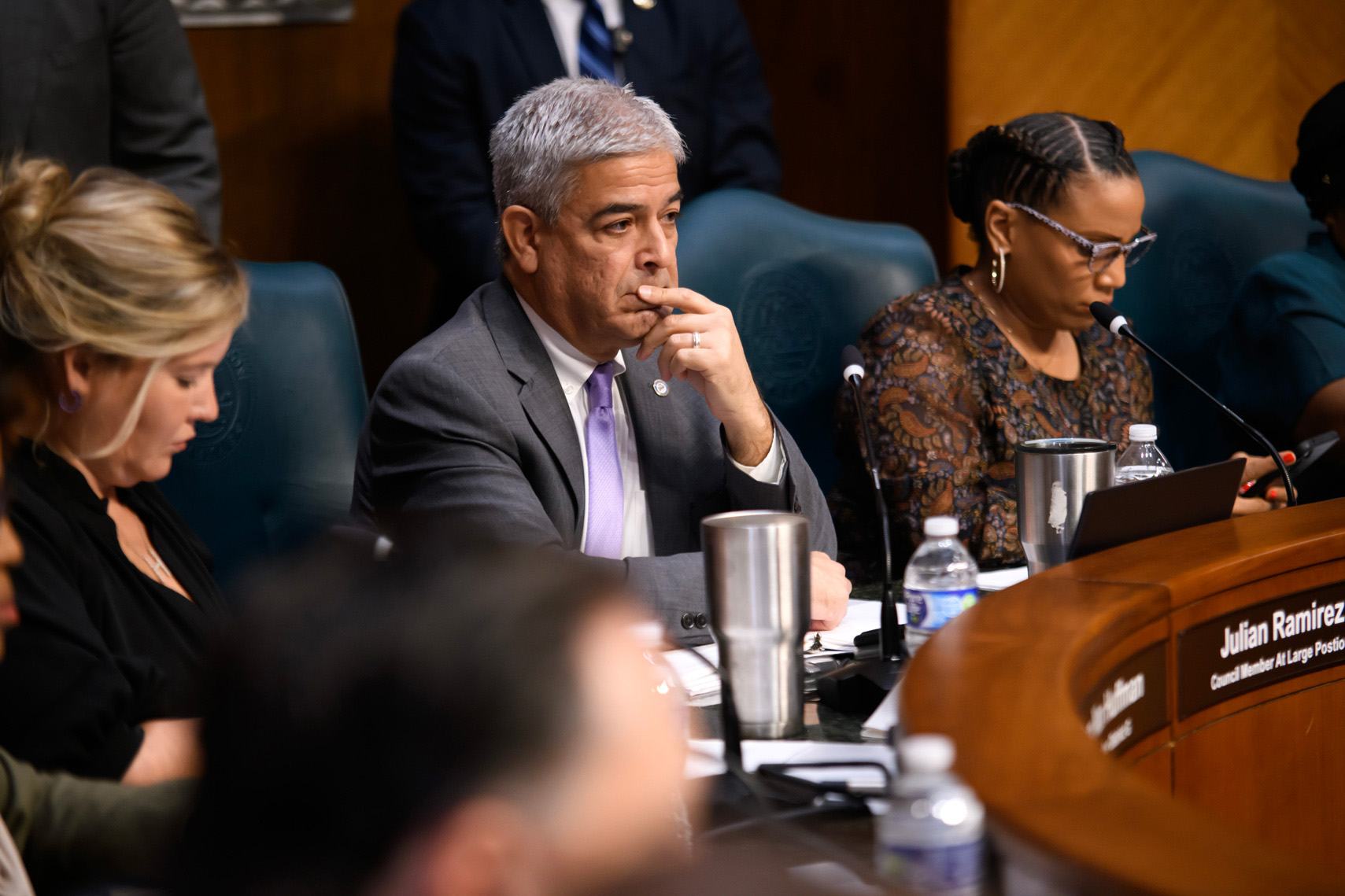
At-Large Councilmember Julian Ramirez questioned why the individual businesses who received the most and the least amount of money in contracts were not removed from the analysis.
“I’m also a little bit baffled that they’re considering dollars spent, as opposed to number of people actually getting the work, right?” Ramirez said after the meeting. “So, you could have one company that gets all the business. Nobody else is getting any of the business. Does that mean there’s not a disparity anymore?”
Councilmembers Joaquin Martinez and Edward Pollard also wanted to know how availability of firms impacted the data because if one group had more certifications for a specific type of contract, it may skew the numbers, they said.
Reporter Monroe Trombly contributed to this story.

