


Deputies in Harris County Constable Precinct 4 initiated dozens of high-speed chases every year over nonviolent, low-level offenses, a Houston Landing investigation has found, resulting in at least nine fatalities since 2021 — a death toll far exceeding that of Harris County’s seven other constable precincts.
Among the dead are a 16-year-old Cypress Creek High School student who crashed while a deputy pursued him for speeding on an empty roadway and two other teenagers suspected of stealing car parts.
Policing experts who reviewed Precinct 4 pursuit data called such chases “crazy” and criticized the precinct’s policy as out of touch with modern best practices.
“Given the high risk associated with pursuits, you should engage in pursuit only if the person you’re pursuing has been involved in a violent crime and there is an imminent threat involved,” said Chuck Wexler, executive director of the nonprofit Police Executive Research Forum, specialized in providing technical assistance and high-level training for law enforcement agencies. “The most important aspect of any policing decision is the sanctity of human life, and that’s what’s involved here.”
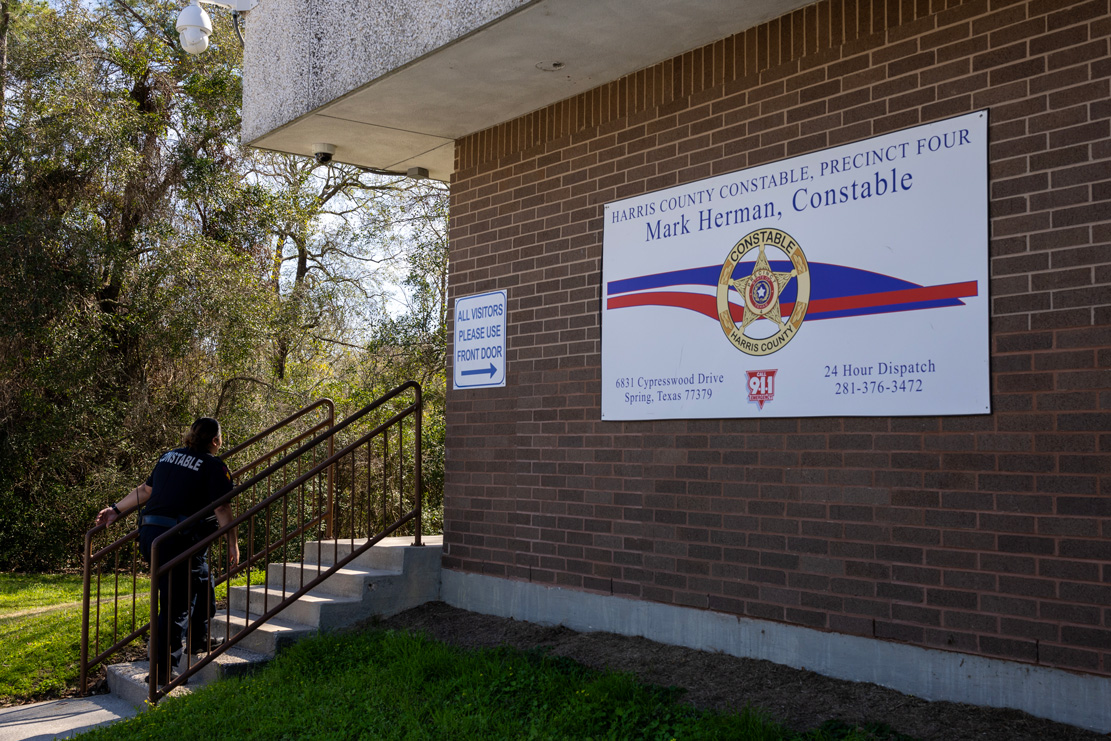
Neither Constable Mark Herman, who leads Precinct 4, or the precinct’s chief deputy Donald Steward, responded to multiple requests for comment via email and phone on the Landing’s findings.

Precinct 4’s pursuit policy does note the hazards of vehicular chases, instructing officers to consider the “seriousness of the offense” and “balance the need for pursuit and apprehension against the probability and severity of damage and/or injury.”
Yet a Houston Landing review of agency data shows that the majority of Precinct 4’s pursuits respond to low-level, nonviolent offenses. In 2024, for example, more than half of the agency’s 137 chases started because of minor traffic violations like speeding, lacking a front license plate or driving with a broken tail light.
Usually, such minor offenses are punishable only by fine. Yet of Precinct 4’s traffic-related pursuits in 2024, 23 ended in crashes; 41 pursuits reached speeds of 90 miles per hour or greater. And in 11 instances, the pursuits reached speeds greater than 90 miles an hour and resulted in crashes.
“That makes no sense,” said Wexler, presented with the Landing’s findings. “Why engage in that pursuit and put everybody’s lives at risk when the consequences are so minimal for any of those activities?”


Precinct 4 is not alone in relying on an outdated pursuit policy. A Houston Landing review of pursuit policies for Harris County’s eight constable precincts found that none impose clear restrictions on the justification for a pursuit as best practices suggest. (Precinct 7, led by Constable James “Smokie” Phillips, said that their policy is currently pending revision but did not specify what the revision entailed.)
Policing experts said that leaves the law enforcement agencies dangerously out of touch with modern standards.
“If you’re going to engage in an activity that puts the community at risk, which pursuits do, then it has to be balanced against the need to immediately apprehend that person,” said Ian Adams, an assistant professor of criminology at the University of South Carolina. “We probably shouldn’t be doing things that end up killing people or seriously injuring them over a broken tail light.”
Policy ‘well outside the norm’
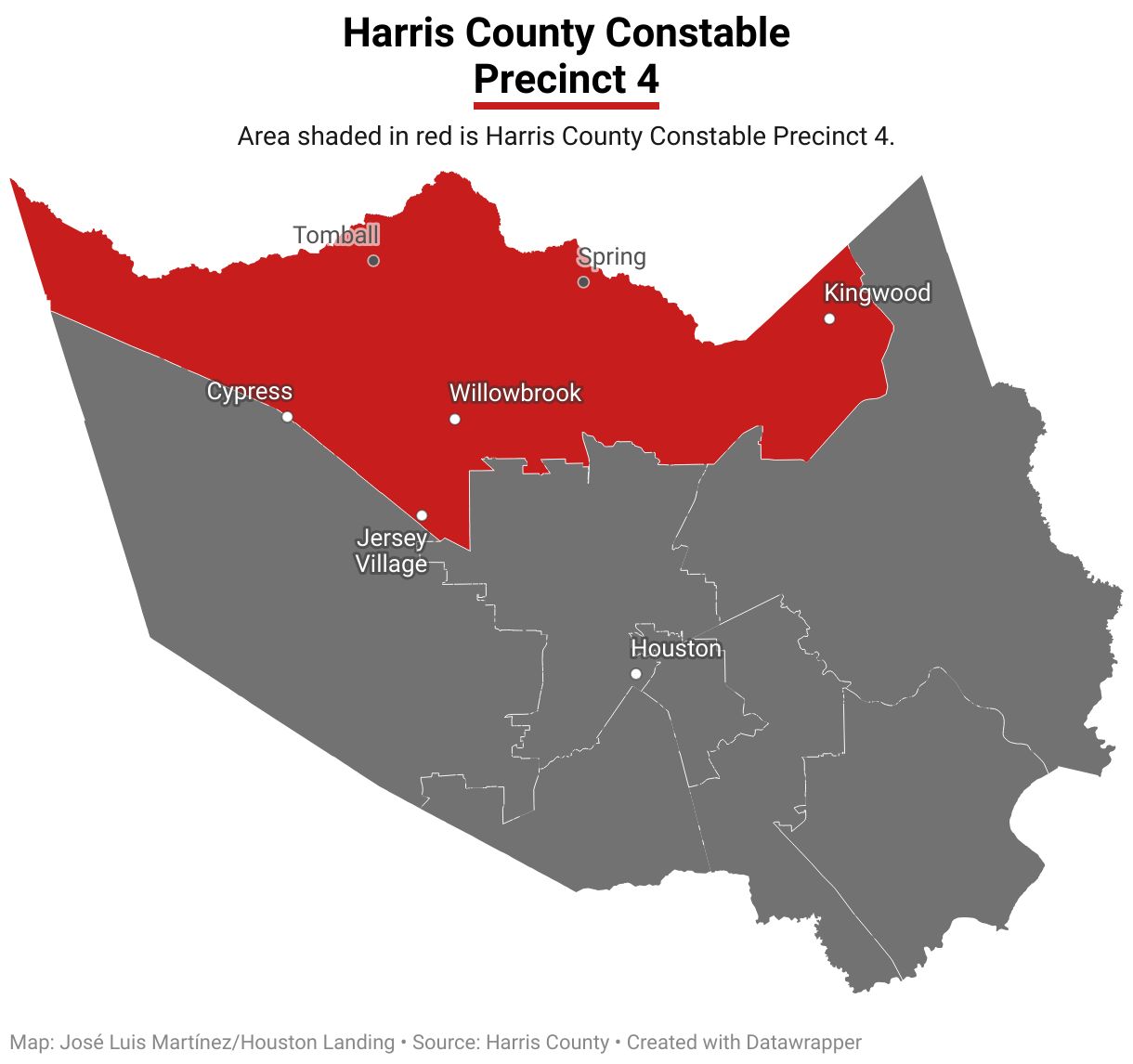
Precinct 4 is the largest constable precinct in Texas, spanning more than 500 square miles in the northern and northwest parts of Harris County, including Humble, Spring and Cypress. Herman, the Precinct 4 constable, oversees more than 600 deputies and an operating budget north of $66 million.

Among a myriad of other activities, Precinct 4 deputies are heavily involved in traffic enforcement. Data maintained by the Texas Commission on Law Enforcement shows that Precinct 4 made more than 104,000 traffic stops in 2023, the most recent year data is available, compared to about 46,000 stops by Precinct 5, Harris County’s next-largest constable precinct.
At the same time, the agency’s pursuit policy permits chases in response to even minor traffic violations, leading to numerous fatal crashes since 2021. Section 20.01 of Precinct 4’s Pursuit Policies specifically defines pursuit driving as the “pursuit and apprehension of a traffic violator or felony suspect in a moving motor vehicle.”
In one case in 2023, a high schooler died after he failed to pull over when a deputy attempted to stop him for speeding. Radar clocked a small sport utility vehicle driving 82 miles per hour in a 65-mile-per-hour zone on Sam Houston Parkway at 2:17 am. The roadway was empty of other cars, according to a police report documenting the incident, yet the deputy initiated a pursuit.
The speeding vehicle accelerated to 115 miles per hour before losing control, careening off the road and ramming into a small tree. The 16-year-old driver died instantly. A passenger, also a minor, was pulled from the wreckage with two broken arms and a broken leg. (Later, deputies learned the car had been reported stolen.)
In another case in 2024, a deputy came upon a vehicle at an intersection “doing donuts,” a driving maneuver that spins the car in circles. The vehicle fled when the deputy initiated a traffic stop and soon crashed, killing three people — the 33-year-old driver and two 18-year-old passengers. A third passenger, the crash’s sole survivor, would spend weeks in intensive care.
Yet Houston Landing’s review of pursuit data between 2021 and 2024 found that chases like the ones that resulted in the deadly crashes are the norm in Precinct 4, not the exception.
For this investigation, the Landing analyzed hundreds of findings by the Pursuit Review Board, a committee of Precinct 4 supervisors that reviews deputies’ post-pursuit forms for policy violations. Led by Captain James Blackledge, the board reviewed every pursuit initiated by Precinct 4 deputies in 2024. Its oversight between 2021 and 2023, however, was more sporadic, leaving the total number of pursuits undertaken by Precinct 4 deputies in that time frame uncertain.
Among the Landing’s findings:
- Between 2021 and 2024, Precinct 4 deputies initiated at least 451 pursuits, 312 of which began because of traffic violations. In 2024, the only year complete data was available, just four pursuits involved drivers suspected of a violent crime.
- Meanwhile, six pursuits ended in fatal crashes between 2021 and 2024, killing a total of nine people. Five of the fatal crashes occurred during pursuits over traffic violations such as speeding, wrong-way driving or doing donuts at an intersection, and the sixth began because two teenagers were suspected of stealing catalytic converters.
- Between 2021 and 2024, minor traffic violations were often the impetus for lengthy and/or high-speed chases. In 2024, these included one 16-mile pursuit with a maximum speed of 140 miles per hour that began because a driver failed to signal a lane change, according to the pursuit data reviewed by the Landing. Another, also in 2024, began because a driver lacked a front license plate. That pursuit reached a speed of 125 miles per hour.
- At least 112 pursuits between 2021 and 2024 ended in a crash, representing nearly a quarter of all chases the Landing analyzed in that time frame. Overall, deputies and their supervisors terminated 50 chases.
- Only two of the instances, one in 2024 and another in 2022, involved the controversial PIT maneuver or Precision Immobilization Technique, but they did not lead to crashes or injuries, records show. These pursuits reached maximum speeds of 107 mph and 80 mph, respectively. The PIT maneuver involves the pursuing vehicle making intentional contact with the rear quarter panel of the fleeing vehicle, causing it to spin and lose control and effectively stopping the chase.
- In no instance reviewed by the Landing was a deputy disciplined for initiating a pursuit. On the 18 occasions between 2021 and 2024 when deputies were found to have violated policy, it was for attempting to conduct a roadblock, failing to use their sirens or failing to notify dispatch about the pursuit.
- Deputies mostly pursued suspects of color in the cases reviewed by the Landing. Those whose race could be identified included 176 Black drivers, 105 Hispanic or Latino drivers and 14 Asian drivers, compared to 73 white drivers.

Many of Precinct 4’s practices go against national best practices around pursuits, notably those outlined in a 2023 report published by the Police Executive Research Forum in cooperation with the U.S. Department of Justice.
In it, a committee of researchers and law enforcement officials urged agencies to “adopt restrictive vehicle pursuit philosophies that permit pursuits only for a limited and serious set of circumstances, which should be clearly and specifically articulated.”
Those circumstances should be limited only to instances when “a violent crime has been committed and… the suspect poses an imminent threat to commit another violent crime,” the authors of the report wrote, citing the high risk of injury and death associated with high-speed chases.
Yet Precinct 4’s policy places no such restrictions on deputies. Adams, the University of South Carolina criminologist, said that it lacks an emphasis on an officer’s duty to protect human life, including the lives of suspects.
“(Precinct 4’s) policy makes an attempt to engage with the most important general practice — balancing the danger of a pursuit with the need to immediately apprehend the fleeing subject,” Adams told the Landing. “But the policy stands well outside the norm in these policy types by not providing some of the basic factors that officers should consider… All in all it’s a fairly weak policy that doesn’t provide the level of information and administrative control that we would generally see.”
Esther Seoanes, executive director of the nonprofit PursuitSAFETY, which advocates for tighter pursuit regulations, said the policy makes it “too easy” for Precinct 4 deputies to launch into dangerous chases.
“It shows in their data,” said Seoanes, whose husband was killed during a police pursuit in Austin in 2012. “Their only recourse is chasing… This is not okay, and it should not be allowed. Their precinct should be reviewed. What kind of accountability do they have to the public?”
‘At what cost?’
None of Harris County’s eight constable precincts impose the stringent restrictions outlined in the Police Executive Research Forum report.
In this regard, the constables mirror the policy in place at the Harris County Sheriff’s Office. It remains at odds with Harris County’s other major law enforcement agency — the Houston Police Department, which changed its pursuit policy in 2023 after an investigation by the Houston Chronicle showed the majority of its chases began over traffic violations. Now, the Houston Police Department prohibits pursuits over such low-level offenses.
Some constable precincts cite traffic violations or misdemeanor crimes as reasons a pursuit “may be terminated.” However, none forbade deputies from initiating a chase or giving hundreds of officers across Harris County the discretion to initiate high-speed chases over minor infractions.
Of Harris County’s eight constable precincts, just two responded to a request for comment on their policies. Jason Finnen, a chief deputy in Precinct 8, noted that his precinct’s policy requires deputies to “terminate pursuits when the hazard becomes too high.” Finnen acknowledged the dangers of pursuits but said the precinct has elected “to give field supervisors the opportunity to gauge each case and make a decision based on all factors.”
Precinct 2, meanwhile, told the Landing that it is currently reviewing its policies “with a particular focus on vehicular pursuit practices,” part of an “ongoing commitment to ensure our operations reflect best practices and meet the evolving needs of our community.
“We are conducting thorough research to identify policies that will enhance safety, improve public trust and align with community concerns,” Precinct 2 command staff told the Landing in an email.
In general, the constables’ policies do emphasize the importance of preserving human life. The policies all require deputies to consider safety in their decision-making, often factoring in variables like the severity of the offense and weather, road and traffic conditions.

For example, the pursuit policy in Precinct 5, led by Constable Terry Allbritton, states that the office “places a high value upon the life and safety of each of its deputies and the public at large… This value on human life must be reconciled with the authority of a peace officer to engage in a pursuit.”
Similarly, Precinct 6, led by Constable Silvia Trevino, instructs pursuing deputies to “drive with due regard for the safety of all persons.”
However, only Precinct 3, led by Constable Sherman Eagleton, provides any guidelines on pursuits over low-level misdemeanors.
“In the pursuit of a Class C misdemeanor, pursuit may also be justified if the deputy reasonably believes that the suspect, if allowed to flee, would present a danger to human life or cause serious injury,” the policy states.
Experts agree that modern best practices urge law enforcement agencies to adopt tighter, more specific restrictions.
“You can get someone the next day but you can’t get a life back,” said Wexler, of the Police Executive Research Forum. “It’s sad to hear these stories… You need to have very specific criteria (in your policies) or you put everybody’s lives at risk. At the end of the day you have to say, at what cost?”

