

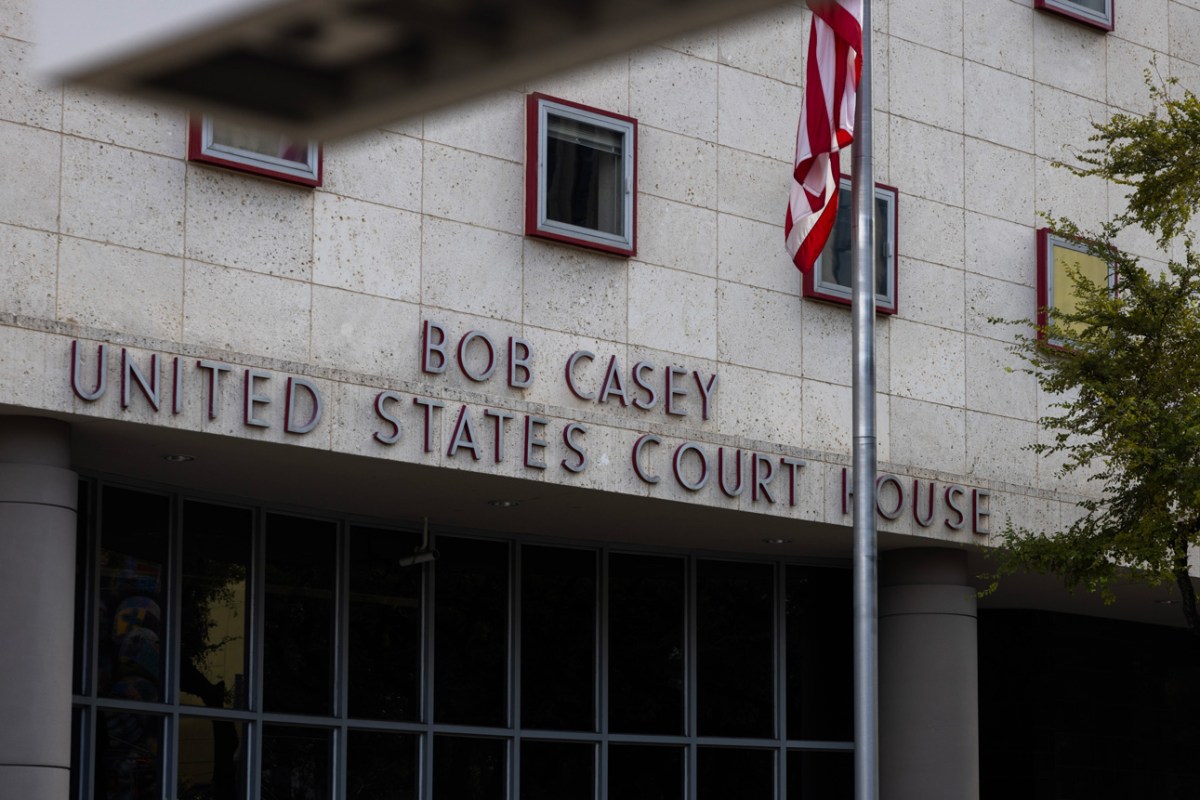
A Magnolia man pleaded guilty in federal court in Houston to extorting sexually explicit photos and videos from teenage girls, which he then sold online.
The man, Andrew Venegas, admitted on Tuesday to coercing three teenagers into producing pornographic photographs and videos and threatening to leak the material if he did not receive more. He also admitted to possessing what a federal prosecutor called a “large and disturbing” collection of child pornography.
Venegas, 25, was initially indicted in August 2023 in connection with allegations from two teenage girls that he had forced them into sending explicit pictures and videos of themselves.
He was subsequently indicted on three additional counts of child exploitation related to similar allegations from three other teenagers, bringing the total number of charges against him to nine.
On Tuesday, Venegas pleaded guilty to five charges. He faces the possibility of decades in federal prison and, once released, will be required to register as a sex offender for life, no matter where he resides, according to Assistant U.S. Attorney Luis Batarse, who prosecuted the case.
Court records show that Venegas first attracted the attention of federal authorities in 2022 during an investigation into two websites that sold sexually explicit images. According to Batarse, Venegas was considered one of the most prolific content producers on the sites and frequently provided identifying information about the girls featured in the photos. A complaint supporting Venegas’ arrest said law enforcement believed there were 1,000 women whose images had been posted on one of the websites.
Authorities traced images back to Venegas by examining watermarks embedded in them, according to court records. The watermarks included phrases associated with an online alias that Venegas frequently used, according to Batarse, which ultimately led investigators to a Telegram channel where Venegas advertised his services.
Court records show that in 2023, an undercover law enforcement officer in Virginia purchased a package of images using cryptocurrency from a Telegram account linked to Venegas. The officer was able to download part of the file before Venegas interrupted the download, claiming that it was taking too long.
Of the three teenagers Venegas admitted to coercing, one reported to authorities that he hacked into her Snapchat account and threatened to distribute private photos she had taken of herself if she did not create explicit content.
Another teenager reported that she sent photographs to Venegas in exchange for money after a female Instagram user told her she had been earning money in a similar way. However, according to Batarse, Venegas threatened to share the photos with her parents if she did not provide more. (It’s unclear whether Venegas pretended to be the Instagram user.)
A third teenager said that Venegas reached out to her on Snapchat about creating pornographic material for money. However, the promised payment never came through, and she was threatened to produce more material or face the risk of having the existing content leaked, according to Batarse.
When Venegas was arrested in 2023, authorities discovered a substantial collection of child pornography on his devices, including clips of children who appeared to be between five and 12 years old, Batarse said.
Defense attorney Trevor Sharon of Paul Doyle & Associates told Kenneth Hoyt, the federal judge overseeing the case, that the plea agreement was the best outcome for his client.
Venegas is scheduled to be sentenced by Hoyt in June.
How to protect yourself
Here are several tips from the FBI on how to protect yourself from becoming a victim of sextortion:
– Be cautious about what you share online. If your social media accounts are public and accessible to everyone, someone can learn a great deal about you.
– Be wary of anyone you encounter online. Block or ignore messages from strangers.
– Be aware that people can pretend to be anything or anyone online. Videos and photos are not proof that people are who they claim to be, and images can easily be altered or stolen.
– Be suspicious if you meet someone in a game or on social media and the person asks you to start talking on a different platform.
– Be in the know. Any content you create and post online, whether a text message, photo, or video, can be made public. Nothing ever “disappears” online. Once you send something, you don’t have any control over where it goes next.

