

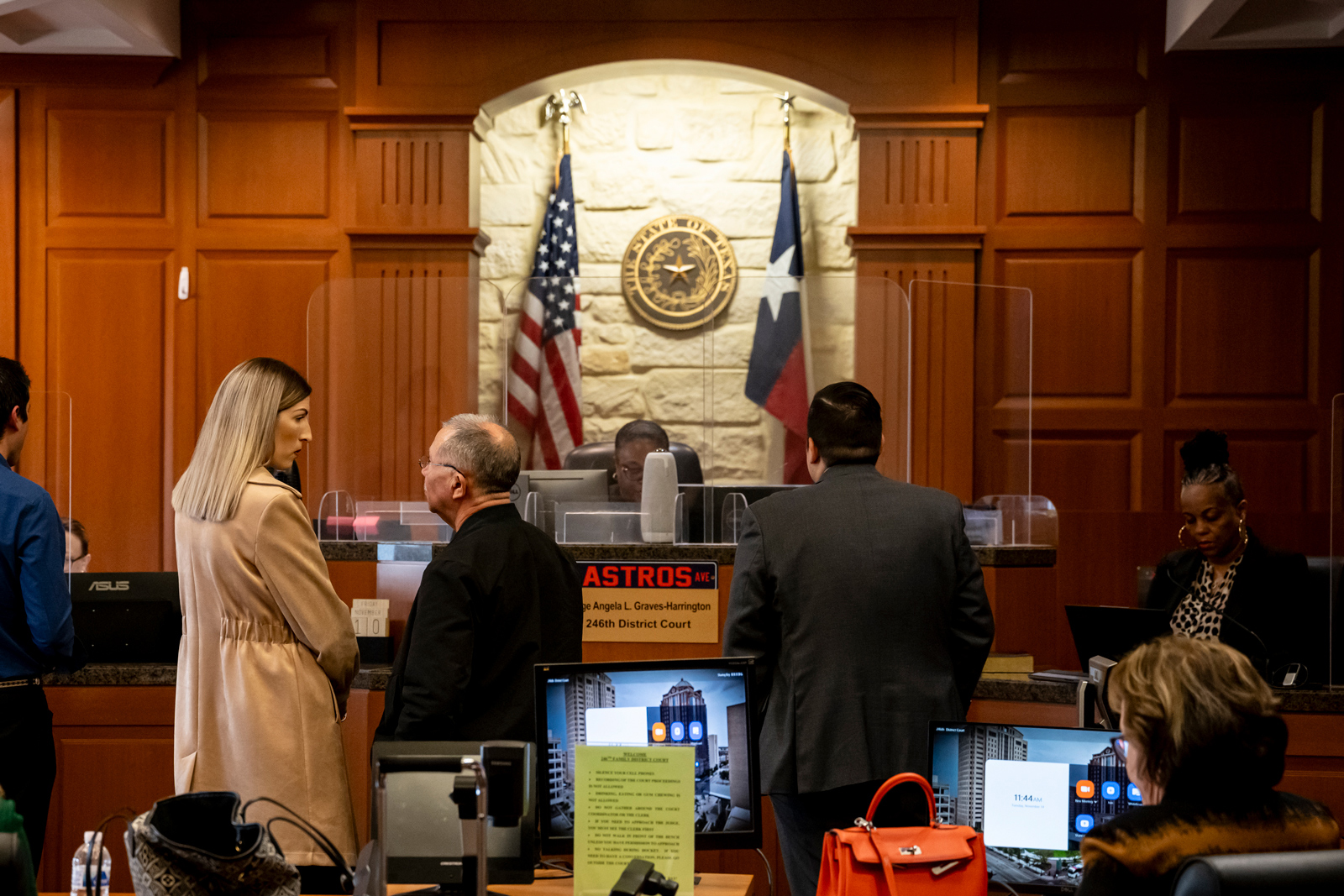
When Ramya Varanasi decided to file for divorce and custody of her child, she thought it would be simple. After all, she had proof of the threats. There were text messages, audio and video.
Navigating the court system proved anything but straightforward, however, because English is not her native tongue.
Varanasi, who grew up speaking Telugu in India, wound up spending hours each day calling interpreters and translation companies that might be able to help. The calls became so time consuming that sometimes she would have to set her son up in the other room and put her parents on a video call to watch him.
“I’m single, I don’t have any support, I don’t know anyone here (in Houston), so there is nobody to watch my child for an hour to give me the peace to make these calls and I was trying to find a job,” she said. “I have enough on my plate already — and then I have to find interpreters and translators.”
The added costs of interpreters — which can run hundreds of dollars a hearing — often forces people to make impossible decisions.
Harris County has long afforded free interpreters to people navigating criminal cases, but it does not always offer the same to those with civil cases, local lawyers say. The denial for interpreters has become so routine that some legal advocates say they rarely even submit requests anymore.
Harris County has a population of 4.7 million people who speak more than 145 languages, according to U.S. Census Data. The county, however, has only 92 court-certified interpreters, according to the Texas Office of Court Administration Judicial Branch Certification Commission database that tracks the information.
Legal advocates and attorneys say the lack of interpreters, combined with what they say is a lack of cooperation from the judiciary, creates an unnecessary barrier for people to get justice.
The problem is not unique or new to Houston.
In 2010, Harris County was sued by the Texas Civil Rights Project for not providing a civil court interpreter to a woman with limited English proficiency. The woman, who was not named in the lawsuit, had gone to court to seek a protective order, custody of her young daughter and child support after leaving an abusive relationship. Living in a shelter and barely able to support her family, the woman was forced to pay more than $1,000 to hire interpreters to attend hearings.
The county ended up agreeing to a settlement in which it committed to adopting a formal plan to provide interpreters to indigent litigants and witnesses in civil hearings relating to family matters.
In neighboring Fort Bend County, the U.S. Department of Justice launched an investigation in 2021 in response to complaints that its district and county courts had denied meaningful access to people with limited English proficiency. The probe ended in a settlement that required the county to develop a plan for tackling language barriers, including offering interpreters for free in civil and criminal cases. Federal investigators said in August 2023 that the jurisdiction complied with its settlement terms and closed the investigation.
Harris County Commissioners Adrian Garcia and Lesley Briones say the problem has long been on their radar. If the county does not solve the problem, Garcia said he fears the county could face a federal investigation next.
The Commissioners Court’s power is limited, however: the county could develop a more comprehensive policy to fund interpreters at the civil courthouse, but it is up to courts and judges to implement and utilize that policy.
Unequal access
Karleana L. Farias, a family law attorney based in The Heights, said she regularly tells clients they will have to foot the bill for an interpreter on top of their legal fees because the court will not provide one for them.
She said clients often are confused and ask why they are being treated differently than someone whose first language is English. Farias said all she can do is agree that it is unfair.
“The other side didn’t have to pay that to present their claims,” said Farias, who describes herself as a fiscal conservative. “That’s not equal access to justice. That is unequal access to justice.”
Certified interpreters are required in court for a number of reasons, including conflicts of interest and a need for specialized training to avoid making mistakes while translating complex testimony.
Interpreters in Houston often require a two-hour minimum for services, which can present an additional obstacle to litigants. In addition to the financial burden — services typically can cost $200 or more an hour — it can present logistical challenges.
Case hearings often last mere minutes, lawyers said, and frequently are postponed. Clients, nonetheless, still are on the hook for the interpreter minimum. And if a case goes to trial, an individual could be looking at thousands of dollars just to make sure they understand what is going on. The cost, lawyers said, often results in people opting to drop their legal cases.
One of Farias’ clients last year spoke Arabic as a first language. Twice, hearings were held via Zoom and lasted all of five minutes, before the trial was delayed. The client’s interpreter bill for the two hearings totaled more than $800.
Farias, who is from Puerto Rico and speaks Spanish and Portuguese, grew so frustrated with the problem that she took her concern to Harris County Commissioners Court several times last fall.
After Farias spoke, Garcia and Briones said the county was aware of the problem and was “taking care of it.”
Garcia said local civil courts have a “haphazard interpreter process” and said he directed the Harris County Budget of Office and Management and the Office of County Administration to create a better framework for those services.
He also touted a $515,000 grant the county received from the Houston Endowment to establish a language access program. (The Houston Endowment is a founding funder of the Houston Landing.) While the grant has the potential to make an impact on civil court services, it is aimed at improving a variety of language services throughout the county.
“We’re addressing it, we have a plan, we sought out funding, and so I’m very hopeful that the experiences of the past will be a thing of the past,” Garcia said.
Plan drafted
The Office of County Administration said it first was contacted by Judge Lina Hidalgo in 2021 to draft a plan for providing interpreters in the court system.
A county administration spokesperson said the courts are reviewing that plan and “working with county officials on next steps.”
Harris County State District Courts said it is the other way around — the judiciary accepted the new plan and now is waiting on county officials to move forward, spokeswoman Amanda Cain said.
Though budget records show interpreter costs have risen the past two years, from $2.6 million to $3.4 million, the county does not track what is being spent on the criminal side versus civil. About half of that allocated money stems from the Language Access Fund, which can only be used for people navigating the legal system who need language services. The fund was established as a result of Texas Senate Bill 41 which targeted and increased some civil courts fees.
Garcia said although Commissioners Court can allocate more funding for interpreters, the obligation is on the judges to provide those services.
“The Harris County State District Courts have implemented and followed their 2012 policy and have routinely provided free interpreters to litigants,” Cain said. “We’re unaware of any systemic problems.”
Farias disagreed, and said she filed a complaint with the Department of Justice last fall.
“On the civil side, there has not been a focus on equal access to justice,” she said. “It’s honorless. It is impossible to many people. So, they end up reaching agreements that may not work. And then they just lead to more litigation — all because the costs associated with having your day in court is so unbelievably high.”
Farias said the county could eliminate the problem if it allocated a few million dollars to the civil courts each year for interpreters, just as it does on the criminal side. To help offset the costs, the county could add a small fee on top of its regular filing fees, she suggested.
For Virginia Prada, a client of Farias’ firm, the problem is all too real.
Her youngest daughter, who is 1 year old, has scoliosis and Marfan syndrome, a genetic condition that affects the connective tissue and requires routine, costly medical care.
Prada, 34, who works as a legal assistant at an immigration law firm, filed for divorce from her English-speaking husband. Though Prada understands and can speak English, it is not her first language and to get her point across in court and fully understand the proceedings, she and her lawyer thought it would be best to have an interpreter.
That interpreter would have cost her at least $500 for just one court proceeding — and that does not include parking and mileage reimbursement. Ultimately, her lawyer was able to find an interpreter to do the work for free.
“I feel bad,” Prada said in Spanish. ”I don’t think it’s something that’s fair to me, which is why I’m trying to find help. We’re both parents. It’s not just me. It feels like everything is falling on me.”
Help available
Daya, a non-profit organization that supports South Asian domestic violence and sexual assault survivors, regularly helps survivors who need interpreters get through the legal system.
Nusrat Ameen, senior director at Daya, said “it’s a well-known problem” that Harris County courts frequently leave non-English speakers on the hook for an interpreter.
The organization has some money dedicated for interpreter services, Ameen said, but not enough to cover the need. Usually, she said, the group tries to help with other costs, including groceries or rent, so clients can afford an interpreter.
“Our clients don’t feel heard by the courts,” Ameen said. “They don’t feel valued, they feel very disillusioned, and they don’t have a lot of hope for justice to come out of the legal system.”
Ameen said she has tried talking with local and federal officials about the issue.
“The onus shouldnt be on us,” she said. “It is the responsibility of the government to ensure language accessibility.”
For Varanasi, Daya was her lifeline.
The organization gave her money for food and enrolled her in life skills classes, helping her craft and polish resumes and practice job interviews. It even provided automobile rides as needed.
Varanasi ended up spending more than $80,000 on her divorce and custody battle — easily double what her English-speaking ex spent.
“It was a nightmare,” she said. “And I still don’t understand why the court didn’t provide me a translator — it’s what they are supposed to do.”
Reporter Angelica Perez contributed to this article.

