


After Hurricane Beryl tore through Houston earlier this month, the streets of East Little York in northeast Houston were choked with several feet of floodwater. Two weeks later, a shallow pool of water remained at the bottom of Kenneth Coffman’s driveway.
Throughout the neighborhood where his family has lived for 60 years, puddles still dotted streets, yards, drainage ditches and old tires, perfect breeding grounds for the mosquitoes that have been swarming Coffman, his neighbors and most of Houston in recent weeks.
“The bugs have for sure gotten worse since the storm,” Coffman said. “It’s like that every time it floods.”
Local health authorities worry the post-Beryl explosion of the blood-sucking insects could become more than a nuisance, raising the risk of infections of West Nile and other mosquito-borne illnesses.

At least 496 mosquito samples have tested positive for the West Nile virus across the county so far this year, according to Harris County Public Health figures. The department recorded 50 positive samples last year, and less than 400 in 2021 and 2022 combined.
As of Wednesday, seven human cases of West Nile have been confirmed since Beryl, said Dr. Max Vigilant, director of Harris County Public Health’s Mosquito and Vector Control. None had been recorded before the storm, he said.
ALL ABUZZ: Yes, there are actually more mosquitoes in Houston this year. Here’s how to avoid getting swarmed.
West Nile virus is the leading cause of mosquito-borne disease in the United States, according to the Texas Department of Health and Human Services. Roughly one in five infected people will develop mild flu-like symptoms. Perhaps one in 150 people will suffer a more severe case of West Nile, develop other illnesses, such as encephalitis, or suffer permanent brain damage.
“We too often forget that this part of the country has a particular vulnerability to mosquito-transmitted virus infections,” said Dr. Peter Hotez, dean of the National School of Tropical Medicine at Baylor College of Medicine and co-director of the Texas Children’s Hospital Center for Vaccine Development. “With (Harris County Mosquito and Vector Control) getting lots of positive samples for West Nile, plus several positive human cases after Beryl in Harris County, you put all of that together, it could be a real problem.”
Mosquito populations typically boom after major rain events such as Beryl. That does not always mean mosquito-borne diseases increase in humans, however.
“West Nile virus is unpredictable,” Vigilant said. “Normally, what you see after a storm is that the number of diseased mosquitoes are less, because you get blow-out and you get wash-out. So, those mosquitoes that survive have to lay again, then hatch again.”
EXPLAINED: A mosquito sample just tested positive for West Nile virus in Houston. Here’s what to know.
After Hurricane Harvey swept through the Texas Gulf Coast region in 2017, Houston saw a spike in the overall mosquito population without a corresponding jump in human West Nile virus cases, Vigilant said.

A puddle outside Kenneth Coffman’s family home in Northeast Houston, Tuesday, July 23, 2024, in Houston. Mosquito numbers have risen over the past week after Hurricane Beryl and a series of storms passes through Houston. (Antranik Tavitian / Houston Landing) 
Ronald Demery opens the side gate to his backyard at his home in Northeast Houston, Tuesday, July 23, 2024, in Houston. (Antranik Tavitian / Houston Landing) 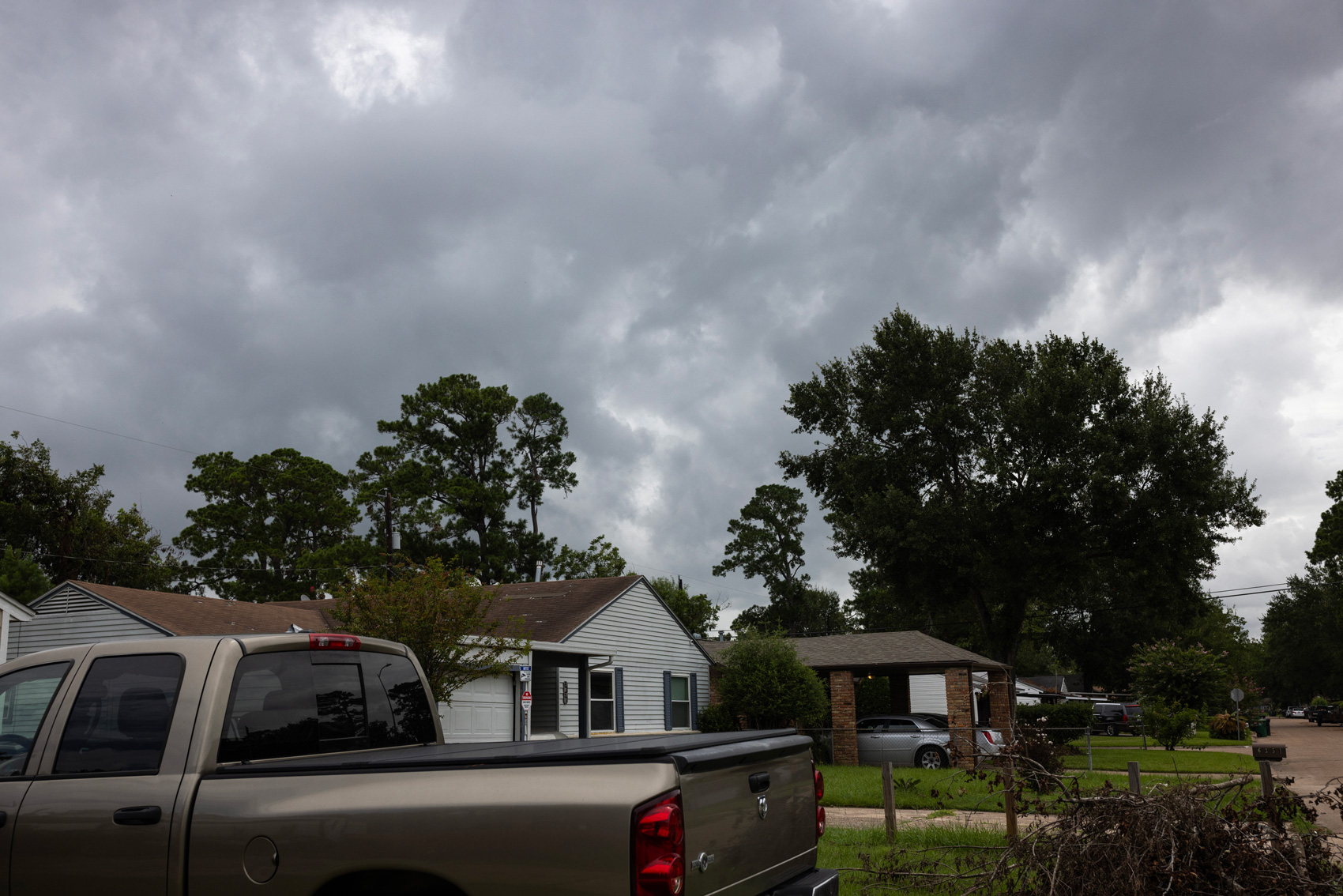
A storm passes by Northeast Houston, Tuesday, July 23, 2024, in Houston. (Antranik Tavitian / Houston Landing) 
Storm damage on the back side of Ronald Demery’s home in Northeast Houston, Tuesday, July 23, 2024, in Houston. (Antranik Tavitian / Houston Landing) 
Storm damage on the back side of Ronald Demery’s home in Northeast Houston, Tuesday, July 23, 2024, in Houston. (Antranik Tavitian / Houston Landing)
Some evidence suggests that major tropical storm events can lead to an increase in West Nile virus cases in humans, however. A 2008 study by researchers at Tulane University School of Public health found positive human cases in regions of Louisiana and Mississippi more than doubled the year after Hurricane Katrina hit the region.
The health department’s mosquito control division divides Harris County into 268 ‘operational areas’ and tests for West Nile and other mosquito-borne illnesses within each. When samples return positive, Vigilant said, the county deploys disease control tools, including the spraying of chemicals to kill mosquito larvae.
County data from this summer suggests the West Nile virus is spreading fast within the county’s mosquito population, at least.
The county’s first positive West Nile mosquito sample emerged in May; only 11 more samples tested positive that month. In June, however, 330 samples – around 25 percent of the total tested – came back positive.
So far this month, 174 samples had tested positive as of Wednesday, including 40 since Beryl hit the Houston area 16 days ago.
Positive samples have been collected in at least 165 of the county’s 260 operational areas, Vigilant said.
Neighborhoods like Kenneth Coffman’s – among the poorest in the county – probably face the greatest risk, Hotez said.
“If you drive through these neighborhoods, you see uncleared drainage ditches, neighborhoods with uncollected debris,” he said. “This is perfect for mosquitoes.”
Ronald Demery, Coffman’s neighbor across the street, knew a bug boom was coming after Beryl.
“It was the same thing after Harvey,” he said. “So I’ve really just been staying inside.”

