

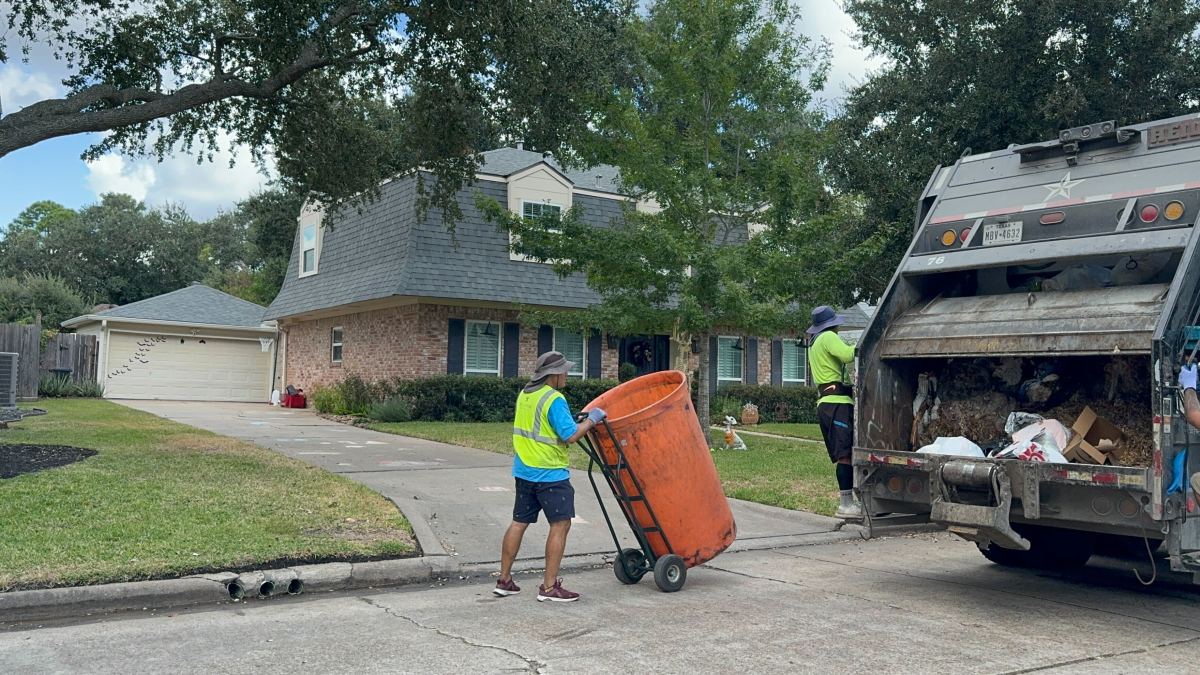
Houston has subsidized the private trash collection of some affluent neighborhoods for almost 40 years, a policy that could complicate the city’s consideration of a monthly garbage fee to help head off a looming budget deficit.
Experts warn that implementing a garbage fee without ending the $3.3 million annual sponsorship to homeowner associations and civic clubs, representing some 47,000 households, could result in an additional burden on lower-income communities.
The city has given participating associations $6 per household each month for their private garbage collection since the 1980s, resulting in neighborhoods with higher average median incomes receiving more frequent services, in part, on the taxpayers’ dime.
The subsidy presents the city with a conundrum amid the Whitmire administration’s efforts to eliminate a budget deficit that is expected to top $200 million in fiscal 2025.
Keeping the subsidy while imposing a garbage fee on the 437,000 households whose trash is collected by the city could provide an incentive for more neighborhoods to switch to private services, which would leave lower-income residents paying for more infrequent service.
Do away with the subsidy and some of those HOAs and civic clubs could decide to change to city collection, raising the question of whether Houston has the capacity to add new neighborhoods to existing routes.
Mayor Sylvestor Turner unsuccessfully tried to eliminate the subsidy eight years ago and faced criticism from affected residents. The idea has not been publicly raised since.
Officials have talked about and resisted a garbage fee for decades, making Houston a state outlier. Each of the state’s largest cities has a garbage fee, ranging from $27.65 in Austin for a 32 gallon bin to $37.81 per month in Dallas.
The idea has reemerged in Houston this year as the city faces a growing deficit.
Switching to a monthly garbage fee could free up more than $107 million a year – the annual cost of operating the Department of Solid Waste Management.
John Diamond, an economist with Rice University, did not know the reason the city historically has resisted a garbage fee, but said implementing one could have results at the ballot box.
“Does it end up just being close enough to a wash that the political fallout from such a move is just not worth it?” Diamond said.
Subsidy support
The city spends more than $3.3 million a year to subsidize private garbage collection for residents who live within participating civic or homeowners associations – accounting for 10 percent of the households needing garbage collection services.
District G residents represent almost 45 percent of all sponsored households with more than 21,000 participating residents, according to data from the Solid Waste Management Department. District E has the second highest number of participants, 19,000 people.
Together, the city subsidies total more than $2.9 million annually for the two council districts, which have the second and third highest median incomes in the city.
Private trash collection comes with varying benefits depending on the company, but can include two pickups per week, no limit on the number of trash cans and back door collection service. Taking away the subsidy could have wide-reaching effects for some HOAs, an administrator for Lakeside Island told the Landing.
Matt Garvis has worked for Lakeside Island, a neighborhood association in West Houston, for nine years and lives in the area’s larger Lakeside Improvement Association. Prices for garbage collection and constable service have increased in recent years, prompting a recent internal vote to increase the annual fees, he said.
Without the garbage subsidy, the HOA would have an approximate $40,000 hole in its budget, he said.
The subsidy has been at $6 since its inception and reasonably could be raised to compete with inflation, District G Councilmember Mary Nan Huffman told the Landing. Huffman lives in an HOA-represented neighborhood that receives the monthly subsidy, and questioned the viability of a citywide fee.
“What would happen if you don’t pay your garbage fee?” she asked. “Are they going to stop picking up your trash?”
The subsidies save the city money, Huffman said, because it would cost more per household to pick up the trash itself. Houston’s 311 service center data shows that missed trash pickup was one of the most frequent problems reported by residents.
“Even if you know, say, all the neighborhoods in District G decided that they wanted to go back to city trash, the city doesn’t have the capacity to take on these neighborhoods,” Huffman said.
Garvis did not think neighbors would be as upset about the cancellation of the subsidy if they had the option to keep private services without paying the city fee. He said some residents likely would want to switch providers if the city fee was cheaper, but he echoed the concern that the city does not have the capacity.
“I don’t know how many neighborhoods would call their bluff,” he said.
Fee-based model
The administration has not said when to expect results of a third-party study of the Solid Waste Management Department approved in May, but Mayor John Whitmire promised City Council it was not a roundabout way of instituting a fee.
“It’s all-inclusive – efficiencies, cost-effectiveness, performance,” Whitmire said at the time. “It’s not focused primarily on the garbage fee, but really to see how they’re doing so well with so little.”
Solid Waste Management Director Mark Wilfalk supports the idea of a garbage fee. The department would operate more smoothly and save the city money with a fee, Wilfalk said, pointing to the city’s small charge for leasing garbage bins as an example.
By charging a small amount to residents each month for their city trash can, the department does not have to pull the additional $4 million from the general fund, he said.
“So, imagine, what would happen today if the city didn’t have to expense $100-plus million dollars to the Solid Waste Department?” Wilfalk said. “How many more officers could we put out on the streets? How many more firefighters could we put out there? How could that response time improve? What could we do for our parks and the communities and our neighborhoods?”
The success would depend on a fee structure, said Diamond, the Rice University economist.
A garbage fee can be a “regressive tax” on low- and middle-income residents, he said. It also could push more residents to private trash haulers for better service, reducing the city’s income anyway, he said.
“In a sense, we’re moving toward a model of, say, the city just getting out of garbage collection altogether,” Diamond said.
Like many cities, Houston currently contracts with private haulers for commercial and multi-family garbage collection, which adds to the annual expense without the worker salaries or the capital costs of truck maintenance.
Wilfalk anticipates the city switching to a fee-based model in the future to take the strain off the general fund and improve services for residents across the city.
Many cities have a base rate with varying additional costs depending on the size of the garbage bin. In Austin, a 24-gallon bin costs $26.20 monthly, while a 96-gallon bin costs $58.40.
Houston would need to collect at least $20.40 per month with the current number of residents served to break even on the current yearly cost of the Solid Waste Management Department expenses.
“We either invest in the program or we stop complaining about the challenges that the program has,” Wilfalk said.

