

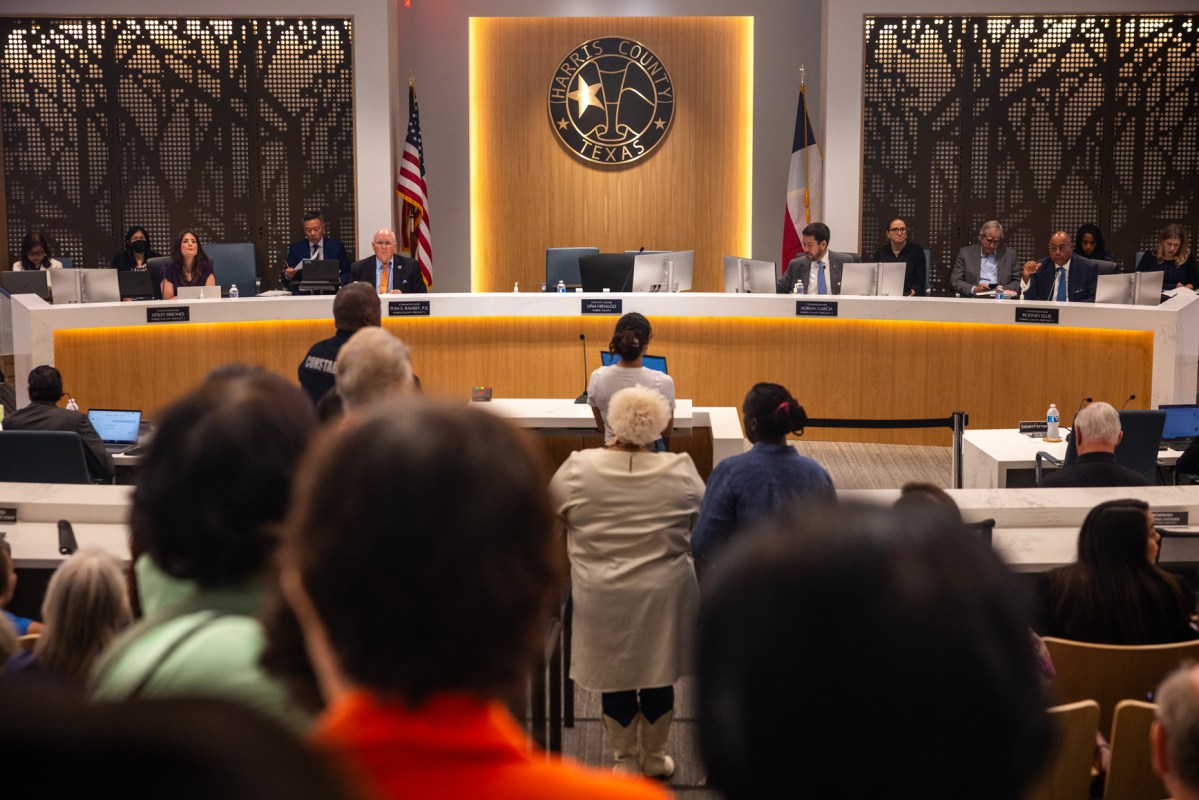
Harris County Commissioners Court agendas regularly run dozens of pages and hundreds of items long. But don’t expect to find much detail.
A Houston Landing review of the cities and counties in the Houston region, found Harris County is among the worst when it comes to posting details of the hundreds of agenda items, including million-dollar contracts, audits and infrastructure projects that make up the county’s $2.6 billion budget.
Of the 49 jurisdictions reviewed, 36 post supplemental or background information for agenda items. Ten governments post only their agendas. Three — including Harris County — post incomplete information.
Houston City Council agendas, for example, regularly include backup materials that include the reason for a measure, whether it is part of an ongoing or new initiative, the cost, the source of funding and who to contact for more information.
While local governments are not legally required to publicly provide these supplemental materials under the Texas Open Meetings Act, transparency experts say it is standard practice to share this information because it breeds trust with the public and is considered good governance.
Justin Kirkland, a professor of politics and public policy at the University of Virginia, said that of any government, people are likely to be more attuned to what is happening locally, which makes it all the more imperative to have accessible records.
“High-quality government recordkeeping is really pretty essential for any kind of government to function the way that it’s supposed to,” he said. “And if you’re going to keep detailed government records, you might as well make them accessible to the public in case citizens want to know what the hell is going on.”
EARLIER: Long meetings, drawn-out debates: Harris County claims to be more transparent. But is it?
Harris County Commissioners Court agendas are inconsistent at best when it comes to including background or supplemental materials related to each agenda item, particularly in advance of the bi-weekly court meetings. Frequently, it will look as if there are details for an item that are included, but the attachment simply repeats the same limited information as the agenda. Often, backup materials are not included in online agenda postings and it can be difficult to find which department has them.
At its most recent Commissioner Court meeting, for example, Harris County had nearly $900,000 in reimbursements for current and former employees to cover legal fees they racked up during a lengthy criminal investigation of a controversial COVID-19 vaccine outreach contract.
There was no way to know who was being reimbursed or why because there was no background materials attached to the agenda listing. The Houston Landing had to ask the Office of County Administration, which took several days to turn over the public records.
‘Pretty problematic’
Harris County’s Office of County Administration, which is responsible for putting together the Commissioner Court agendas, declined to answer questions about supplemental materials and declined an interview request.
Instead, the office issued a statement saying the county has significantly improved its agenda process and transparency over the years: “Recent improvements include expanded electronic access, a new courtroom designed for greater public engagement, and the publication of the discussion list. We will continue to explore ways to make the process even more accessible and efficient for the public.”
Harris County Commissioners Court agendas regularly include more than 400 items, varying in magnitude from sweeping propositions about updating the county jail and allocating federal funding to approving mundane budget line items amounting to as little as $10.
Not all agenda items are discussed individually. Most are passed by a single sweeping vote on what is known as the consent agenda.
Commissioners Court members can add or remove items from the consent agenda for separate discussion and debate as they choose.
Within recent months, Harris County has begun publicly posting a discussion list, but it rarely includes background materials for those agenda items.
RELATED: Efficiency or civic engagement? At Houston city council meetings, you have to pick one
Kirkland said Harris County’s inaccessibility to supplemental meeting materials is “pretty problematic,” particularly because Commissioner Court meetings take place during the work day and can run six hours or more.
“The fact that other counties do a better job is just evidence that it doesn’t have to work that way,” Kirkland said. “In Harris County, they’ve just chosen for it to work that way.”
Brazoria County, for example, includes a complete “agenda packet” that has all the documentation related to the measure and proposals Commissioners Court is expected to vote on or consider.
Jami Geserick, office manager for Brazoria County Judge Matt Sebesta, said the county has made all the materials accessible to the public for years, even before the agendas were digitized and posted online.
“We could just go with the agenda and call it good, but we believe that these are open government records and we are open to public scrutiny,” she said. “We don’t want to hide anything.”
‘Transparent as possible’
Brazoria County regularly has more than 50 items on its agenda, though it can top 100 during busier times of the year, such as budget season.
Before each commissioners court meeting, Geserick and Megan Hudman, senior administrative assistant, work with the county’s 15 different departments to ensure that materials for all agenda items are submitted five days in advance of the meetings. The two then review the materials for proper formatting and to ensure that no personal information, such as home addresses and Social Security numbers, are published. The agenda and packet are then reviewed and published by the county clerk’s office 72 hours before the meeting, per state law.
If a change needs to be made to materials after that deadline, Hudman said an addendum will be made and it will be clearly noted on the materials that something was adjusted.
“I’d rather be transparent than someone think we are hiding something,” Hudman said.
RELATED: Houston City Council meets when many people cannot attend. Should the city change that?
Jasmin Torres, Spring Valley Village city secretary, said that city, along Interstate 10 outside the 610 West Loop, switched to a new platform in recent years that makes it easier to access and search agenda background materials.
Torres, who has been with Spring Valley Village for four years, said it is rare for any materials related to an agenda item to not be shared with the public.
“It’s just to be as transparent as possible,” she said. “We try to answer as much as we can and give as much background. That way, anyone, whether it’s a resident or council member, any of the whys as to what’s going on can be answered.”
Tyler Simko, a political post doctoral research associate at Princeton University, said providing supplemental materials to government decisions should be an “easy transparency” decision, adding that asking citizens to hunt for information or submit formal public records requests is unreasonable.
“You’re not asking local governments to do anything extra,” he said. “They’re already making these materials, sending them to government officials.”
Longstanding practices
Simko said most jurisdictions tend to be good at transparency, but that it often is the small jurisdictions with fewer resources and larger jurisdictions that have more records that fall short in that area.
Around the area, the cities of Anahuac, Galena Park, Hedwig Village, Hempstead, Jacinto City, Taylor Lake Village, South Houston, Southside Place and Waller post their city council agendas without supplemental materials.
EARLIER: Three ways Commissioners Court could shorten its meetings without sacrificing transparency
In Liberty County, supplemental materials generally are posted online, but finding them can be difficult. County Clerk Lee Haidusek Chambers had to walk a Houston Landing reporter through how to find the materials.
To find the additional meeting materials — and to view agenda minutes — users would have to know to look under the “county offices” tab on the main website and click “county clerk.” Then, under “Commissioners Court,” click “meetings” and then “Commissioners Court Minutes.” That leads to a calendar to click and view the agenda and minutes — it generally does not pop up immediately and may require clicking it a few times. Users then need to click the three dots to be able to view and download the additional materials.
The supplemental materials are not attached to the meeting notice and agenda because the file size would be too large, Chambers said.
Still, she conceded that where the additional materials are posted is “not that helpful” for those who wouldn’t know to look under the county clerk’s office.
“Our website does need to be more accessible,” she said. “It’s not that friendly to people who are coming in and trying to get county information.”
The lack of backup materials with Harris County’s Commissioners Court agendas is a long-standing practice, dating back decades, well before the Office of County Administration was created in June 2021.
While experts agree it is better to make more information available to the public, Katherine Levine Einstein, an associate professor of political science at Boston University, said it is not a panacea. Just because everything is visible, it won’t necessarily lead to better outcomes or create more efficiency. The flip side is that without transparency, it can leave taxpayers in the dark about what their elected representatives are doing.
Jurisdictions looking to improve transparency could consider adopting new web platforms that would make it easier to post supplemental materials, Levine Einstein said. She also said that decisions about what local governments should publish and publicize could come from mandate at the state level.
Kirkland offered another solution: streamline record keeping to a central office or department. Not only would it improve recordkeeping, he said, but it also would free up other staff from having to respond to public records requests.
“Keeping difficult records or keeping citizens from being able to find out information is sort of hiding government from citizens,” he said. “I would hope that all these governments would take recordkeeping seriously, even if it was a challenging human resource environment for them to make it a priority.”

