

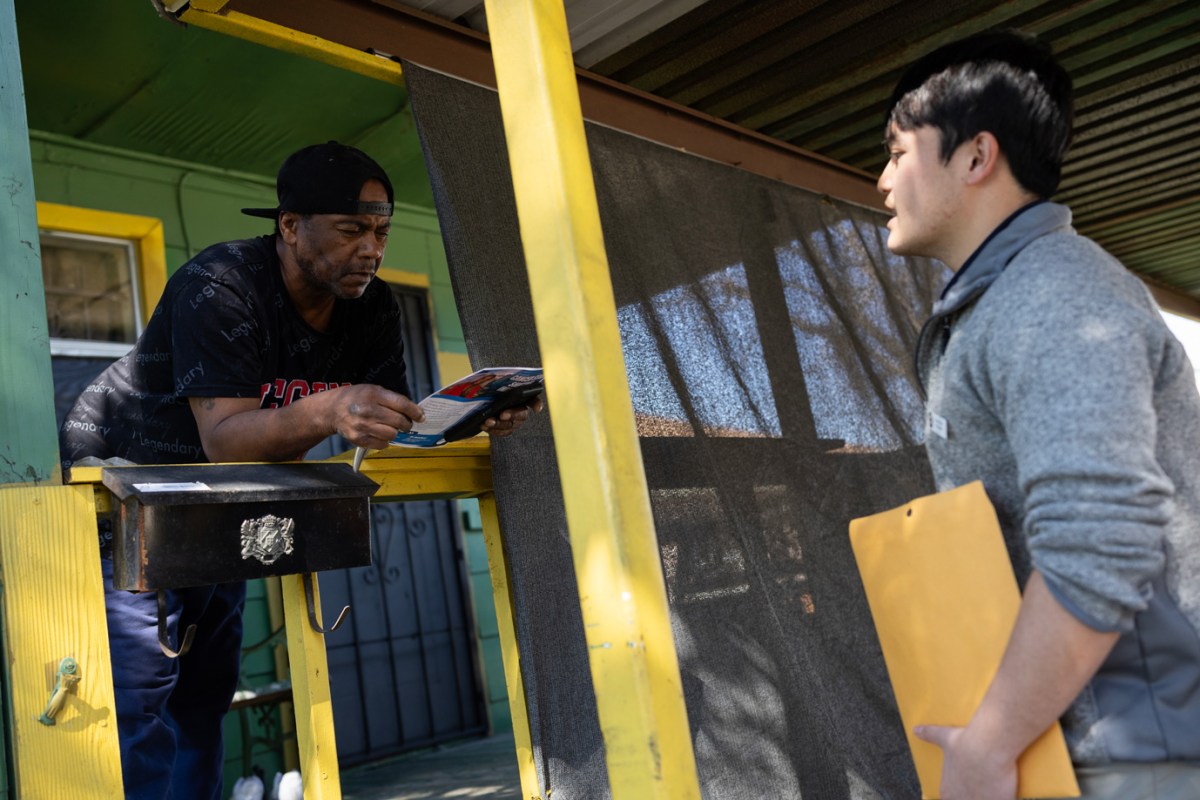
It’s late Monday morning. Kevin Chen is standing at the edge of Amboy Street in Houston’s Greater Fifth Ward. He clutches a manila envelope stacked with fliers and a clipboard with a short script on it. Just behind him, his colleague, Cuong Dong, has a folder with a map of homes on it.
The two walk across a grassy lawn to a smaller brick house. Chen, 22, knocks and a woman comes to the door after pulling her dog back.
“I’m with Councilmember Leticia Plummer. We have a few upcoming opportunities in Fifth Ward,” Chen said, handing out a flier.
Chen and Dong are spending the next few hours volunteering for the councilmember’s office as part of a new program to screen for cancer in Greater Fifth Ward. Plummer is working with the National Minority Quality Forum – a nonprofit based in Washington D.C. – and its Cancer Stage Shifting Initiative meant to tackle cancer disparities in communities disproportionately impacted by a lack of medical access and environmental pollution.
The multi-year $1.2 million program starts with canvassing. Volunteers, like Chen and Dong, will knock on a little over 300 doors over the next four weeks, informing residents that they can get screened for cancer at the Grace Clinic Houston on Liberty Road for free.


This initiative is in response to growing frustrations from community members in Greater Fifth Ward over the contamination that for decades leached from the old Southern Pacific Railyard into the neighborhood. Union Pacific Railroad, which merged with Southern Pacific in 1997, and the Environmental Protection Agency began testing the soil and water last year for cancer-causing contaminants in the area. However, residents have expressed frustrations over this testing and the results – ultimately asking officials to address their overwhelming health concerns.
In February, the EPA investigation found higher levels of dioxins – a toxic chemical that can cause cancer – behind the Julia C. Hester House community center and next to an Early Headstart preschool. The agency tested the property again in early March with results coming in a few weeks.
On Amboy Street, 35-year-old Destini Harris takes Chen’s flier. Her extended family lives in most of the homes on Amboy Street – her grandmother was two doors down before she passed away, her uncle lives next door, her great-great cousin lives on the other side of that house. Just down the street is the old Southern Pacific railyard, fenced off and empty.
Her aunt died 10 years ago of cancer. Her uncle across the street has cancer now. Others on the block, non-related, have also died of cancer.
“Some of my family are in their 60s or older,” Harris said. “I’ll let them know.”
Catching cancer early
This is the National Minority Quality Forum’s first screening program of this kind. The entire program will span five years, consistently following up with participants as they screen for cancer and, in some cases, get treatment for cancer through the local healthcare system.
For residents who sign up, the program starts with bloodwork. At this stage the goal is not a diagnosis but instead to look for risk markers.
“Cancer research and detection has really evolved so that changes in blood chemistry can signal the onset of cancer sometimes a year or two before the cancer is actually formed in the body,” said Gary Puckrein, the CEO and president of the National Minority Quality Forum. “We are just drawing blood, no medicine or anything. It’s very low risk.”

Once the bloodwork is completed, the physicians at Grace Clinic Houston can have a conversation with patients about what to do next if the bloodwork is concerning. For residents without medical insurance, the Forum has partnered with Harris Health to work with patients on getting insured.
For residents with bloodwork that shows no early signs of cancer, they can get tested again in a year and then again in another year.
“Year one you might show no risk, but then in year two you could show risk,” Puckrein said.
The bloodwork screens for multiple cancers, including pancreatic cancer, breast cancer, prostate cancer, lung cancer and colorectal cancer. Early screening like this can catch the cancer before it even becomes stages 1 through 4, which Puckrein says can also save the patient the high cost that comes from cancer treatment.
In Greater Fifth Ward, the state found statistically higher levels of liver, lung and bronchus cancer as well as larynx cancer, esophagus cancer and acute myeloid leukemia.
“We take our social contract very seriously,” Puckrein said. “We have an obligation to each other in moments like this where we have communities with a unique set of risks through no fault of their own and we should collectively come together and bring the best of our science to help.”
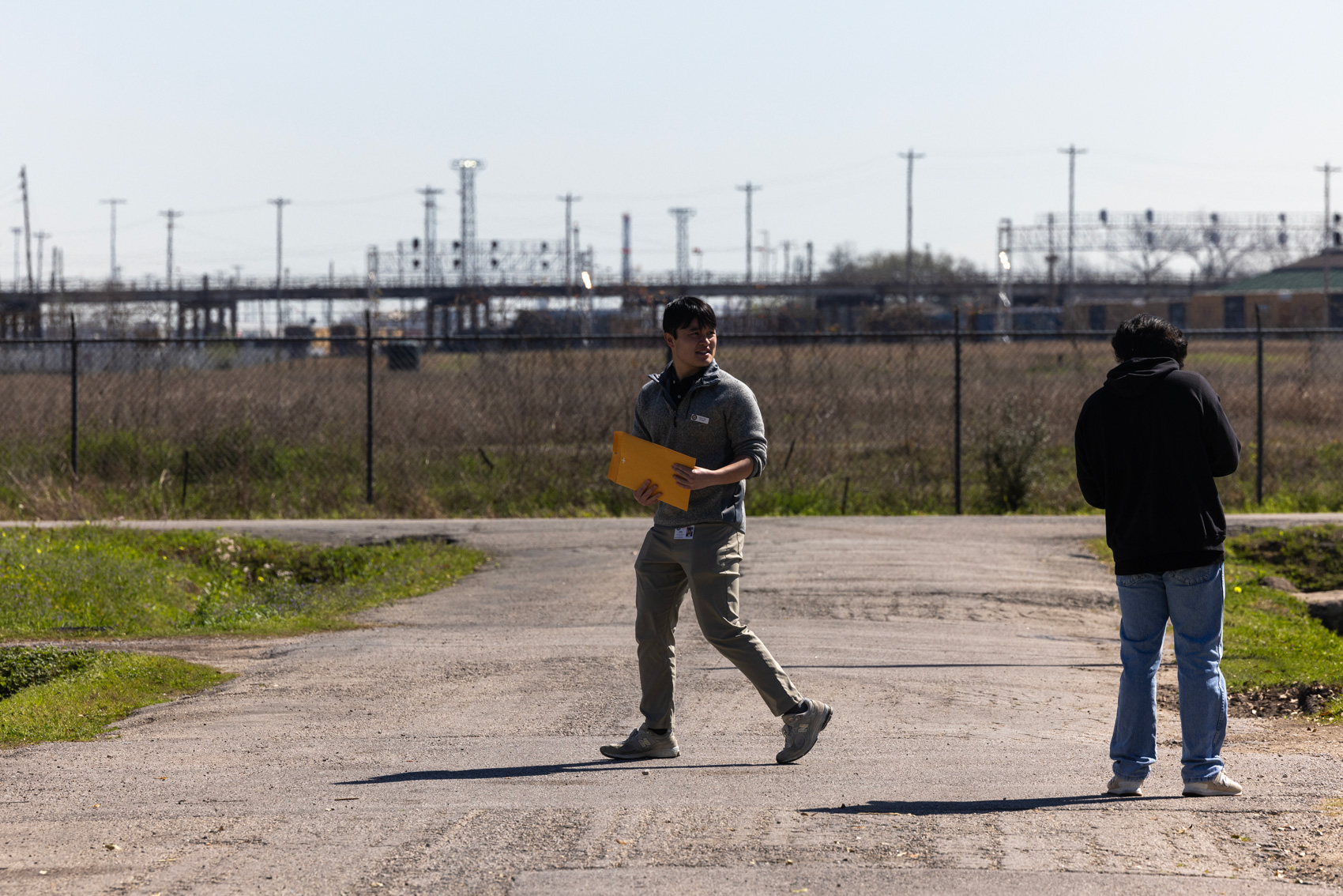
While the program is launching in Houston, the organization is going to be working in several other communities over the course of the next few years. The plan is to enroll as many as 100,000 people with an initial 200 this first time in Greater Fifth Ward.
In the field
On the program’s first day, Veronica Xiloja rolls a cart full of fliers, maps and informational documents for volunteers into a conference room at the Fifth Ward Multi-Service Center. About ten people have signed up to canvass, including members from the community.
As deputy chief of staff for Councilmember Plummer, Xiloja is responsible for setting everyone to go out into the community. Volunteers will partner up in twos to handle a section of the affected neighborhood, which has been divided into four zones.
“Obviously, this is all confidential,” Xiloja tells the volunteers. “The overall goal is making sure that we can get as many people screened as possible so we can detect cancer early, instead of waiting until it’s too late.”

Over the course of the four weeks, volunteers will be door-knocking during the day, after 5 p.m. and on the weekends. Each home will be visited three times in case a resident isn’t home or needs more time to consider. Depending on how the resident responds, the volunteer will mark the address they have visited and the level of interest on an online form. They also mark notes like “beware of dog” or “go around back” for future volunteers.
On March 13, Councilmember Plummer will also host an event at the Deluxe Theater on Lyons Avenue to discuss the cancer shifting initiative with Puckrein from the Forum and present Plummer’s recently published documentary on Greater Fifth Ward’s contamination.
Back in the field, Chen hands fliers out to a number of residents. Each flier has the number of Grace Clinic Houston on it to make an appointment to get bloodwork. He points it out every time.
At one spot on the west side of the old railyard, 59-year-old Joe Lewis is sitting outside with his friend, Derek. Neither has been screened for cancer before. They both glance over the flier. Having spent most of his life in Greater Fifth Ward, Lewis knows about the contamination. Friends and family have died from cancer.
“I’ll consider it,” he said. “I should probably see what’s going on.”

