

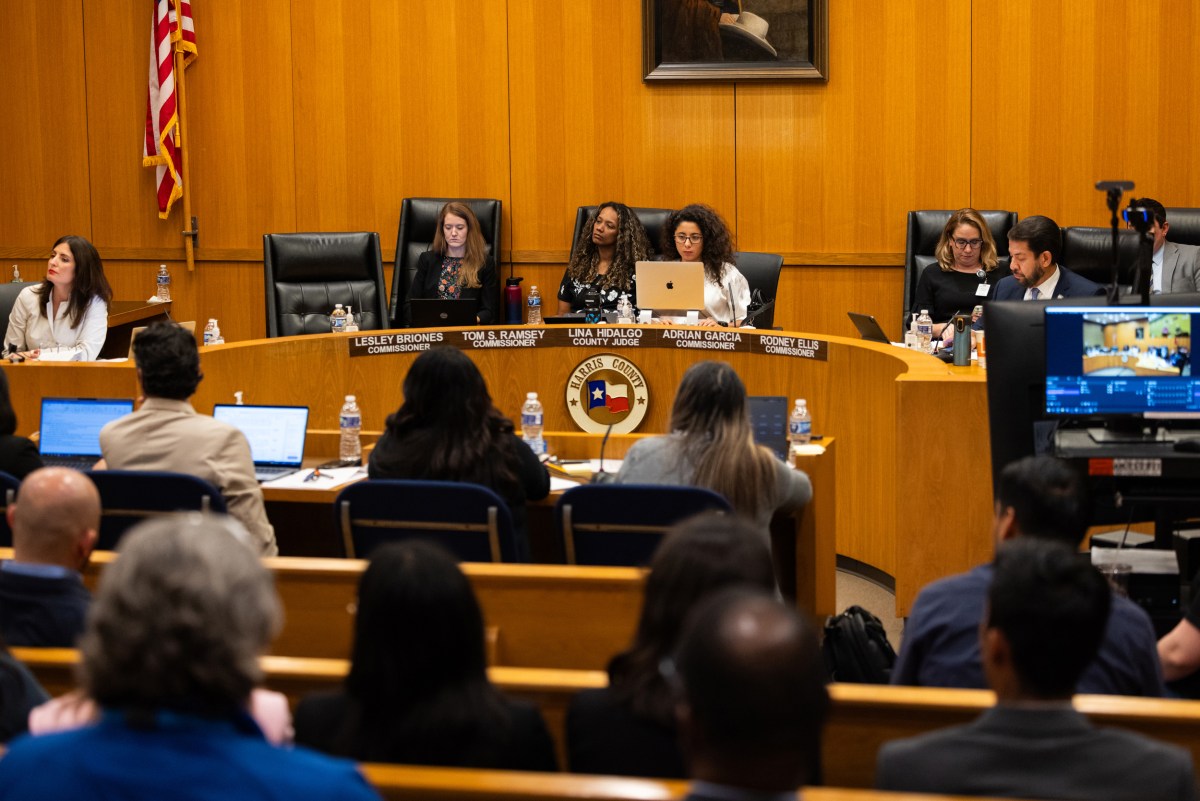
Earlier this month, Harris County budget director Daniel Ramos issued a stern warning to Commissioners Court: Tough financial decisions are ahead and officials will need to drill down on priorities.
“I can tell you this is my 11th budget cycle and this is the closest I’ve ever seen a jurisdiction be to their budget,” he told the court. “So, we really are on this razor’s edge.”
Just four years ago, the county ended its fiscal year with more than $150 million in surplus funds. Last year, the county ended with $6.4 million, and that number is projected to go down by more than $1 million this year.
Had it not been for some federal grants and one-time lawsuit settlements, such as the JUUL vaping litigation that saw the county awarded $20 million, Harris County would have ended its last fiscal year in the red and projected to be in a deficit this year.
Officials have said this not only serves as a harbinger for what is to come, but also demonstrates how Harris County has evolved in recent years.
Throughout her campaign for county judge in 2018, Democratic political novice Lina Hidalgo talked about the need for criminal justice reform and public transportation, envisioning a significant expansion beyond Harris County’s traditional role in funding flood control, roads and parks.
Democrats swamped local ballots that year, helping Hidalgo defeat popular 11-year Republican incumbent Ed Emmett to become Harris County judge. Adrian Garcia also defeated Precinct 2 Commissioner Jack Morman, giving Democrats a majority on Commissioners Court for the first time in decades. Four years later, the Democrats added a fourth member, giving them a supermajority.
Instead of focusing largely on infrastructure as it traditionally had, the new Commissioners Court vastly expanded social service programs aimed at strengthening the safety net for the unincorporated areas of the county. That expansion of services was made easier during the coronavirus pandemic when the county was awarded $1.8 billion in federal aid.
For example, the county embarked on a departure from its traditional anti-crime efforts with a $50 million Clean Streets, Safe Neighborhoods program. The idea is to enhance public safety by targeting blighted areas for improvements to sidewalks, street lighting, vacant lots and removal of abandoned and decrepit structures.
The program largely is funded through the American Rescue Plan Act. Continuing it after the federal money runs out will require county leaders to shift money from other initiatives or find a new source of funding.
The county also undertook a $6 million gun violence interruption program and invested $5 million in Holistic Assistance Response Teams to help tackle police calls involving mental illness, drug use, homelessness and social welfare.
Other examples include $34 million spent on indigent defense last year to help fix a process that allowed private attorneys to take on far more clients than what the state recommended. Earlier this year, the county spent $13 million to purchase a 20-story office tower. Officials said the purchase was necessary to provide more room as the county continues to expand.
Jay Malone, a spokesman for the Texas Gulf Coast Area Labor Federation, AFL-CIO, said under the new Commissioner’s Court, he has seen a greater investment in bringing more jobs to the county. He said the elected officials are “thinking big” and in a “very different way” about how to best serve residents.
Last year, the court approved a $9.1 million contract to double enrollment in local union apprenticeships in the building and construction trades and create new ones in the entertainment and transportation industries. The investment, which was funded through federal ARPA money, was among the largest investments in union apprenticeship training programs in the country.
“We’ve seen a real democratization of the county budgeting and spending priorities,” Malone said. “Instead of the county having a very narrow view of what it should do and the benefits of those priorities flowing to a smaller group of residents, they've thought holistically about how they can tackle big problems.”
Balancing act
Ramos, the budget director, called the current spending level “the new fiscal reality” for the county. To stay ahead of it, the county is creating a five-year financial and strategic plan.
“Commissioners Court can do a lot, but it can’t afford everything,” Ramos said. “We have to offset new spending with existing spending.”
Richard C. Auxier, a senior policy associate at the Washington, D.C.- based Urban-Brookings Tax Policy Center, said what is happening in Harris County is becoming more common throughout the country, particularly in Republican-controlled states with Democratic local governments who are looking to expand services that may be limited by the state.
Even though the county is experiencing a financial squeeze, Auxier said it is “worth an eyebrow raise but not panic.”
“All governments, especially those that are expanding services, are trying to get every last dollar before they have to go into the tax increases to meet the services they want to provide,” he said. “But if you are doing it so much so, where you can look down the road and every year it is getting worse and worse, that’s when the red light flashes.”
Auxier also said that a budget surplus is “not a synonym for good” and does not indicate healthy fiscal policy. If a local government runs a large surplus, he said, it can mean it is overtaxing its residents.
Ramos said it is a balancing act to make sure the county has a healthy cash balance and enough in its contingency fund, which has $197 million allocated, in case of a disaster or other emergency.
“We don’t want to have these huge surpluses because then that means we’re taxing people for money we don’t have a purpose for,” Ramos said.
Precinct 2 Commissioner Adrian Garcia, who describes himself as a “fiscal conservative,” said he believes the surplus going down is a sign the county is budgeting “more accurately than ever before.”
Garcia, who previously served as sheriff, said county departments used to be allowed to “roll over” unspent budgeted money from one year to the next without much oversight, which often created confusion and lacked transparency.
The county moved away from the practice after the Democrats became the majority on court, and began adopting more traditional budgeting procedures, he said.
“Knowing what our financial status is shouldn’t be a shell game and it shouldn’t be a hidden process,” Garcia said.
Officials said the county’s financial forecast also displays the consequences of implementing a no-new revenue tax rate for two of the last four years along with several state-mandates, including revenue caps and the outsourcing of jail inmates.
“It’s the local taxpayers that will pay for it,” Garcia said. “We'll have to factor that number into the budget in some possible way. And it's going to push something else that is a constituent-defined priority.”
Room for improvement
Hidalgo said she was “struck” when Ramos said this is the closest a jurisdiction he has ever worked in has come to being in a deficit.
“We brag a lot about how we didn’t have to use federal dollars to patch our government, but we would’ve if it hadn’t been for some of these one-time payments,” she said. “It’s very concerning.”
Hidalgo praised the county’s reformed budget practices, but said there is room for improvement. The judge said she would like to see changes in how contracts are awarded and adjustments in how money is divided among the four commissioner precincts.
She also questioned the court’s decision to approve an almost 40 percent raise earlier this month for Harris County Toll Road Authority Executive Director Roberto Trevino. Hidalgo, who was the single dissenting vote, said the county needs to be mindful of its spending. The Toll Road Authority is funded by the tolls it collects.
“We can’t control what the legislature does,” she said. “If they hadn't capped our revenue, it would've been good, but we can only control how we manage our own offices and practices.
“There are extreme inefficiencies and inconsistencies,” she continued. “There are a lot of great efforts that are going to end if we don't figure out how to do things more efficiently.”
Precinct 3 Commissioner Tom Ramsey said he has long thought the county is spending too much money, which is reflected in the surplus going down.
“We do adopt a budget, we don’t spend more money than we have. But if there’s anything I’ve expressed consistent concern about, it’s our spending,” said Ramsey, the lone Republican on court. “I don’t think we have a revenue problem. We’ve got a spending problem.”
Ramsey said the county is spending too much on social programs — such as the guaranteed income pilot called Uplift Harris — instead of focusing money and resources on infrastructure.
Uplift Harris is being funded through $20.5 million in federal ARPA money.
Precinct 4 Commissioner Lesley Briones, who declined a request for an interview, issued a statement saying the county would continue to engage the public through town halls and incorporate residents’ feedback into its budget.
Precinct 1 Commissioner Rodney Ellis did not respond to a request for comment.
The next budget cycle will be difficult, County Administrator Diana Ramirez said, and will require focusing on outcome-based budgeting that focuses on performance measures.
“We’re going to have to be very honest about the need to internally reallocate some money,” she said. “It’s not going to be easy.”

