
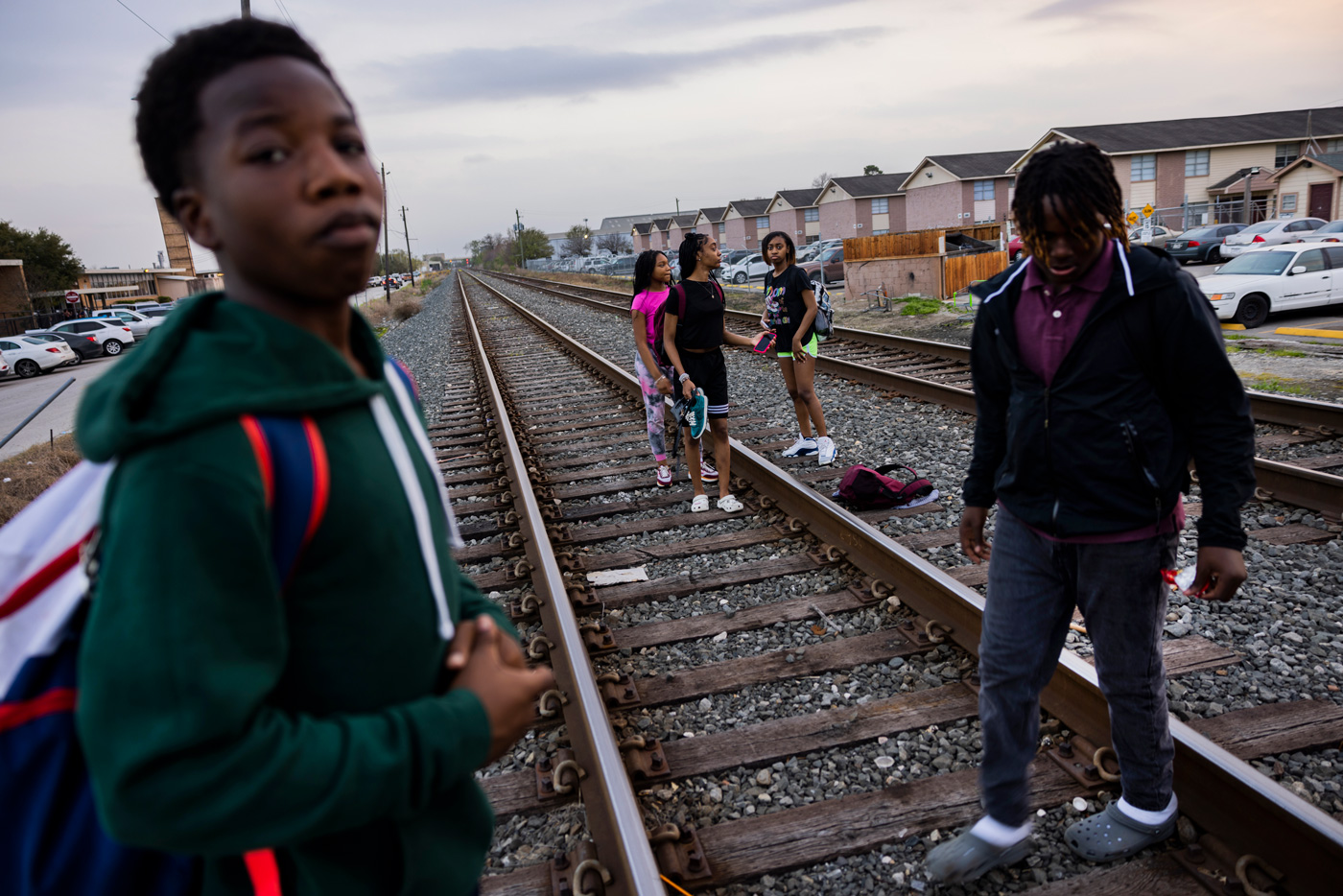


Stalled trains have clogged tracks near Houston ISD schools on hundreds of occasions in the past year, adding danger to the commutes of thousands of students and pushing some children to climb through stopped cars, a Houston Landing investigation shows.
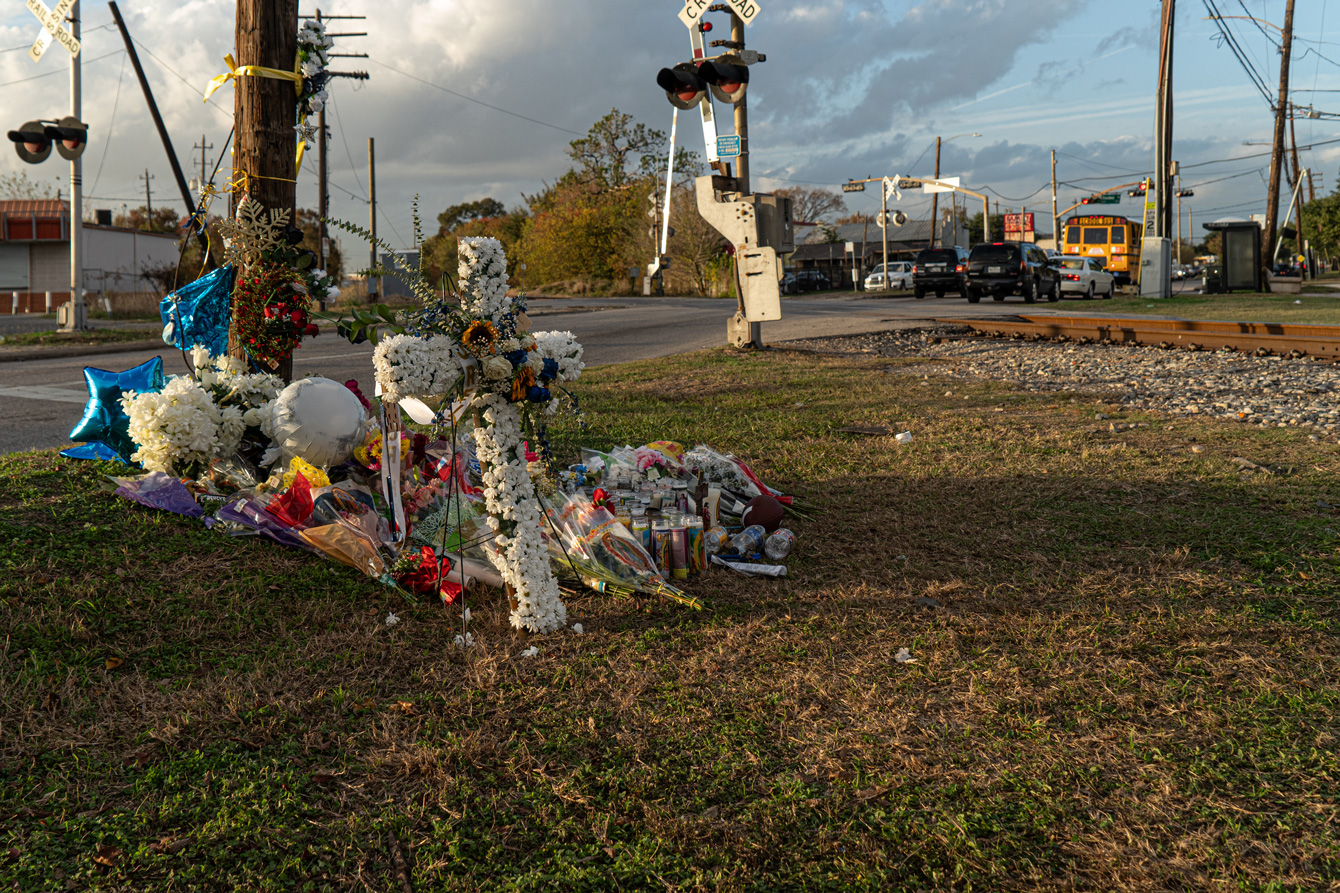
A Landing analysis of Federal Railroad Administration records shows local residents regularly report that trains operated by the railway company Union Pacific block roads around schools during student drop-off and pickup times. The data illustrates the scale of a longstanding issue in Houston, one of the nation’s busiest rail hubs, after a train struck and killed 15-year-old Sergio Rodriguez last week near HISD’s Milby High School.
Local and state political leaders have pledged to build a multimillion-dollar pedestrian bridge near the site of Rodriguez’s death, but the Landing’s analysis shows the issue of dangerous rail crossings near schools spans far beyond Milby High. To provide safe travel across dozens of frequently blocked train crossings, local government leaders likely would need to spend tens or hundreds of millions of dollars on similar projects.
The hundreds of stoppages near HISD schools likely represent an undercount, because the data come from people reporting train issues to the FRA. Agency spokesperson William Wong wrote in an email this week that “not every instance of a blocked crossing is necessarily reported to this portal.”

For example, the data include just one occasion where a train blocked the tracks near the intersection where Rodriguez died. But parents and students told the Landing in recent days that blocked crossings at the site are common during those hours.
Milby High Senior Henry Benitez recalled two times when he crossed despite a train on the tracks. In the first instance, he ran to cross the tracks ahead of an oncoming train. In the second, a stopped train blocked his path home after classes finished, so he climbed over a ladder between the cars.
“I was hopefully thinking that the train wouldn’t move, but if it moved, I would have probably just jumped off,” Benitez said.
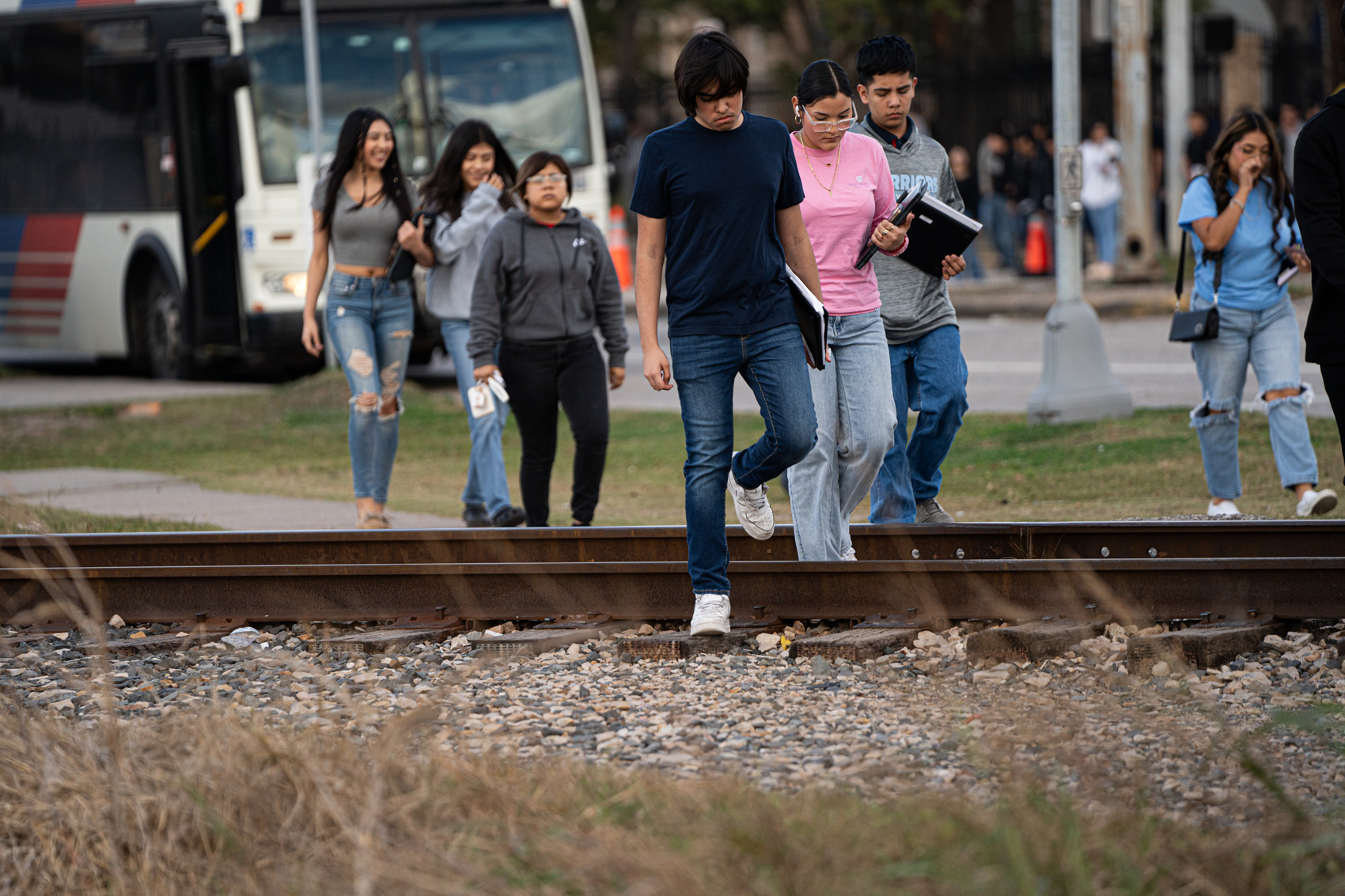
After analyzing over 5,000 reports of stopped trains in Harris County and interviewing families, politicians and a spokesperson for Union Pacific, the Landing has found:
- In 2024, people have reported roughly 600 instances of trains blocking intersections within a mile of 71 HISD campuses between 7 to 9 a.m. or 3 to 5 p.m. on days school was in session. Most blockages were from trains sitting still, while about 40 involved moving trains.
- In about 300 cases, the people contacting the FRA reported that pedestrians climbed on, over or through the trains. Many people specifically noted the impact on school pickup and drop-off, such as users who reported seeing “parents climbing the rails to take their children to school” and “kids climbing through trains,” agency records show.
How to report a stopped train
The Federal Railroad Administration allows members of the public to report when a train is blocking an intersection. To file an online report, click here.
- Union Pacific representatives offered contradictory messages on whether it’s feasible for the company to limit train traffic near schools during pickup and drop-off times, a common request from families.
Clint Schelbitzki, the company’s assistant vice president of public affairs for the Southern Region, said in a Tuesday interview that the “sheer volume” of rail traffic in Houston means restricting hours of train travel would cause buildup and slowdowns elsewhere in the city, so the best solution is to “keep those trains moving” to avoid stoppages. Meanwhile, another company spokesperson, Robynn Tysver, released a statement Tuesday saying Union Pacific’s president had met with Whitmire and agreed to “immediately adjust our operations to avoid running trains near Milby High” for one hour each during pickup and drop-off times.
- There is no online tool that allows the public to track train traffic in real-time and plan their commutes, similar to what exists for planes on the website FlightAware. Union Pacific is looking into whether it can provide more information to the public about real-time train locations, including potentially incorporating information into apps like Waze or Google Maps, though there is no timetable on when those features might be available, Schelbitzki said.
HISD Superintendent Mike Miles said last week that his administration would work with city, county and state leaders to look into building overpasses or underpasses around tracks near nine schools, including Milby High, where the risk to students is greatest. A total of 118 out of HISD’s roughly 270 schools have rail lines that could impede some students’ path to campus, Miles said.
Miles also said he was “hopeful” Union Pacific would assist with the projects. Schelbitzki said the company would participate in the planning processes, but when asked what level of financial contribution Union Pacific might provide, he did not respond directly.
“We’ve been in contact with HISD, we’re going to sit down with them and we’re going to go through the planning process to understand what projects are appropriate for each school,” Schelbitzki said. “We’re going to work with those partners to come up with what the appropriate investment from each of us is.”
A decades-old problem
Train traffic and pedestrian safety have been a longstanding issue in Houston, especially on the city’s east side, largely because of the way Harris County’s rail system is designed.
About 100 trains enter and exit the city each day, crossing through more roads and sidewalks than in any other metro area in the Union Pacific network, Schelbitzki said. By comparison, the Chicago area has about 70 percent more bridges and underpasses to route trains away from car and foot traffic, translating to four times fewer direct intersections between tracks and roads, he said.
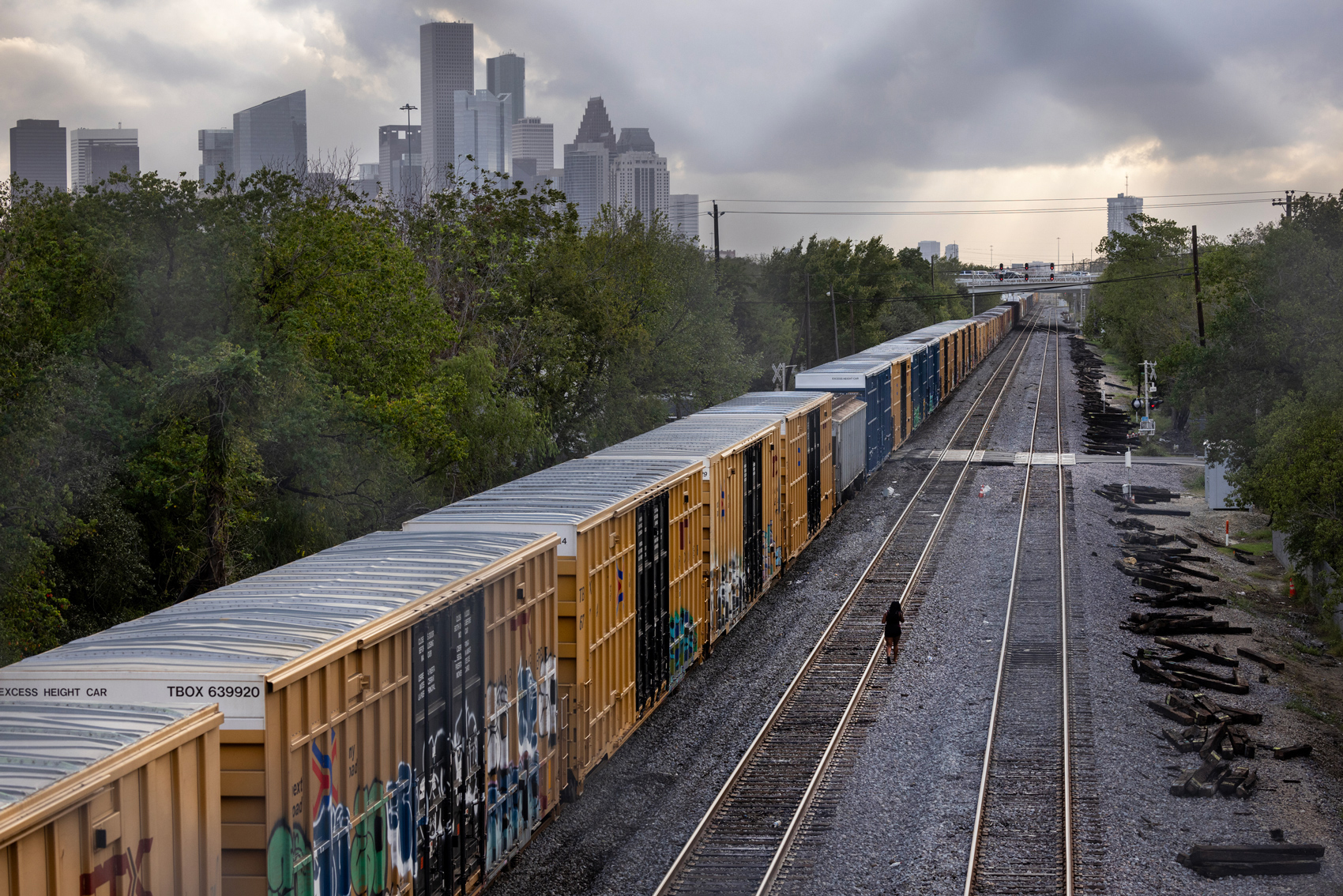
With hundreds of sites where roads come into contact with tracks, pedestrian injuries on the rail lines are a sad fact of life for some Houstonians. A man in a wheelchair was hit by a train in the Fifth Ward in September, according to eyewitness accounts. In 2005, a Deady Middle School student had his legs crushed under a train on the same tracks as the recent collision near Milby High.
In Rodriguez’s case, Houston police investigators said the sophomore football player might have tripped and fell while trying to cross in front of a moving train shortly before classes began.
State Sen. Carol Alvarado, D-Houston, who attended Milby High and serves a district spanning much of Houston’s east side, said train crossings were an issue when she was a student in the 1980s.
“Those of us that lived in Manchester (a neighborhood directly northeast of Milby High), we were surrounded by tracks, so that was a daily thing,” Alvarado said. “This is nothing new.”
Now, when Milby High mother Maya Lopez picks up her ninth grade daughter from school each afternoon, she watches the teen traverse the same tracks that were the site of the recent tragedy. She fears for her daughter’s safety and hopes to see prompt solutions.
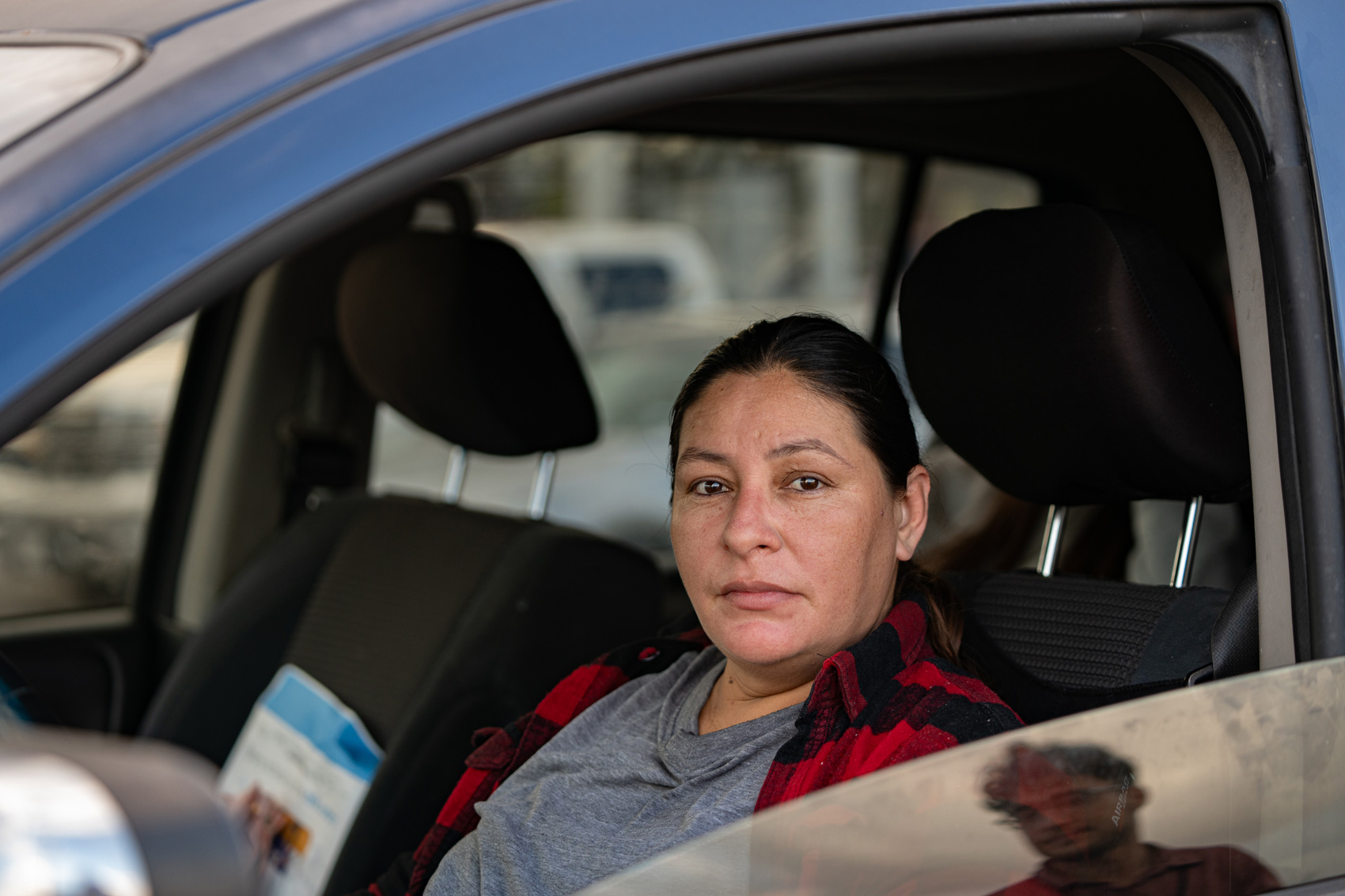
“The district should at least talk to the company so that the train doesn’t pass during school hours, because of the danger that it can cause,” Lopez said in Spanish on Monday, a day before Union Pacific announced it would limit train routes in the area.
Search for solutions
While Union Pacific, Whitmire and others have trumpeted the train schedule adjustment near Milby High, the majority of lines across Houston continue to operate as normal, meaning students at dozens of other schools remain at risk.
The federal records show some school communities have seen dozens of instances of trains blocking tracks during drop-off or pickup times. For example, people reported that stopped trains impeded an intersection three blocks north of Lantrip Elementary School in the East End about 60 times this year during those hours.
Wider, longer-term safety measures may prove much more difficult to achieve. Whitmire estimated that a Milby High pedestrian bridge would cost $6.5 million at a recent city council meeting, suggesting the total for the nine potential projects identified by HISD officials could be tens of millions of dollars.
Whitmire said Wednesday that he could not yet provide a budget or a timeline for the projects, but they’re all “under review.” The mayor said his team and HISD would “drill down on each individual site” to understand what new structures might be appropriate.
hisd’s identified schools
Houston ISD officials say train issues on tracks near these nine schools pose the greatest danger to children in the district.
- Burnet Elementary School
- Cook Elementary School
- Forest Brook Middle School
- Kashmere High School
- McReynolds Middle School
- Milby High School
- Tijerina Elementary School
- Roosevelt Elementary School
- Waltrip High School
“The initial accomplishment is getting an embargo during pedestrian traffic at Milby (High), stop the train,” Whitmire said. “Then, ultimately, we will have a long-term solution for helping students get to school.”
Whether Whitmire and Miles succeed in building out the new infrastructure may depend on whether they can persuade Union Pacific to foot a significant portion of the bill. The company operates lines near seven of the nine campuses identified, Schelbitzki said, and it contributes to projects like the overpasses and underpasses described by Miles on a “case by case basis.”
But on a broader scale, Union Pacific and other rail companies have fought against local measures that force them to pay for stopped trains and lobbied in Washington for less regulation over the industry. Houston-area community members and advocates also have criticized Union Pacific for not doing more in Greater Fifth Ward, where cancer-causing substances leeched into the ground decades ago at a property that the company subsequently acquired in 1997.
Kristen South, another Union Pacific spokesperson, argued the company is an essential component of Houston’s economy, employing 1,600 people in the region, moving goods across the city and taking trucks off the road. Instead of limiting the hours of operation for trains during school hours, she suggested investments in rail efficiency could reduce blocked crossings.
“If we can invest in the yard and get (trains) in faster, it opens up that crossing faster,” South said.

U.S. Rep. Sylvia Garcia, D-Houston, who represents much of Houston’s east side and has advocated for greater train regulation, thinks the solution needs to be more comprehensive. She filed a 2023 bill to prohibit rail carriers from blocking intersections for more than 10 minutes, though the legislation never received a hearing in a congressional subcommittee.
Now, Garcia is working on a bill to limit the speed, length and frequency of trains crossing near campuses that she plans to file in January. The idea is similar to laws limiting car speed in school zones, she said.
“We regulate cars for the safety of children,” Garcia said. “There’s no real reason why we can’t regulate trains for the safety of children.”
Correction, Dec. 19: An earlier version of this story incorrectly stated Union Pacific’s connection to the spread of cancer-causing substances from a property in Houston’s Greater Fifth Ward. Union Pacific acquired the property after the use of cancer-causing products by another company.
Staff writer Hanna Holthaus contributed reporting and staff writer Anna-Catherine Brigida contributed translation for this story.
Asher Lehrer-Small covers Houston ISD for the Landing. Find him @by_ash_ls on Instagram and @small_asher on X, or reach him directly at asher@houstonlanding.org.

