

Editor’s note: This story has been updated to reflect the correct panelists.
Harris County Public Health’s third annual Maternal and Child Health conference, held annually during Black Maternal Health week, drew a crowd of over 300 health workers, researchers, advocates, and birth workers from across the U.S. to the Marriott Marquis Houston hotel.
With a theme of “Curating Change, Transforming Communities, Building Healthier Families,” this year’s two-day conference on April 15-16 aimed to improve maternal child health outcomes by raising awareness on disparities in maternal and child health and provide a development opportunity for those working in the field. Building off of momentum from last year’s conference where HCPH released its inaugural maternal and infant health report and a Maternal Health Bill of Rights, panel discussions focused on integrating mental health into maternal care systems, the power of fatherhood, the perinatal population, holistic care from doulas, midwives, lactation professionals, and confronting bias.
RELATED: Harris County has had the highest Black maternal death rates in the U.S. for years. Here’s why.
While organizers say the conference has always talked about birthworkers like doulas and midwives, this year they tried to be more intentional about including them based on feedback from the community they serve regarding a growing interest in those services.
“We work with our partners and our populations and we hear from them,” said Rohish Lal, Harris County Public Health’s communications director. “We want to make sure that they understand what resources are available.”
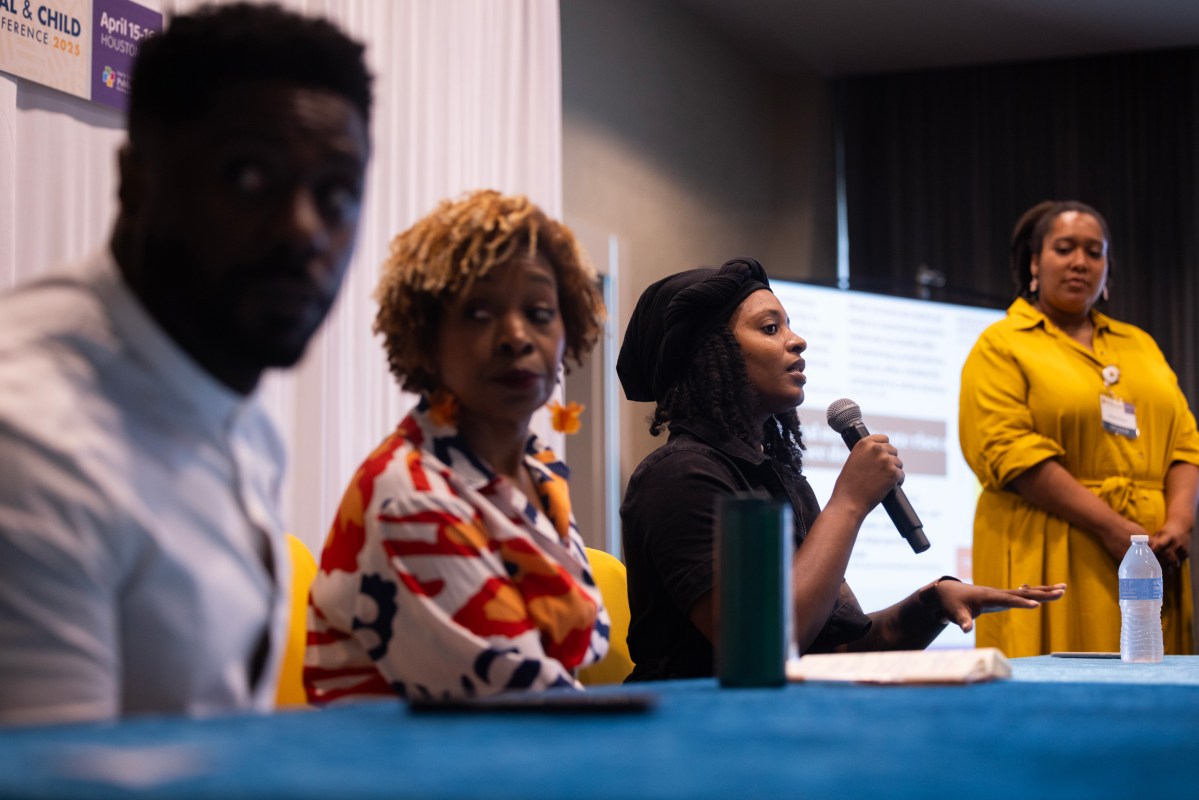
Among one of its most popular, well-attended sessions was “Confronting Bias: Strategies for Elevating BIPOC Communities in Maternal and Child Health” moderated by Jamie Chinn, a behavioral health program manager with HCPH.
Black women are three times more likely to die from a pregnancy-related cause than white women due to a number of factors, such as variation in quality healthcare, implicit bias and underlying chronic conditions, according to the U.S. Centers for Disease Control and Prevention. More than 80 percent of pregnancy-related deaths in the U.S. are preventable, according to the CDC.

“We are living in a time where confronting bias and racism is no longer something that we can afford to view as optional,” said Chinn in her opening remarks. “It is at the forefront of our professional and personal lives every single day and I believe it takes intentionality to address.”
Panelists included Joy Malbrough, a community clinical navigator with Inside Edge Consulting Group, Jay Barnett, a health administrator and marriage and family therapist and licensed midwife, DeShaun Desrosiers of Harmonious Birthing.
RELATED: How a Black Houston midwife trains aspiring doulas of color
Here’s what panelists had to say. Answers are edited for clarity and brevity.
Q: What are some strategies that you believe BIPOC populations need to utilize or consider for their own health and wellness?
Desrosiers: One is knowing your options. A lot of times people get pregnant and they’re automatically ‘okay I need to go to the doctor and set up my first visit.’ People should know that they have options. A lot of times midwives or doulas are not even thought of. I’ll have people that are transferred late into care at 32 weeks because they’re like ‘yeah I’m not really feeling my OBGYN, they’re not allowing me to have options, my appointments are just five minutes long, instead of putting things in the forefront of our pregnancy, [you] could’ve had multiple consultations with midwives and doulas or having different options and segways for the type of care that you want.
Also having a doula doesn’t mean you have to have a water birth or you have to have a homebirth. Doulas are for everyone.
Q: How do the experiences of racism and discrimination in health care or everyday life manifest in the mental health of black mothers? How can community therapists help their clients to navigate these challenges while advocating for structural change?
Barnett: When you think about cultural competency, we should speak about cultural sensitivity and think about them in a historical context and the historical relationships that Black and brown and indigenous individuals have with the healthcare system. It is not a trustworthy system for us. And when we are going into the hospital there’s a level of fear and a level of anxiety that we are experiencing, and to understand someone’s fear you have to have an understanding of what caused that fear. … To understand the level of depression, you must understand the level of trauma that [is] associated and that are connected to the experiences.
What does that look like? To really help people is understanding the need[s] of people. And oftentimes we’re trying to offer people things that they don’t need. Some of these people just need a conversation on where they are and what they’re feeling, and not someone to gaslight them with another pamphlet or another resource, but to just be able to meet them exactly where they are in their state of humanity.
Q: How can healthcare professionals begin to repair trust with BIPOC communities?
Malbrough: Be considerate. Consider the fact that your presence alone can be a reminder of the past, the present, and the current or systemic tragedies or biases that have taken place year after year. And then we must consider engaging the engagers before we go out and work with the community. Are we on the same page? Do our goals align? Are we like-minded? We must consider our biases and take them into consideration each time.
We also have to consider the fact that biases aren’t always negative. We have positive biases. So [ say] you have an affinity for a particular group, then you may overlook some things and that positive bias may in turn serve the blind spot and can do damage that you’re not trying to do. So we have to check all of our biases.
We have to be considerate of what we don’t know. We don’t know everything.
Consider the fact that even if you’re part of that community, generationally, needs change. There are differences. What was a need last month may not be the need today. We have to acknowledge that fractures exist. Acknowledge the fact that the things that are broken, the trust that’s not there is well earned and currently well-documented.

Q: What reporting channels should a patient utilize if they feel they have been discriminated against in the hospital?
Malbrough: If you’re in the hospital specifically, your social worker or you have one, if you’re a birthing person who has a doula, reach out to that person, the hospital administrator, the nurse administrator, risk management if you have to, anybody who will listen. The patient advocate, the family advocate, everybody, anybody and then do it on repeat. It shouldn’t be a one time thing. Everybody should know what’s happening or what’s not happening so that you can advocate for yourself best.
Desrosiers: You can also report them to the Office of Civil Rights. You can do that easily online. Being repetitive is important as well. The number one step is patient advocate. For doulas and midwives that’s like our first line of defense. If we’re in the middle of labor, you can fire the nurse, you can fire the OBGYN right then and there. Not only that but make sure things are documented. A lot of times hospital policies will say you can’t record, but do it anyway. Let’s say you’re in a prenatal visit and your nurse practitioner is refusing to give you care or just offering medications for serious depression. You need to say, ‘Do you mind documenting that you’re refusing what I’m asking for?’
I think a lot of times a lot of them get away with things because it’s not being recorded through all these channels. Another way is to hit them in their pockets, whether it be a lawsuit, going to [the] news media to get these stories out and pretty much publicly shaming them.
Malbrough: When you are being refused, go back and look at your record and see what’s being said about you. Your record is a long-term thing and it goes with you, it goes before you and you want to know what’s being said about you because it may impact how you’re being treated in other aspects of your care. So make sure you’re reviewing your notes on a regular basis.

