
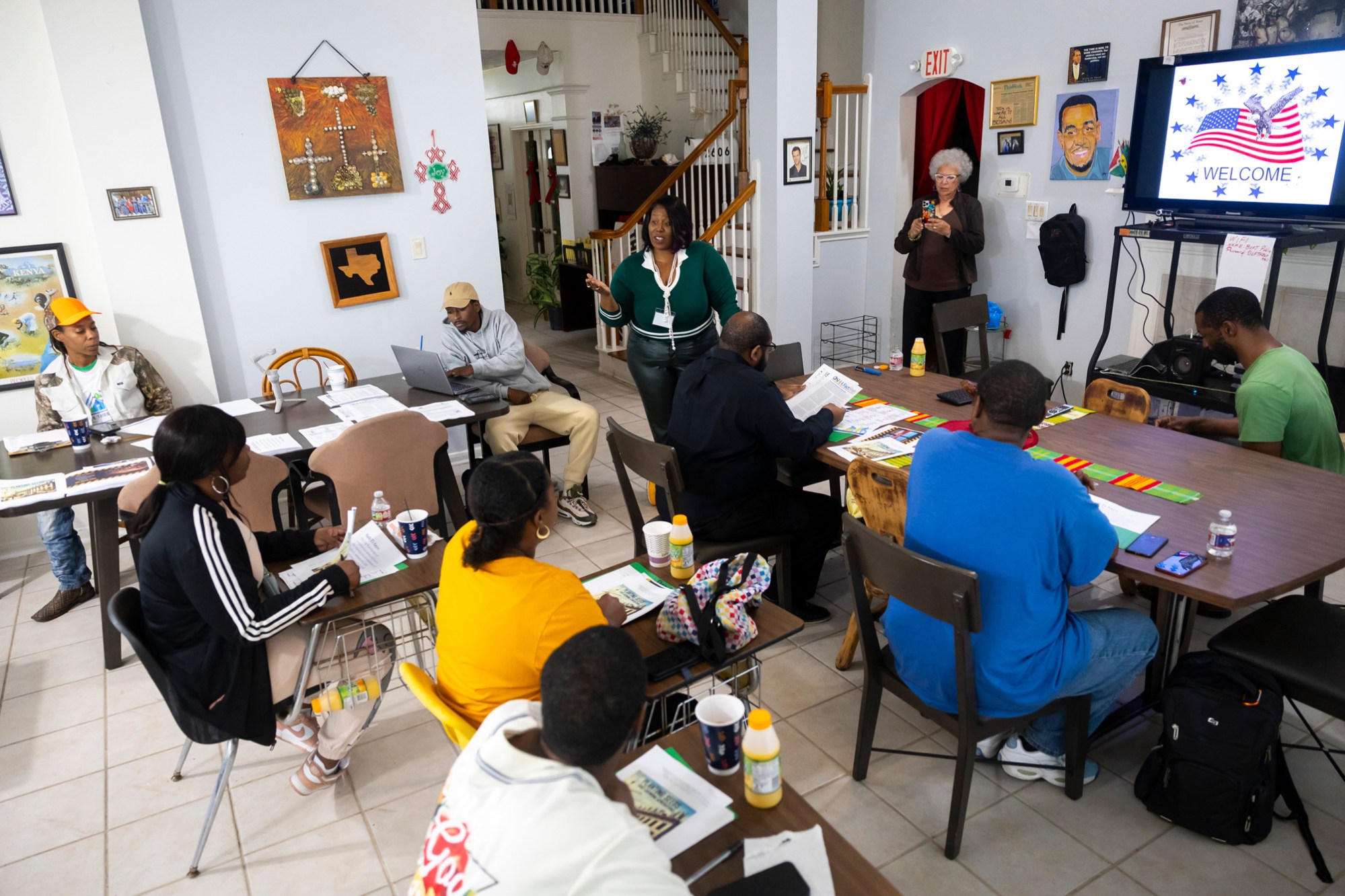

At the start of class, Timesha Beattie gives a brief introduction to her students. She’s Professor T, Professor B, or Timesha. Whatever everyone is comfortable with. She tells them that they are pioneers in the first class and they should be proud of themselves. That there will already be a test tomorrow, but don’t be nervous. Breathe, breathe, she says.
She reminds them that once they earn these credentials, nobody can ever take them away.
“This is a really great thing to be able to show for yourselves, to be able to show for your communities,” Beattie said. “You are going to be able to take back to your families the knowledge, the information, the credentials.”
It’s the first day of solar panel installation program training at the Black United Fund of Texas – a nonprofit organization in Houston’s Greater Fifth Ward. Students from the neighborhood and other communities in Houston will participate in a 22-week course to be certified in construction safety by the National Center for Construction Education and Research, or NCCER and learn about solar installation. Beattie is a program director for Green Thumb Academy, an NCCER-accredited training and assessment center hired to teach the class.
The solar installation training is funded in part by the Environmental Protection Agency in a $20 million grant to the Black United Fund and the Houston Health Department to address climate resilience and environmental justice challenges. The initiative is part of President Joe Biden’s Inflation Reduction Act, which designated $2 billion to climate and environmental justice initiatives around the country.
It is also funded by two other EPA environmental justice grants, totaling at $500,000 and $1 million.
The program is meant to bring both sustainable energy projects and job security to Greater Fifth Ward. Rather than contracting solar installation companies outside the community, the funding can be used to train residents to work within their own communities. However, this funding and the program could be in jeopardy. Since President Donald Trump took office in January, he has targeted environmental justice initiatives, leaving members of the Black United Fund concerned about the future. Funding for the class and the instructors has mostly been secured, but the grantees may need to look elsewhere for financial support for the rest of the program.

“This is something they promised to us,” said Velika Thomas, chief financial officer for the Black United Fund. “Just simply, we went through the process, we received the funding, it should be okay. But now it’s not.”
A spokesperson from the Houston Health Department said the department currently has no information regarding potential impacts on funding.
In an email to the Houston Landing, the EPA said all accounts of IRA funding should have been accessible as of last Friday, February 7. However, the EPA said it also “has identified certain grants programs as having potential inconsistencies with necessary financial and oversight procedural requirements or grant conditions of awards or programs.”
Regardless of possible challenges in financing the initiative, Thomas emphasized the class will continue as planned.
“We’ve worked before without literal dollars,” she said. “It would be awesome to have the money, but we’re going to get through it somehow.”
Learning about solar
The first to show up for the training is Markus Rue – the team leader for the class of 12. The 42-year-old grew up not far from the Black United Fund in Greater Fifth Ward. He knew the community well, and even participated in the organization’s outreach program for children when he was young.
Thomas and Black United Fund’s Texas founder, Cleo Johnson, have known him for years.
“I chose a different route for a while,” he said before class. “But when I came back, they always embraced me here, gave me opportunities and I just made up my mind, saying ‘I want to do the right thing.’ I just want to create my portfolio, add more and more to it. I’m really excited”

The day class runs from 9:30 am to 3:30 pm Monday through Thursday for five months, with another cohort doing the night class. A new group of students will start on March 3. After the class is finished, the students will spend four weeks at Houston Community College completing the training and then move into an internship. The last step is being placed at a job. All expenses are covered by the grant.
The first two days of class are spent talking about employee rights under OSHA, or the Occupational Safety and Health Administration. Beattie has laid out several agency documents, detailing its whistleblowers’ protection program and safety tips.
Once the students have gathered the forms and settled in, Beattie goes through the PowerPoint presentation she prepared. NCCER instructors AK Caraway and Antwon Baker stand nearby and jump in with comments. At one point, Beattie specifically addresses the women in the room and the reactions new employees get for being a person of color when they start working.
“Don’t expect anybody to make it easy for you,” Beattie said. “It’s hard and you have to advocate for yourself, but you can do it. AK and I remember our first times on the job, how we were treated. You got to know your stuff.”
Some of the students nod in agreement, others jot down notes.


Marissa King, a student from Acres Homes, said she’s not too worried about being a woman in the workplace. She says she was used to it from her previous jobs and can take care of herself. She’s also getting her Commercial Driver’s License, or CDL. But she is excited about learning about solar.
“Solar is the way the world is going,” the 36-year-old said during a break. “I want to be a part of that.”
An uncertain future
Since its inauguration on Jan. 20, the Trump administration has issued 33 policy changes, including halting all environmental justice activities and putting nearly 170 employees of the EPA’s Office of Environmental Justice and External Civil Rights on paid leave last week. The grant funding was paused when the new administration put the entire budget on hold at the end of January.
President Trump swiftly rescinded the memo that halted the budget, but the administration is still fighting in out in court to keep the freeze in place. Since then, Thomas said it hasn’t been the same. She had initially pulled some funding from the grant to pay the instructors and start the 22-week class. When Thomas heard the funding might be frozen, she tried to draw out some more from the $500,000 grant. Usually, the money shows up in the next day or two, but now she hasn’t been able to get anything.
“We wanted to make sure we could pay the contractors who are teaching, but the staff here hasn’t been able to get paid,” Thomas said. “I just have to have hope the money will show up and we can get going on it all.”
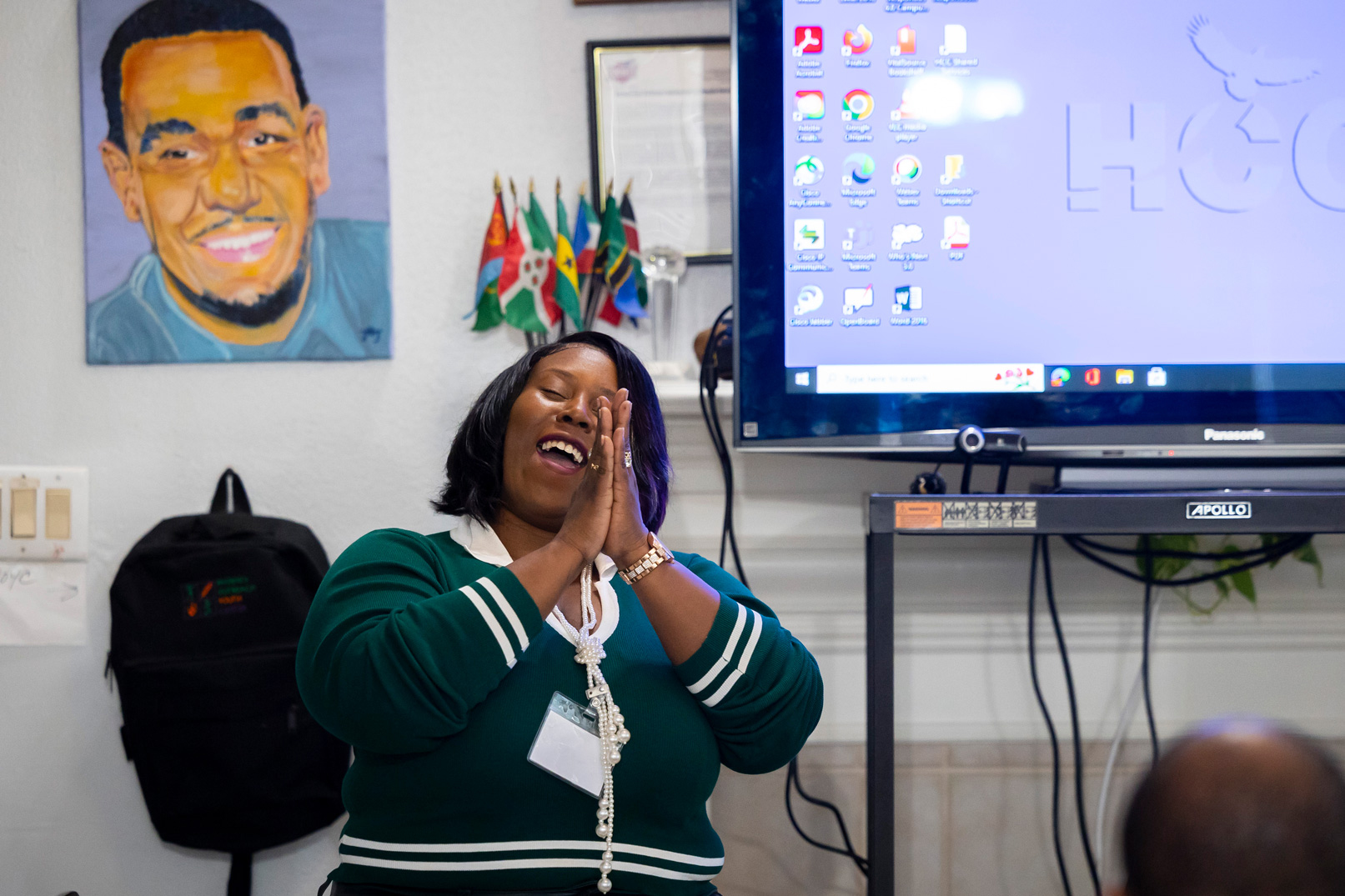
The Black United Fund and the Houston Health Department aren’t the only ones impacted by the changes to the Inflation Reduction Act budget, especially on diversity, equity and inclusion programs. The Solar for All grant awarded by the EPA to Harris County and its partner Texas Solar for All Coalition is frozen as of Wednesday, according to Harris County Attorney Christian Menefee.
“We’ve been fully locked out of the federal portal (for the funding),” Menefee said. “When Trump issued that memo, we were blocked out of the portal. Then last Friday, we were temporarily let back in. Now, we are locked back out of the portal as of yesterday morning.”
Since the funding is a reimbursement process, the county is unsure whether to spend the money without fully knowing where the budget stands. The $250 million grant is meant for the installation of clean solar energy in lower-income and disadvantaged communities across Texas.
Despite all of this, Thomas and Johnson say they remain hopeful that it will be okay. They have to keep the class going strong – the students depend on them.
Thoughts about funding fade as Johnson gets up in front of the class to congratulate them all for showing up and starting a new stage of their lives. While the funding is uncertain, the class is not.
“You are champions here,” Johnson said. “We all know that you all have the capacity to do what I can’t do and I’m so looking forward to living through you. I’ll be able to look back and say I was a part of that. I know who they are.”
This story was updated to clarify that the solar project is funded by three different grants.

