

Each week, “Answer Key” aims to help families by responding to an important question about education and schools in Greater Houston. If you have a question for us to answer, please email us at education@houstonlanding.org or fill out the form at the end of this article.

This week’s question:
How are Texas’ public schools funded? And how is it decided how much money they get?
As recent elections in Alief and Spring ISDs showed, residents can get up in arms about their property taxes. When those districts sought to increase their property tax rates, some residents questioned why local communities were being asked to foot the bill when the state has a multibillion-dollar surplus.
Public education funding in Texas is complicated and it varies from district to district. Here’s a basic overview of how public schools get tens of billions of dollars each year.
How do school districts get funded, and where does the money come from?
There’s no easy way to explain exactly how Texas school districts receive their funding. The amount of money each district gets is dependent on dozens of factors, the biggest of which include the number of students enrolled, the size of the local tax base and funding formulas set by state lawmakers.
In simple terms, nearly all of the money comes from three pots:
- Local property tax revenue, which is determined the value of properties in a district and a tax rate set by each school board.
- State funds that come from numerous state taxes, including Texas’ sales tax.
- Federal taxpayer funds, which largely help cover the costs of providing meals to kids and giving support to low-income children and students with disabilities.
In 2022-23, those three sources accounted for about $67 billion given to schools to pay for employee salaries, building maintenance, transportation and numerous other costs related to running schools.
Independent school districts also took in about $10 billion in local property taxes to pay for the costs of voter-approved school bonds, which allow districts to essentially borrow money to pay for building and renovating new schools, buying new technology and expensive one-time projects. (Charter schools don’t get local property tax revenue from bonds.)
Do all Texas schools receive the same amount of money?
No. Texas legislators have created state laws that try to balance out sources of funding, so that no district is significantly better or worse off than any other, but some districts can still receive thousands of dollars more per student than others.
School districts with larger tax bases may receive a smaller portion of state funding than lower-income districts. In Houston ISD, for example, about 85 percent of funding for operations came from local property taxes in 2022-23, while state and federal funding made up 11 percent. In Aldine ISD, meanwhile, state funding provided 54 percent of the district’s operating budget, 39 percent came from local taxes and 4 percent came from federal funding.
Even under this system, districts can see pretty significant differences in funding, largely because more state and federal money flows to districts that serve lower-income students.
Higher-income districts Conroe and Fort Bend ISDs received just over $10,000 in operating revenue per student in 2022-23, while lower-income districts like Aldine, Alief and Pasadena took in about $14,000 to $15,500 per student.
How do local property taxes fund public education?
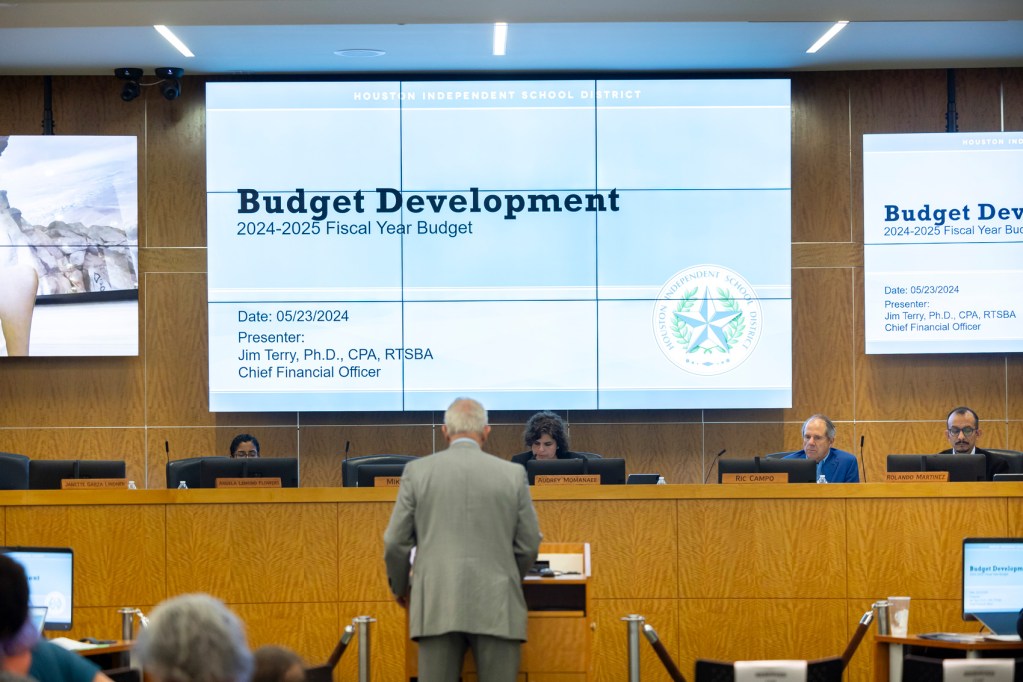
Each school board votes every year on a tax rate to determine how much local revenue it receives. That rate varies from district to district — Pasadena ISD has the highest tax rate among large Houston-area districts at $1.23 per $100 of taxable value, whereas HISD has the lowest at $0.87 per $100.
While school boards set the tax rate, state lawmakers and voters have limited their power over the tax rate in recent years, effectively capping the amount of property tax money they can collect. A state law passed in 2019 also forces districts to lower residents’ tax rates, in a process known as “compression,” if property values suddenly spike.
District residents can still vote to slightly exceed the de-facto cap or lower their tax rates through a voter-approved tax rate election. Alief ISD voters approved a higher rate in November, while Spring ISD residents rejected one.
What state funding do public schools receive?
There are many different mechanisms through which school districts receive state funding, but the main mechanism is the basic student allotment, a set amount of money per student attending the school district.
The amount of per-student funding a district receives is calculated based on the district’s average daily attendance, not its total enrollment. For that reason, districts with higher rates of absenteeism may be underfunded relative to districts with strong attendance.
Since 2019, the state’s basic student allotment has been $6,160. Many Texas superintendents and school board members have criticized the Texas Legislature for not increasing the basic student allotment to keep up with inflation.
Last legislative session, Gov. Greg Abbott tied additional school funding to a controversial private school voucher program that didn’t pass. He’s expected to do the same during the 2025 session, though the voucher proposal is more likely to pass after last year’s elections.
What is “recapture,” and how does it affect public school funding?
For school districts with larger tax bases relative to the number of students enrolled, the Texas Legislature forces them to give some of their local property tax revenue to the state in a process known as recapture. In turn, the state redistributes it to other Texas public schools.
The goal of recapture, also known as the “Robin Hood” plan, is to address funding disparities between wealthier, well-resourced districts and lower-income ones. However, wealthier districts often argue they should get to keep their money and the state should cover more costs in less-wealthy districts.
The Texas Education Agency estimates that nearly 200 of the state’s 1,200 districts will combine to pay about $2.9 billion in recapture in 2024. La Porte ISD ($39 million) and Galveston ISD ($29 million) face the biggest bills in the Houston area.

