


Nikki Tran was enticed by Houston’s sweltering southeast Texas heat and a surprisingly large Vietnamese community that gave the Ho Chi Minh City-born restaurateur an intimate sense of home. But it was the city’s underappreciated reputation as a “global food mecca” that cemented Tran’s place as an international ambassador for Houston’s innovative culinary scene.
Over the past decade, Tran has become a pioneer of Houston’s Viet-Cajun — or, as he calls it, Viejun — cuisine, which transformed the Gulf Coast’s trademark crawfish boils into a global fusion sensation. Tran built a Michelin-blessed Montrose neighborhood restaurant and exported Houston’s Viejun style back to Vietnam, where his unique approach to food caught the attention of restaurateur and author David Chang, who showcased the chef’s cooking on his Netflix series “Ugly Delicious.”
“The food scene here (in Houston) is crazy,” said Tran, who sports a “Fish Sauce American” tattoo on his forearm. “I’m very proud to be here and thankful for those that paved the way for me.”
Tran is emblematic of the impact the Vietnamese diaspora has had on Houston over the 50 years since the fall of Saigon and the end of the war in Vietnam. Houston became one of the main sanctuaries for refugees who fled the republic after North Vietnamese fighters drove American and South Vietnamese forces out of the country.
The Houston area now is home to America’s largest Vietnamese population outside of California, with estimates between 100,000 and 150,000. The growth of Harris County’s Vietnamese population has outpaced all other Asian groups, according to estimates by the U.S. Census and the Pew Research Center.
Along the way, Vietnamese refugees and their families have subtly shaped Houston’s cultural, political and economic evolution.
Chloe Dao, whose parents fled the war in Vietnam in the 1970s, leveraged her 2006 Project Runway victory into a successful career as one of Houston’s most celebrated fashion designers. Crawfish & Noodles owner Trong Nguyen, whose father served in the South Vietnamese military, spearheaded the creation of Houston’s unique Viet-Cajun cuisine. Houston’s Wendy Duong escaped Saigon in 1975 aboard a U.S. cargo plane and rose to become the first Vietnamese American appointed as a judge in the United States. Hubert Vo, who also fled with his family in 1975, is the first-and-only Vietnamese American to be elected to the Texas Legislature. Binh Ho, a South Vietnamese Air Force officer who fled the country in 1975, starred with his Houston family in two seasons of the HBO Max reality series “House of Ho.” Sugar Land raised Keshi, a Grammy Award nominated, second generation Vietnamese American alternative rock singer, just performed at Coachella.
For many Vietnamese in Houston, however, progress has been uneven.
A recent analysis by Rice University’s Kinder Institute Houston Population Research Center found Vietnamese Americans are the poorest Asian minority in the city.
About 10 percent of local Asian-American households reported an income of less than $25,000 a year, researchers found. For Vietnamese households that number was 18 percent, the highest among all Asian–American subgroups. Nearly 46 percent of Asian-American households reported incomes of more than $100,000. That number was 29 percent for Vietnamese households, the lowest among local Asian Americans.
Houston’s Vietnamese community has seen some success in advancing its political ambitions, but it lags behind other Vietnamese enclaves, such as Orange County, California.
In Houston, only three Vietnamese-American politicians have ever been elected to City Council. Only one legislator, Democratic state Rep. Hubert Vo, has been elected to represent the area in the 50 years since the fall of Saigon.
Though the Houston metropolitan area has the second largest Vietnamese population in the United States, the Pew Research Center puts it around half that of Los Angeles, giving the California contingent more political influence than its southeast Texas counterparts. However, the population in Southern California also votes at higher rates and has seen far more Vietnamese Americans elected to municipal and state office. Orange County elected its first member of Congress of Vietnamese descent in 2024.
Bryan Chu, president of the nonprofit Vietnamese Community of Houston and Vicinities, called the lack of political representation the community’s “biggest challenge.”
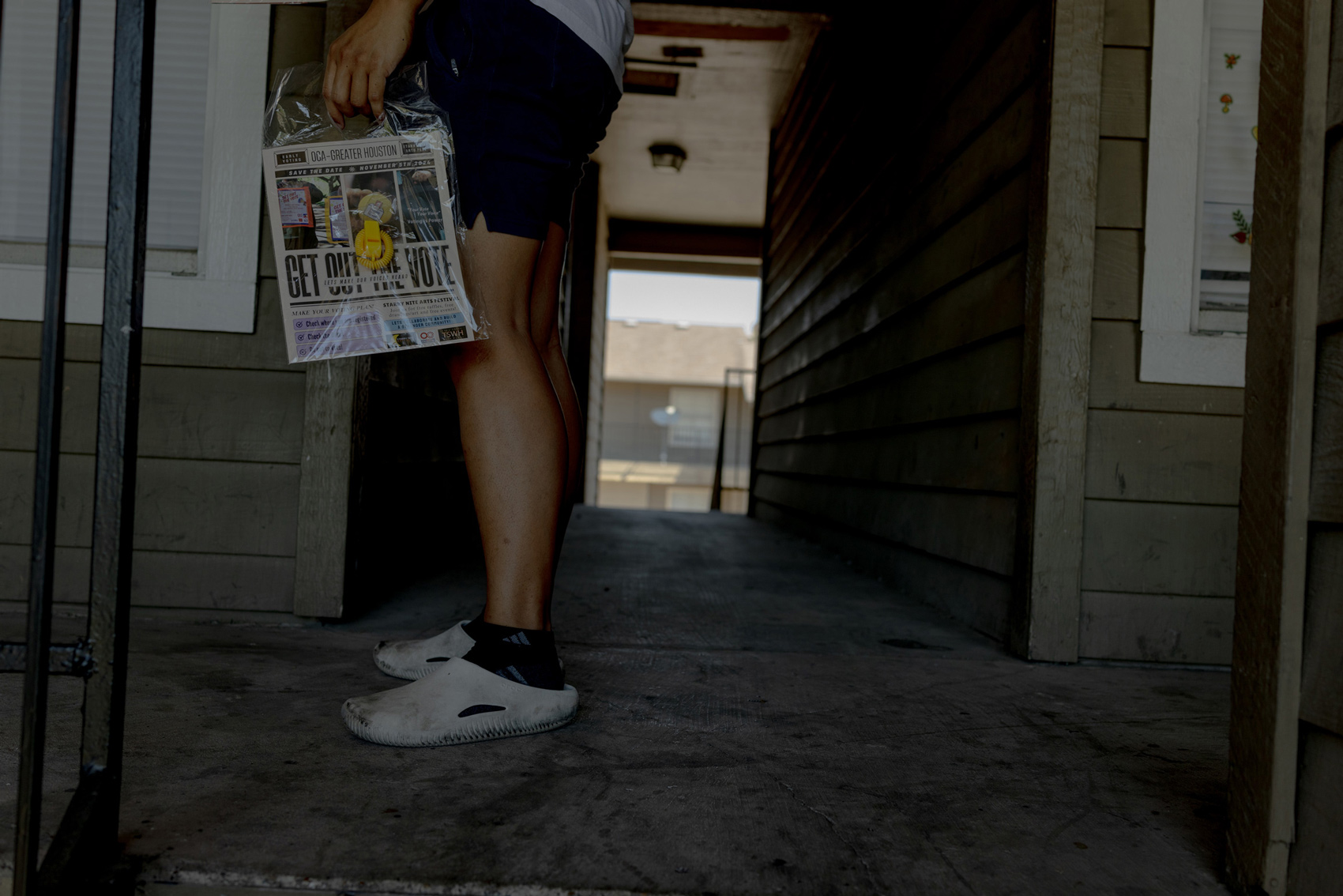
“We don’t have the number of representatives for our population here,” Chu said. “I wish that more people would be more interested in running for office. As president, I call on people all the time to come out and run. I ran in 2016 (for state representative), and it was tough, it cost a lot of money, and that’s the obstacle for a lot of people.”
In Houston, the challenges with political representation are commonplace among other minority groups, including such factors as language, education, economic stability and more barriers to vote in Texas than in states such as California.
There also are challenges unique to the leftover from the war and its trauma. Al Hoang, the first Vietnamese-American politician elected – in 2009 – to City Council, was ousted four years later after alienating Vietnamese constituents by taking a polarizing 2010 trip to Vietnam and attending a reception in Houston for a visiting Vietnamese dignitary.
Legacy of war
Roy Vu, a history professor at Dallas College North Lake Campus who has studied Houston’s Vietnamese community, said refugees forced to flee their countries with little capital and a weak grasp of English often struggle to adapt to life in the United States.
“In general, they are always going to struggle, particularly the first generation,” Vu said. “They’re going to struggle more-so economically than, say, middle-class immigrants from South Korea, from India, who have professional degrees. Such immigrants have some capital and some knowledge of English and other built-in advantages. Whereas Southeast Asian refugees, like the Vietnamese, Cambodians and Laotians, would struggle.”
The end of the war in Vietnam came on April 30, 1975, when North Vietnamese forces seized Saigon, a time South Vietnamese refugees often refer to as “Black April.” About 130,000 Vietnamese refugees immediately fled, with the United States helping many resettle in Houston.
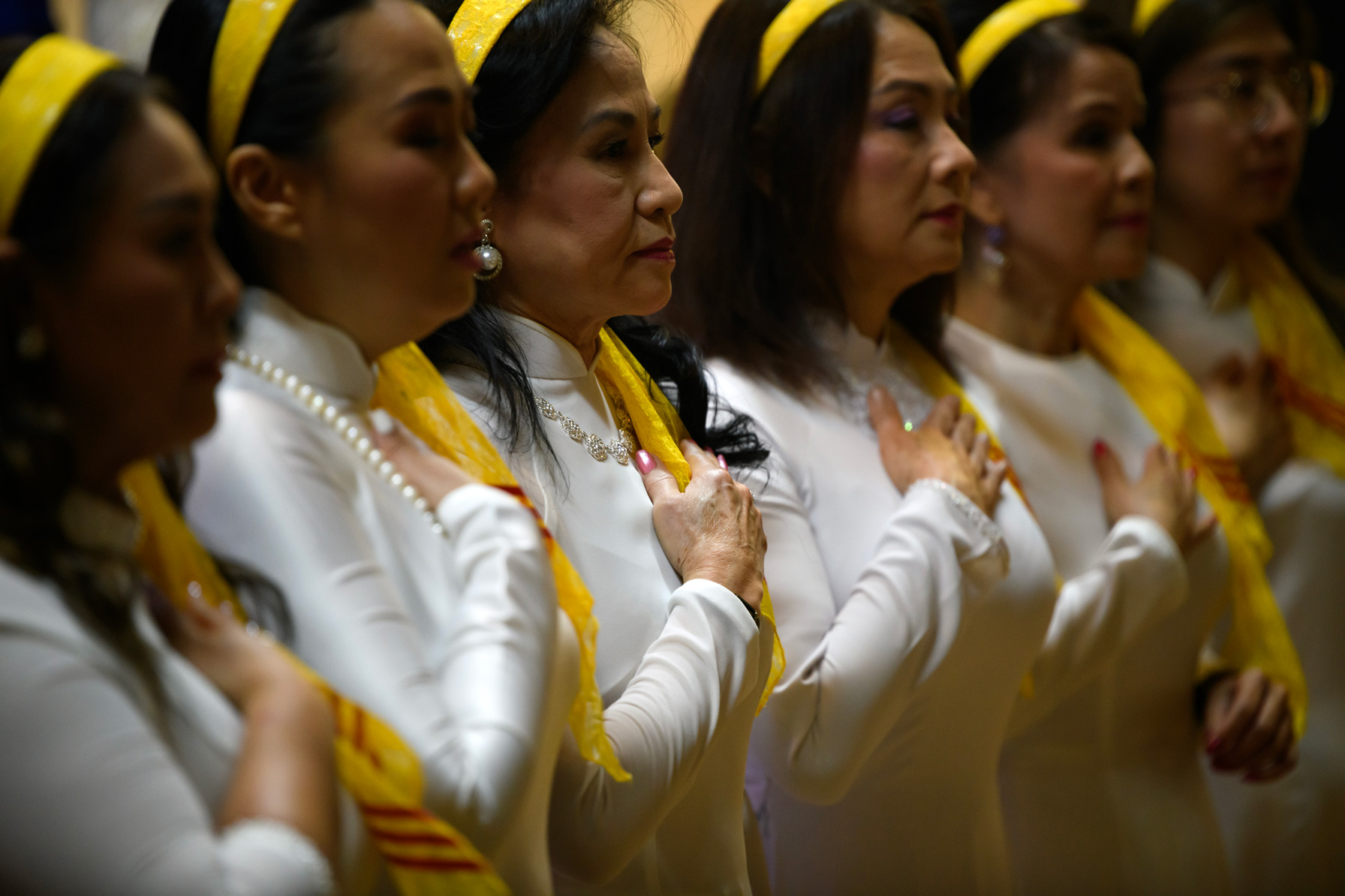
Vietnamese businesses have prospered in Houston’s unofficial “Little Saigon,” nestled alongside a six-square-mile stretch of Chinatown southwest of downtown. Vietnamese immigrant Hai Du Duong built Hong Kong City Market in 1999, a thriving shopping center that has become an anchor for Vietnamese businesses in the area. They proudly fly the South Vietnamese yellow flags with three red stripes, even though the 20-year-old country ceased to exist in 1975, when the U.S.-backed Republic of Vietnam fell.
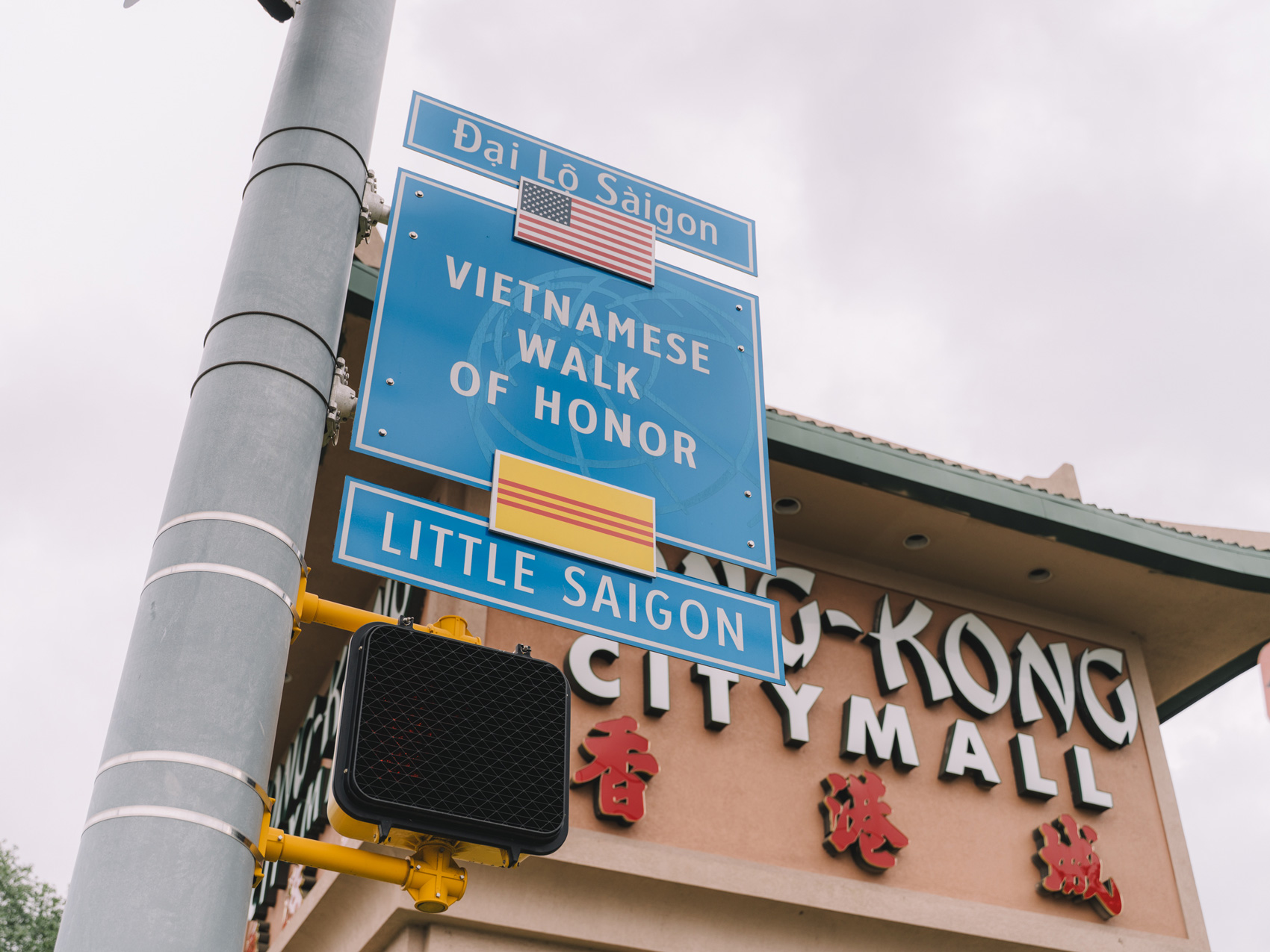
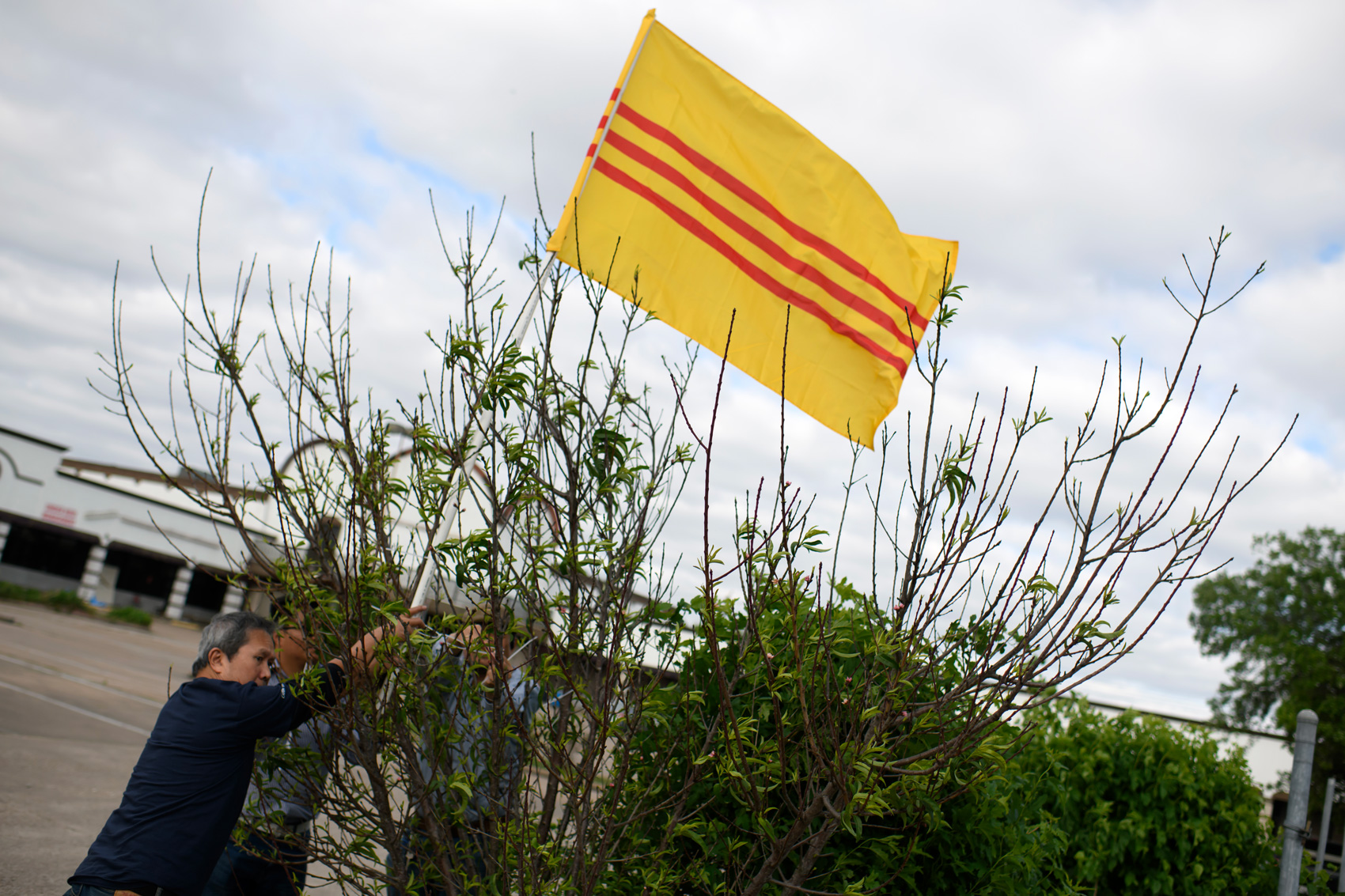
Little Saigon features one of America’s only war memorials honoring South Vietnamese veterans. The neighborhood features a “walk of honor” with streets named after South Vietnamese generals. Vietnam’s current flag, with a single yellow star on a red background, is all but impossible to find flying prominently in the area.
The war’s traumatic legacy has played out across Houston in the decades since the fall of Saigon, with sometimes deadly results. In 1982, Vietnamese journalist Nguyen Dam Phong, was shot dead in the driveway of his Houston home after writing a series of investigative stories in his newspaper spotlighting corruption among anti-Communist groups in America.
In 2020, Houston businessman Nguyen Le was flooded with death threats when he put up a “Black Lives Matter” billboard in English and Vietnamese above his office in Little Saigon. Attackers derided Le as a Communist. His real estate and insurance business nearly collapsed because people were afraid to work with him.
Viet Thanh Nguyen, an author and University of Southern California English professor, said he sees an ideological transformation taking place in Vietnamese communities across the country.
“This year feels different because 50 years really marks probably a generational shift,” said Nguyen, who was 4 when his family fled Vietnam in 1975.
“Obviously, the generation that had the most direct involvement with the war and its aftermath is now fading,” said Nguyen, whose Pulitzer Prize-winning book, “The Sympathizer,” recently was turned into an HBO series starring Sandra Oh, Robert Downey Jr. and Hoa Xuande.
“I think there’s a shift in the cultural memory of the entire country because of the change in generations,” he said. “And what that means is that some of the harsher feelings around these anniversaries, I think, have faded.”
For the younger generation of Vietnamese Americans, those not raised with a steady diet of American-centric Vietnam War movies like “Apocalypse Now” and “Full Metal Jacket,” the conflict is more abstract history than personal biography.
The “generational shift means that, for a younger generation, the past will be an intellectual matter, not an emotional matter,” Nguyen said.
Letting go of the past
At USC, Nguyen said, Vietnamese and Vietnamese American students that once kept their distance from each other now hang out and work together.
“They couldn’t care less about the fact that their parents’ generation fought a war with each other,” he said. “They’re just kind of curious. This is history… Why is it called Black April? We don’t get it.”
Karen Siu, the only Vietnamese American doctoral student in Rice University’s Humanities Department, said she sees the same dynamic among students in her class on Vietnamese American Feminism in Literature.
“Like so much about the Vietnam War or American War in Vietnam, Laos, and Cambodia, there is often no consensus about what happened,” she said. “Even what to call the conflict is up for contention.”
Siu prefers to refer to April 30th as “The Fall of Sài Gòn” – or “the day we lost the water (ngày mất nước).”
To lose the water, Siu said, evokes a sense of being cut off from one’s source of life.
“Nước is the Vietnamese word for water that also metaphorically can mean nation, country, homeland, and even life and hope,” said Siu.

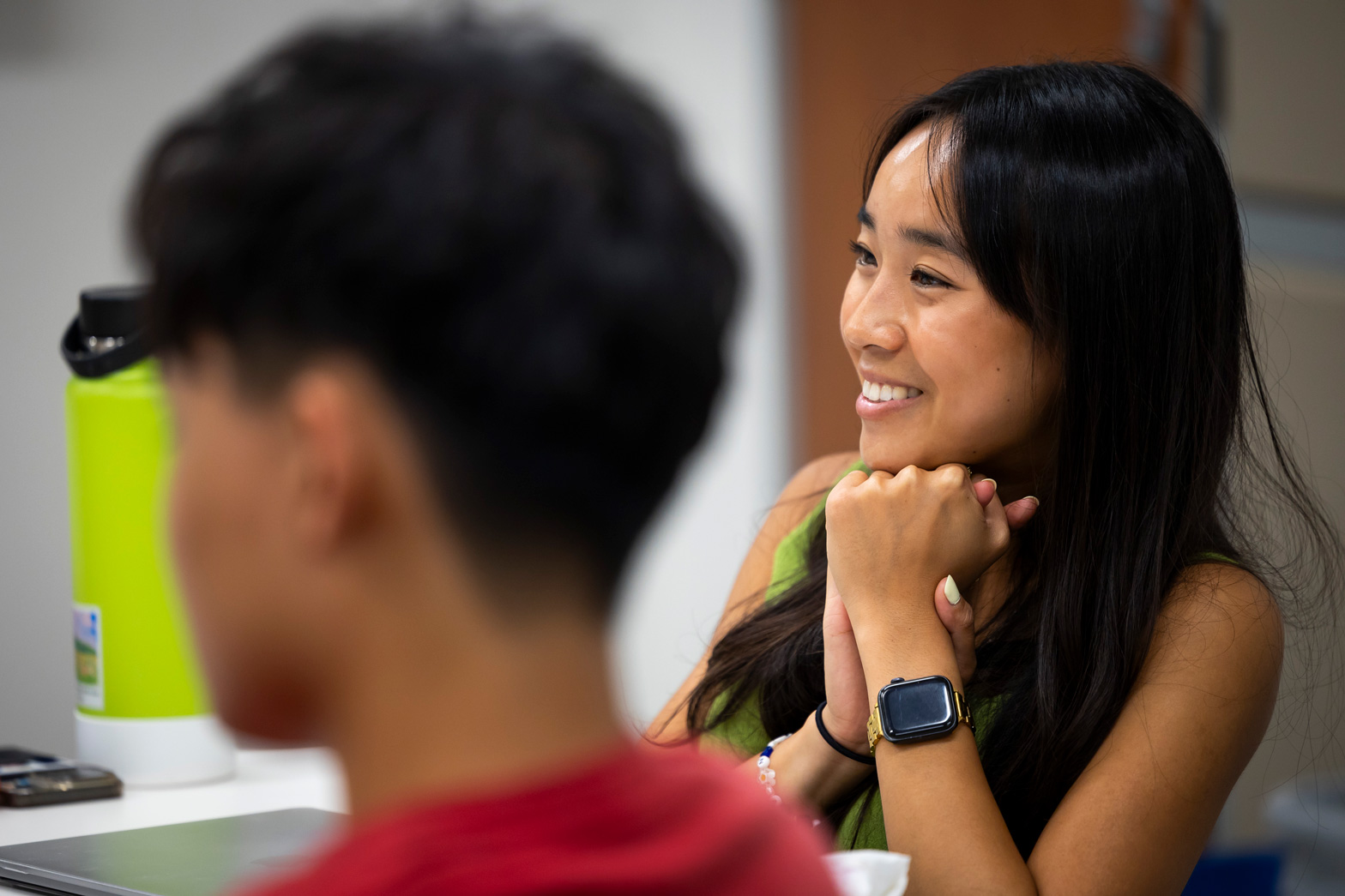
Lana Nguyen, a second-year English and Asian Studies student at Rice University, said she wants to see Vietnamese and Vietnamese Americans move on from the trauma of the war.
“I feel like the Vietnamese people were kind of stuck in a state where we’re always fixating on the past sort of and it’s kind of hard to move on,” she said. “And, you know, that’s the older generation. Especially the refugees, I think their experiences are something I can never fully understand. But I feel like people of my generation, it’s our responsibility to create a new meaning (and) move on.”
Cecilia Nguyen, a Rice University cognitive science major, is seeing the anniversary of the Fall of Saigon through an entirely new lens this year. The daughter of Vietnamese immigrants who grew up in a conservative, Catholic community outside Houston is studying abroad in Ho Chi Minh City – her first time visiting the country her parents left in the 1990s.
In Ho Chi Minh City, the city formerly known as Saigon, the anniversary is celebrated as “Liberation Day” with military parades, fireworks, drone shows, and extended school holidays for students.
“It’s such a stark difference (from how the Vietnamese remember it in the U.S.) but it’s important to think about why that difference exists,” Nguyen said, “I think the Vietnamese diaspora really tends to be stuck in (the past).”
Thanh-Tri Nguyen, the grandson of Nguyen Dam Phong, the Vietnamese journalist killed in Houston in 1982, said his family’s personal trauma and the guidance of his parents’ generation resonate as he thinks about the challenges he faces as a University of Texas chemical engineering student.
“The whole mantra is: I went through a war, you can get through college,” he said. “You did not have to run from gunfire, get off a boat and just find your way out of a country; you just have to find your way out of college and you have all these resources. It’s a kick-in-the-pants.”
Moving forward
For Chu, the legacy of the war is very much alive.
Chu escaped Vietnam in 1980 by boat and stayed in a Malaysian refugee camp for one year before making it to America in 1981. He was only 13 years old when he left Vietnam.
He considers himself “generation 1.5,” caught between the first generation of war refugees and the second generation of American-born Vietnamese.
“I think the younger generation think that their parents, their grandparents are all about hatred, not letting go, not forgiving, but they must understand that the trauma that their parents’ generation went through is not something that we can easily forget,” Chu said. “The younger generation want to move on, they’re looking for the future, but how can the Jewish people forget the Holocaust? How can the Cambodians forget about the genocide that Khmer Rouge killed like four or five million Cambodians?”
Chu has little memory of the war since he escaped the country at a young age. His only point of reference were the harsh memories of his relatives who escaped and the history books he read after he came to the States.
“Many of the people I interacted with (said) they were in prison for 10-15 years at the so-called ‘re-education camp’ but there’s nothing about re-educating. It’s all about hard labor and torturing and a lot of people didn’t (survive),” Chu said. “Hundreds of thousands of people were imprisoned in those re-education camps and tens of thousands of people died.”

Now, Chu is president of Vietnamese Community of Houston & Vicinities, a nonprofit formed in 1983 in response to harassment and discrimination against Vietnamese fishermen by the Ku Klux Klan. Today, the organization helps Vietnamese Houstonians navigate everyday tasks such as job searches, applying for government benefits and filing taxes.
Nowhere has the Vietnamese diaspora had more of an impact on Houston than the city’s celebrated food scene. Celebrity chefs like Anthony Bourdain and David Chang have made the pilgrimage to Houston to honor the city’s Vietnamese cuisine.
“Houston is such a foodie city and I think this city is a great example of how the diversity of residents that live here literally flavor the food that’s offered,” said Jennie Bui-McCoy, the daughter of Vietnam War refugees who works as a spokesperson for Houston First, the city’s marketing arm.
That’s what drew Nikki Tran to Houston. In 2018, Tran opened Kau Ba, a quaint restaurant in Montrose that quickly gained fame for serving a signature Viejun crawfish tossed in garlic butter and a “Happy Salad” of stir-fried beef, pineapple, Thai eggplant, mint, lemongrass, sesame seeds, and citrus tossed in a passionfruit dressing. The restaurant won coveted recognition last year from Michelin as a Bib Gourmand, right after Kau Ba closed its doors as Tran set off in a new direction.
“The most important thing about Viejun food is the journey,” Tran said. “The journey is the world journey of the Vietnamese people.”
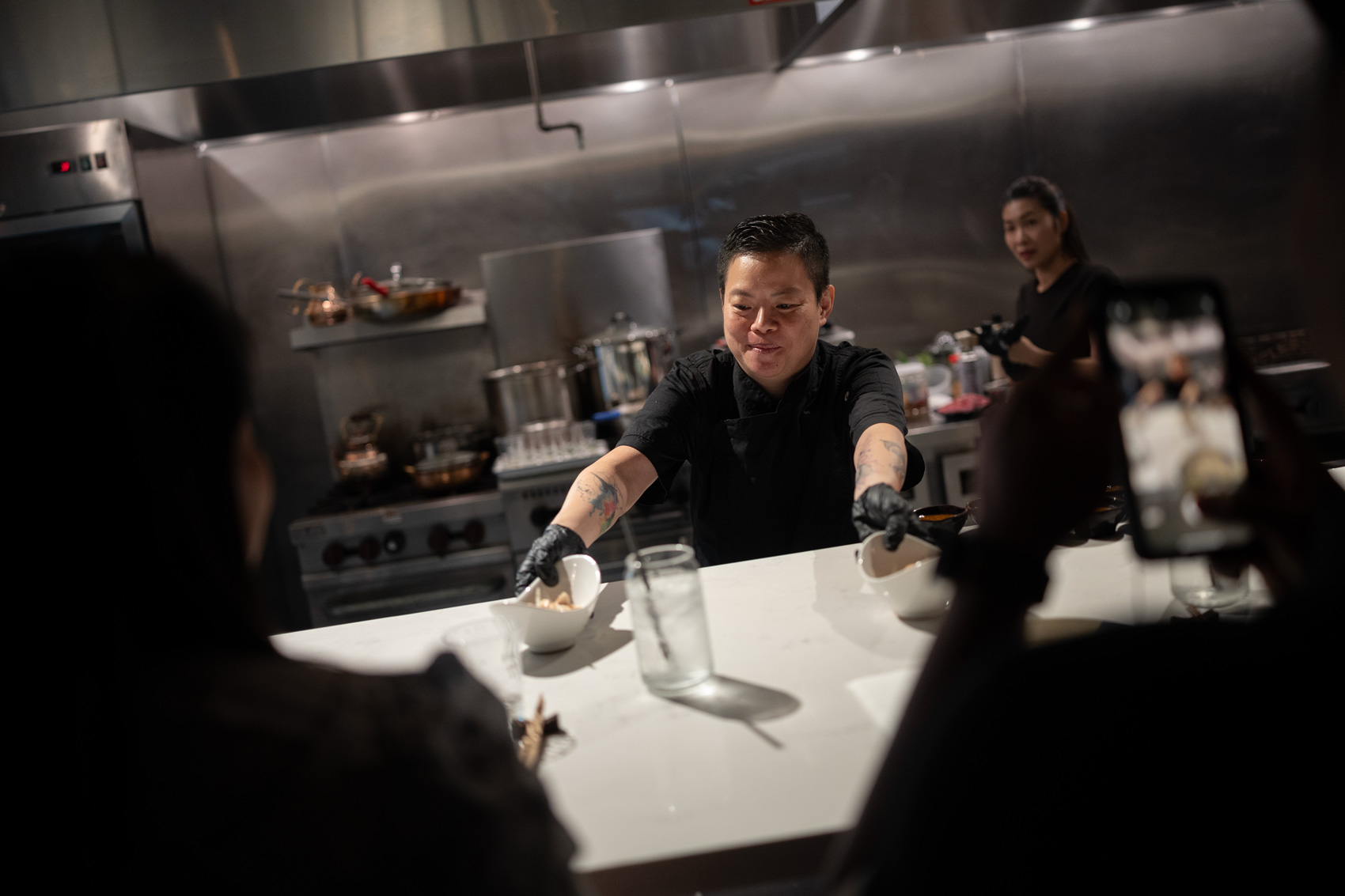
Tran cut his culinary teeth in Houston and then decided to export Viejun food back to Vietnam. Back in Ho Chi Minh City, Tran uses river prawns as a substitute for crawfish when making his signature Viet-Cajun dish with Cajun garlic butter, accompanied by potato, corn-on-the-cob and sausage.
“I’m proud to say that Vietnamese people actually brought Cajun food to the world,” Tran said. “Because around the world now you have Viejun restaurants.”
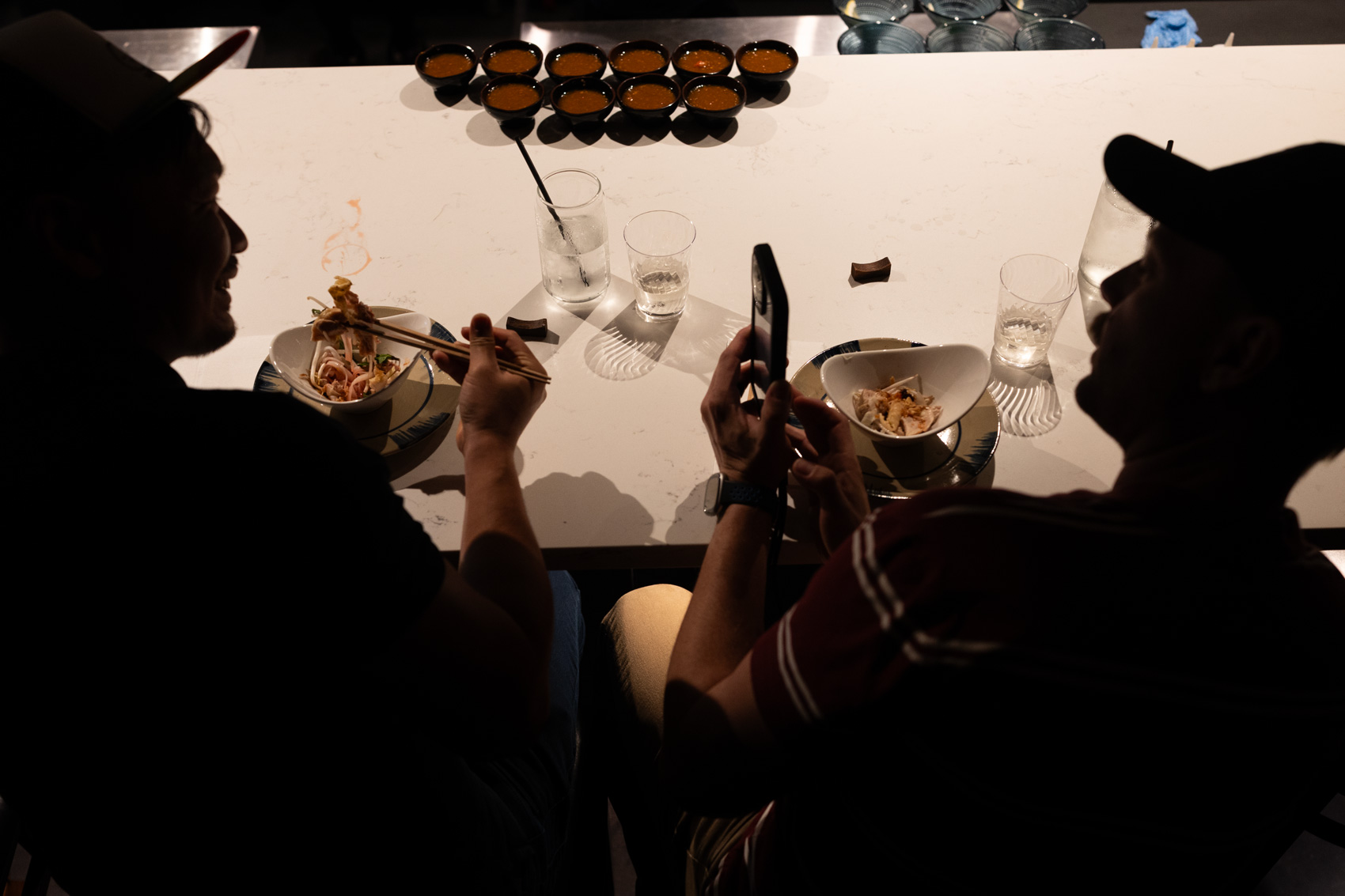
To commemorate the anniversary of the Fall of Saigon, Tran has been hosting a series of curated dinners in Houston centered around the origins of pho, the popular Vietnamese noodle soup. During the two-hour meals, Tran serves up eight different kinds of pho and talks about the power of the number, which, flipped on its side, could resemble the boats Vietnamese refugees boarded in hopes of finding sanctuary after Saigon fell. It also resembles the infinity symbol, Tran said, and handcuffs.
The Fall of Saigon, Tran said during one recent dinner, has given rise to the rise of Little Saigons across America – an example of the Vietnamese diaspora’s ability to transcend adversity. Food, Tran said, is one thing that can still unite people in divided times.
The end of the war in Vietnam will be commemorated in Houston with celebrations honoring South Vietnamese veterans who often dress up in their old military uniforms for the events. Business leaders are flying more South Vietnamese flags to remember the millions of people who died during the war or fled the fighting, along with those tortured in “re-education” prison camps by the Communist-led government.
Reporter Paul Cobler contributed to this story.

